
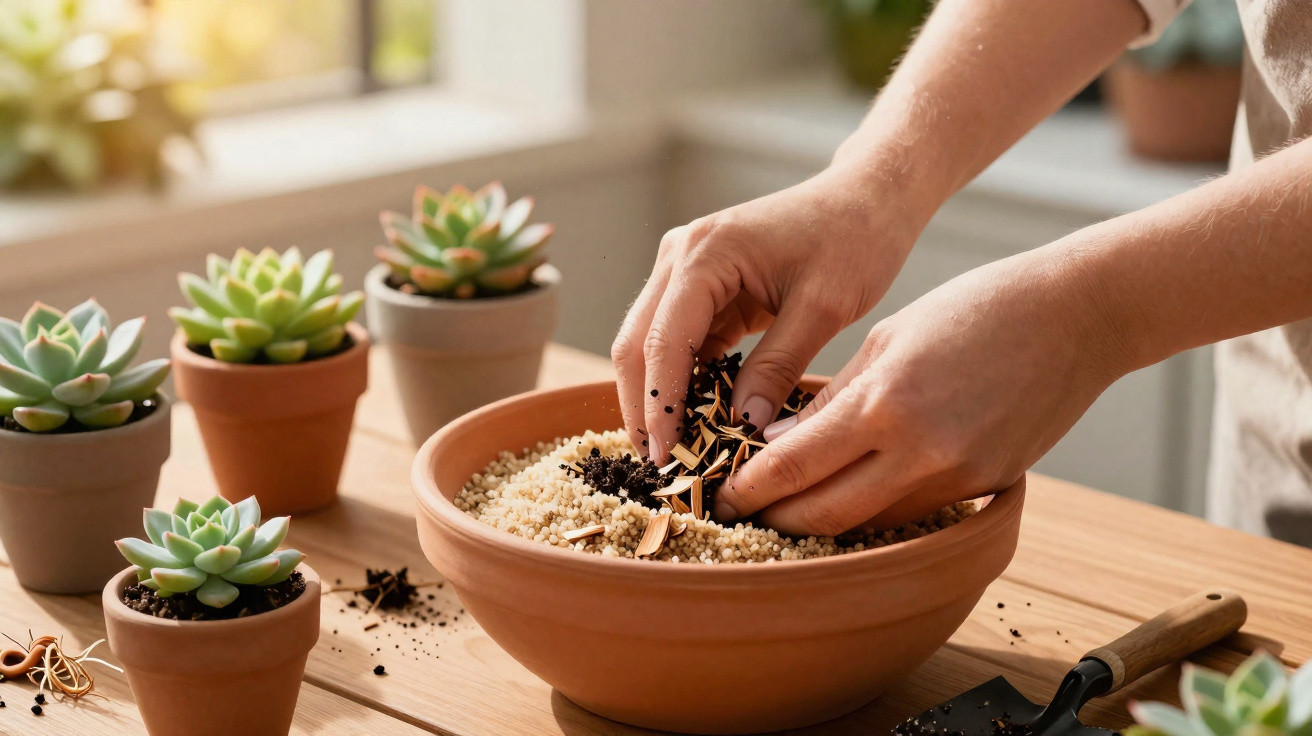
Growing succulents in pots relies heavily on the quality of the substrate selected. Even hardy plants may grow poorly or develop root rot when the soil becomes compacted or waterlogged. For this reason, many growers make a light mix at home from straightforward, inexpensive materials, adapting its drainage to their local climate.
What is an ideal light substrate for succulents?
A light substrate for succulents is a porous, free-draining blend with good airflow between its particles, preventing water from sitting around the roots. Rather than relying solely on garden soil, it combines organic and mineral ingredients to keep the growing medium open and loose.
The aim is for the mix to retain enough moisture without becoming saturated. This is particularly important for plants that are sensitive to excessive moisture, including echeverias, crassulas and sedums. The resulting conditions support rooting, allow the roots to breathe and encourage balanced plant development.
Which simple ingredients can be used in a light substrate?
Making a light substrate for succulents at home does not require specialist products. It simply involves combining clean materials that are preferably free from chemical residues. The blend can be tailored to the climate: in very hot places, it should retain slightly more water, while in humid regions, rapid drainage should take priority.
Several readily available ingredients, found in garden centres and supermarkets or reused from everyday materials, can be combined in different ratios according to the desired soil behaviour:
- Topsoil or universal potting compost: an organic base containing some nutrients.
- Washed coarse builders' sand: improves drainage and creates a looser growing medium.
- Carbonised rice husks: lightweight and porous, they are excellent for aerating the substrate.
- Perlite or vermiculite: very light expanded minerals that improve aeration.
- Fine gravel or grit: mainly used at the bottom of the pot to aid drainage.
How do you prepare and test a good substrate for succulents?
To make the blend at home, use a large bucket or basin in a well-ventilated area. Mix every ingredient thoroughly until the texture is even. A widely used ratio is 1 part topsoil, 1 part coarse sand and 1 part porous material; add more sand or mineral material in very humid areas.
Once mixed, the substrate should be tested. Moisten a small amount and press it gently in your hand: it should form a clump but break apart easily. When watering a test pot, the water should run out through the drainage holes within a few seconds rather than pooling on the surface. After drying, the substrate should still be loose, without turning muddy or developing deep cracks.
What care is needed when using light substrate for succulents?
As well as preparing a suitable mix, a few additional measures help keep plants healthy and stable, since light soil dries more quickly and can shift easily. Pots with suitable drainage holes are essential, while ceramic or cement pots generally provide greater stability in windy locations.
It is advisable to adjust the watering schedule, add a layer of small stones over the surface to hold the substrate in place, and watch the plants during the first few weeks. Wilted leaves suggest insufficient water, whereas soft, translucent leaves indicate excessive moisture. This may mean that both the watering routine and the substrate composition need to be adjusted.

Comments
No comments yet. Be the first to comment!
Leave a Comment