
Once found on every corner of many cottage gardens, it is now making a surprisingly strong comeback – bringing several benefits with it.
Amid thuja hedges, gravel front gardens and exotic ornamental shrubs, an old favourite is reappearing: the black elder. Once a familiar sight by farm entrances, stable walls and roadsides, it is now considered an insider choice for anyone looking to make their garden more natural, productive and resilient.
A traditional farm shrub with an almost forgotten history
Native to Europe, the black elder has lived alongside people here for centuries. In rural areas, it was part of everyday life – not a romantic decorative feature, but a genuinely versatile useful shrub.
Its flower heads were made into cordials and syrups, while the berries went into jams and juices. Children used the hollow stems as “whistles” or small tubes. Even the leaves had a purpose: they were hung in stables or near windows to help keep flies away.
Elder was once a natural medicine cabinet, larder and protective tree all in one.
Many farmers regarded the shrub as protective. It was planted close to homes and barns because it was believed to have a special, almost magical effect – alongside its very real medicinal properties.
Land consolidation, new housing developments and standardised green spaces gradually pushed elder out of view. Uniform hedge plants, decorative exotics and low-maintenance lawns replaced it. Now, with climate-friendly gardening, self-sufficiency and medicinal plants all gaining popularity, it has suddenly returned to the spotlight.
A display of flowers and a fragrance that fills the garden
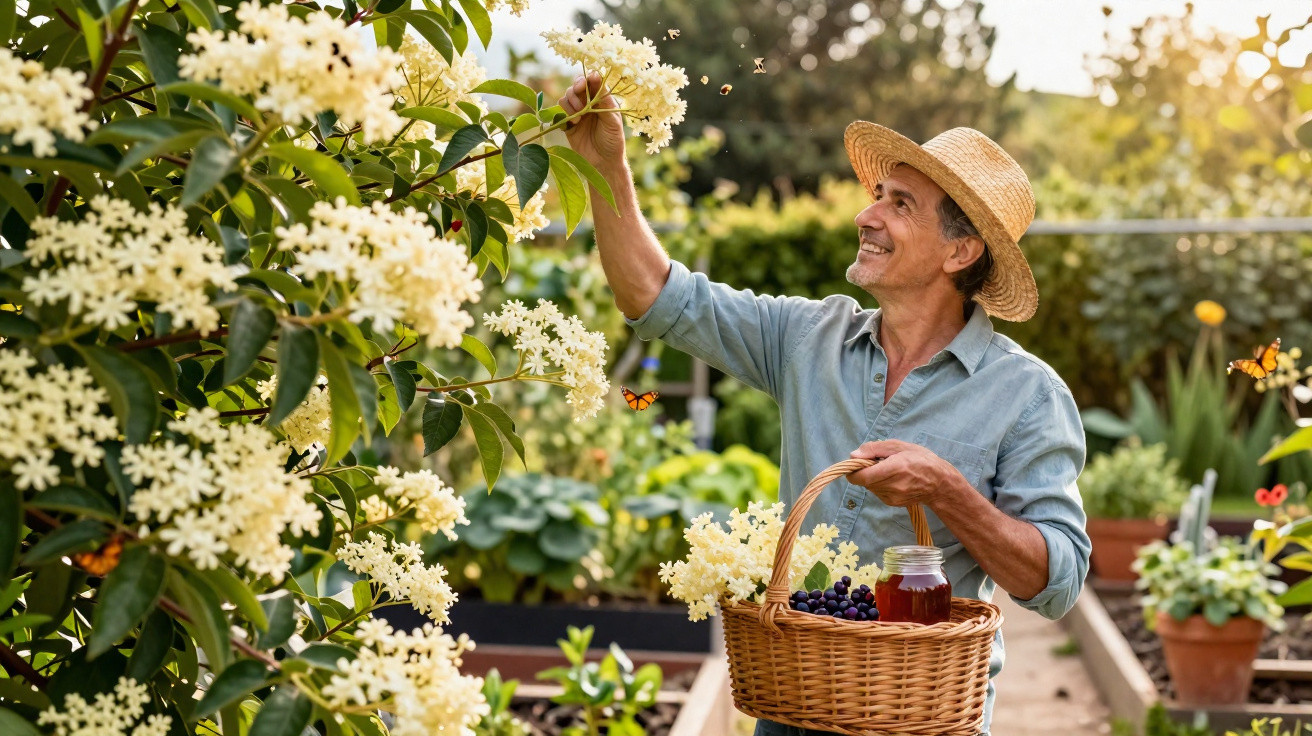
The black elder may appear unremarkable at first, but that changes completely in early summer. The shrub then comes into its own. Reaching four to five metres in height, it grows in a loose upright to broad, bushy form and bears large, flat, creamy-white flower heads in May and June.
Its scent is sweet and almost vanilla-like without being overpowering. Anyone walking through the garden on a warm evening will quickly notice how the fragrance envelops the whole area. At the same time, there is a constant hum: bees, hoverflies and butterflies flock to the abundant nectar.
The shrub remains appealing after flowering, too. Its pinnate foliage adds structure to beds and hedges. Modern cultivars, including so-called “Black Lace” types, have deep, almost black foliage and visually resemble an ornamental maple more than a traditional cottage-garden shrub. This means elder also works well in modern, minimalist garden designs.
By late summer and autumn, dense clusters of blackish-purple berries hang from the branches. They are a feast for birds and provide many home cooks with the basis for juice, jelly or liqueur.
Gentle remedies from flowers and berries
Black elder has a well-established role in traditional herbal medicine. Dried flowers have long been used in teas for colds, flu-like infections and fever. They encourage sweating, help loosen mucus and soothe irritated airways.
The dark berries are rich in antioxidants, especially anthocyanins. When cooked – for example as juice or purée – they can support the immune system, stimulate digestion and are regarded as a traditional aid during viral seasons.
Flowers for the teacup, berries for winter stores – one shrub meets several needs at once.
Care is needed with the leaves, bark and raw berries, as these parts of the plant contain substances that may be poorly tolerated in larger quantities. Ripe berries should therefore always be heated. Anyone wishing to use bark or leaves therapeutically needs sound specialist knowledge.
Black elder in a medicinal and edible garden
Elder can be incorporated easily into a small self-sufficiency garden, a mixed hedge or a separate herb area. It provides ingredients for home remedies, syrups and stored produce without demanding much maintenance.
- Flowers: for tea, syrup, cordial and batter
- Berries: for juice, jelly, purée and liqueur
- Position: as a structural element in hedges, along a boundary or at the back of beds
Low-maintenance, tough and remarkably adaptable
One reason for elder’s revival is its forgiving nature. It grows in full sun as well as partial shade, copes with clay, calcareous and looser soils, and tolerates both temporary drought and damp conditions.
Winter hardiness is rarely an issue. Black elder generally survives temperatures down to minus 20°C without winter protection. A little mature compost at planting gives it a good start; afterwards, it usually manages without fertiliser.
Most maintenance involves pruning if you want to control its size and shape. In late winter, old, thick stems can be removed close to ground level while younger shoots are retained. This rejuvenates the shrub and encourages vigorous new growth.
Leave it unpruned and you will get a substantial bush. Prune it regularly and you can shape a compact shrub that flowers freely.
Elder is also very easy to propagate from hardwood cuttings or by layering. A lowered shoot often roots within a single season. This makes it possible to raise several plants for different corners of the garden at little cost, or to give them away to neighbours.
Biodiversity and the kitchen benefit equally
At a time when insects and birds are losing habitat in many places, elder is a small but useful contribution to greater garden diversity. Its flowers offer pollinators a generously stocked table. Later in the year, numerous bird species eat the berries and use the dense branches for shelter and nesting.
At the same time, the shrub supplies an abundance of kitchen ingredients. The flowers can be turned into refreshing syrups, fragrant cordials or elderflower fritters. The berries form the basis for jellies, juices, vinegar, and traditional wines or liqueurs.
- Elderflower syrup: a summer classic when diluted with water
- Berry jelly: vivid in colour with a fruity sharpness
- Elder vinegar: a delicate note for salads
- Home-made wine or liqueur: an aromatic digestif
- Flowers in batter: a sweet dessert with a nostalgic touch
Just one or two larger shrubs can provide a household with a generous harvest for winter stores. Leaving some berries on the plant for birds combines enjoyment with nature conservation.
Where black elder is especially worthwhile in the garden
The shrub is well suited to natural-style gardens, mixed hedges and boundary planting. In these positions, it creates screening, wind protection and structure. At the edge of a vegetable garden, it makes an interesting backdrop while also offering habitat for beneficial wildlife.
| Planting idea | Benefit |
|---|---|
| In a mixed hedge | Screening, flowers, berries and habitat for birds |
| At the edge of the vegetable garden | Windbreak, shade and a short walk to the harvest |
| As a specimen in a lawn | Eye-catching flowers and berries |
| Near the patio | Fragrance and the hum of insects in early summer |
Those with limited space can choose less vigorous cultivars or keep the shrub compact through regular pruning. Elder is only partly suitable for permanent container growing, but it can be grown for several years in large pots provided it receives sufficient water and nutrients.
What home gardeners should also know
Eating the berries raw can cause stomach problems, whereas cooked berries are well tolerated. Children should only be given processed products such as juice or jelly. The juice stains heavily during harvesting, so gloves and old clothes will prevent frustration afterwards.
Elder combines well with other native shrubs, such as Cornelian cherry, serviceberry or hazel. Together, they create a richly structured hedge that supplies food and shelter for wildlife for almost the entire year, while also filling your own store cupboard.
Many people associate elder with childhood memories – elderflower syrup at their grandmother’s house, dark juice in winter and its distinctive scent in June. This blend of nostalgia, usefulness and resilience is exactly what makes the shrub so appealing again in 2026: it fits perfectly into a time when gardens are expected to be more than simply green decorative spaces.
Comments
No comments yet. Be the first to comment!
Leave a Comment