
Many amateur gardeners breathe a sigh of relief in February: their lemon tree in a pot appears to have come through winter unscathed, the first fresh leaves are emerging and the days are getting longer. Yet this is precisely when the most insidious risk arises – late frost, which strikes not from above but from below. Anyone protecting only the canopy and leaves leaves the roots exposed to the cold.
Why March is so dangerous for lemon trees in pots
Lemon trees in pots can seem remarkably hardy in early spring. During the day, sunshine warms the balcony or patio and temperatures rise into double figures. On clear nights, however, the temperature can suddenly drop to minus two or minus three degrees – and that is where the danger lies.
The most common misconception is to protect only what can be seen. Winter fleece over the canopy, a partially sheltered position and slightly reduced watering all help, but they are often insufficient. Cold travels straight through concrete, paving slabs or stone into the container. The roots are effectively sitting on an icy slab.
“For a lemon tree in a pot, the fatal cold usually comes not from the air, but through the ground.”
This effect is particularly pronounced on balconies and patios, as these surfaces cool sharply overnight and slowly pass their stored cold on to the pot. The tree may still look healthy in the evening, yet show unexpected damage by morning – without any visible overnight ‘drama’.
The straightforward solution: an insulating board beneath the pot
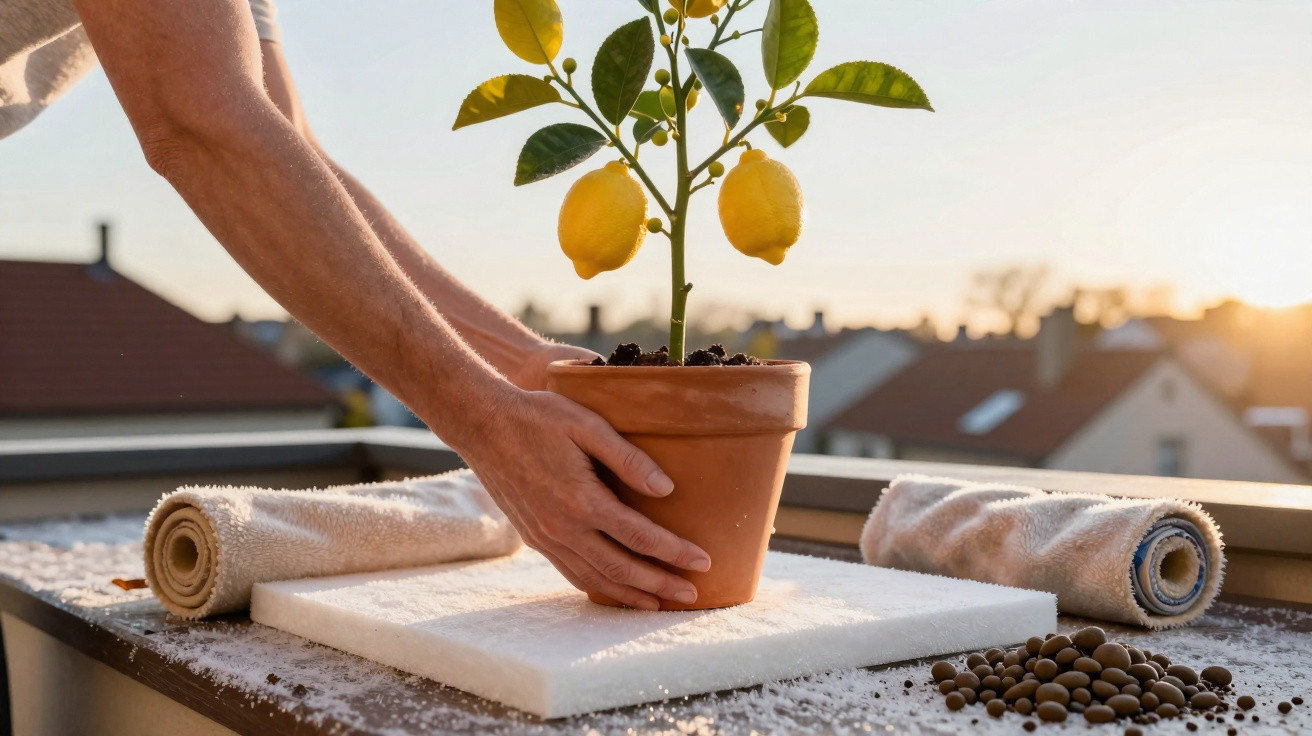
The most effective protection is surprisingly simple: place an insulating board under the pot. It breaks direct contact with the cold surface and significantly slows heat exchange.
Suitable materials include:
- a polystyrene board, for example from packaging for electrical appliances
- a thick cork mat or cork trivet
- a sturdy wooden board combined with a thin insulating layer
A thickness of roughly two to five centimetres is ideal. The board should extend around one to two centimetres beyond the pot on every side. This prevents direct contact with cold at the edges.
“A small ‘thermal plinth’ beneath the container breaks the invisible cold bridge to the ground.”
Keep drainage clear
Crucially, the drainage holes in the base of the pot must not be obstructed. If water collects, the risk of frost damage rises further, because wet compost freezes more readily and puts greater strain on the roots.
A practical trick for balconies and patios is to halve corks lengthways and position three or four halves beneath the base of the pot. This provides:
- a thin air layer between the board and pot, adding further insulation
- sufficient clearance for water to drain freely
- stable support without wobbling
It takes only a few minutes, and the materials are often already available at home – while the protective benefit lasts throughout the entire frost period.
How late frost actually damages roots
Experts have pointed out for years that potted plants react to cold differently from those growing in the ground. Garden soil stores warmth and releases it only gradually. A pot standing on paving slabs or concrete has none of this natural ‘buffering’ effect.
Damage generally develops as follows:
- The night turns colder and the balcony or patio becomes icy.
- The surface draws warmth from the pot, especially from the lower root zone.
- Fine root tips freeze, causing water uptake to fail.
- Several days later, leaves darken, curl up or suddenly drop.
The tree can look ‘scorched’, even though air temperatures were not particularly low. The cause is the unseen fall in temperature at the bottom of the pot.
Lemon trees are generally considered somewhat frost-tolerant; for short periods, well-protected specimens can even withstand temperatures of around minus six to minus seven degrees. But once the container is chilled from below, the balance changes. It is therefore not just the air temperature that matters, but what happens at the base of the pot.
Combine protection sensibly until the Ice Saints
Ideally, the insulated base beneath the pot should remain in place continuously until mid-May. In many areas, night frosts occur until the Ice Saints, often just as lemon trees begin producing their first flowers.
On nights when frost is expected, ground protection can be combined with additional measures without having to wrap the whole tree in a complicated way:
- Light fleece over the canopy and branches: ideally drape it over simple canes or a plant ring, so that the fleece does not rest directly against the leaves.
- Make use of the location: move the pot close to a warm house wall, preferably on the south-facing side, or place it beneath an overhang.
- Raise the pot further: stand it on wooden blocks, for example, if the surface becomes extremely cold.
This combination can quickly provide a few degrees of extra protection, which can make the difference between slight and severe damage when temperatures hover around freezing.
A “second skin” for the pot
Anyone wishing to take protection a step further can give the pot a kind of coat. This helps prevent major heat loss through the side walls:
- wrap a layer of bubble wrap directly around the pot
- add a layer of hessian, coconut matting or fabric over it for appearance
- leave the top open so that the plant can breathe
This creates an insulating cover that keeps temperatures in the root area more stable. Even so, one point remains important: do not ‘drown’ the compost. Keep it slightly drier before forecast frosty nights, as wet potting compost cools more quickly.
Care mistakes that encourage late-frost damage
Several common oversights make a lemon tree especially vulnerable in spring:
- fertilising too early and too heavily while weather conditions remain unsettled
- repeatedly moving the tree between a warm indoor space and a cool outdoor position
- permanently wet compost with no drainage layer
- very dark pots on pale, cold surfaces, creating a pronounced day-to-night contrast
At this stage, less is often more: water moderately, choose a lightly sheltered spot, avoid drastic temperature changes – and use the unobtrusive insulating base under the pot as a safety net.
Practical examples and extra advice for potted citrus
The method described is useful not only for lemon trees. Other citrus varieties, including mandarins, kumquats and oranges, also benefit when positioned in exposed locations. Even container-grown oleanders and olives often respond well to an insulated standing surface.
Those with numerous pots can use a simple construction: a narrow wooden frame with one continuous insulating board underneath, with all sensitive containers arranged side by side on top. This creates a small protected ‘frost platform’ that can be used again every spring.
Combining the method with heat stores is also worthwhile. A large water container or dark stones placed close to the pot absorb solar warmth during the day and release it again at night. Together with ground insulation, this creates a small microclimate that may add one or two degrees – often exactly the margin that determines whether leaves are lost or healthy new growth develops.
Anyone treating their lemon tree as a long-term ‘family member’ should regard its roots as the plant’s hidden heart. Frost damage there is harder to repair than a few frozen leaf tips. The insulating pot stand is therefore not a perfectionist detail, but one of the most effective and inexpensive ways to guide potted citrus safely through the difficult late-frost period.

Comments
No comments yet. Be the first to comment!
Leave a Comment