
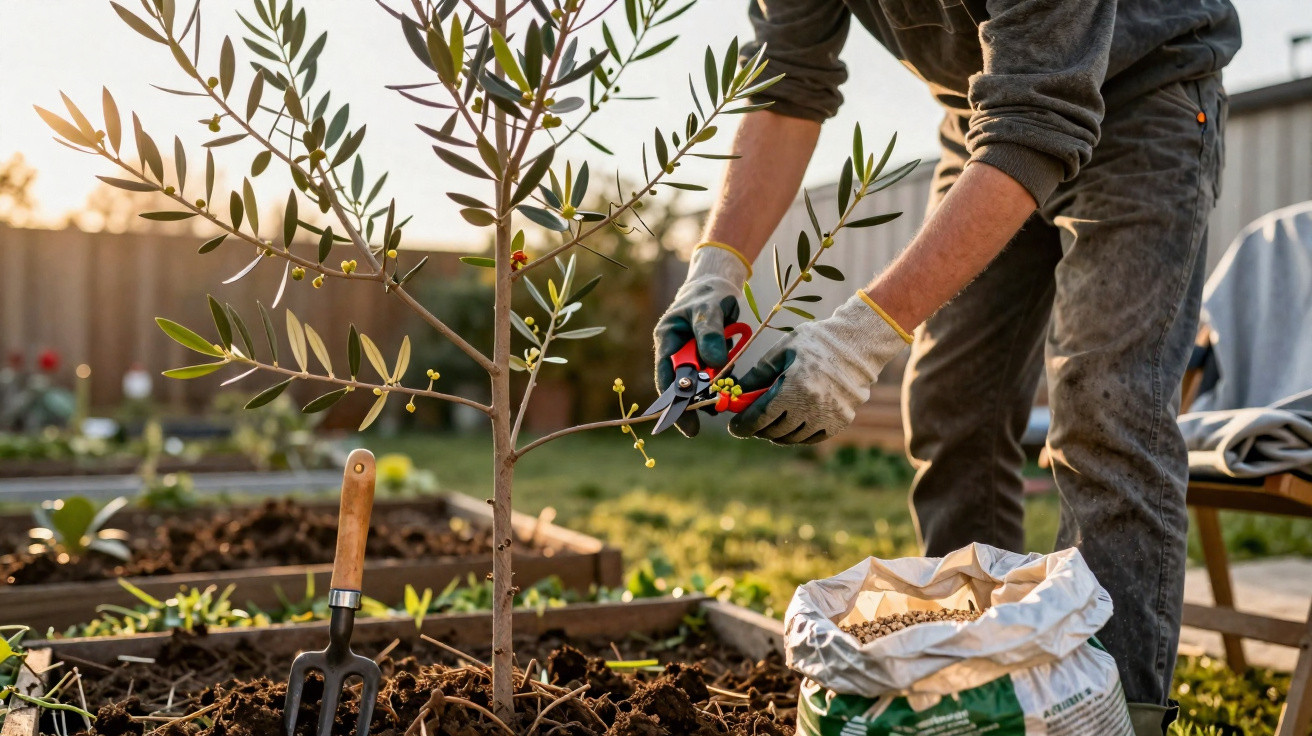
Many amateur gardeners look forward to the first warm days – and that is exactly when they make a care mistake that costs their olive tree its blossom.
Winter is retreating, light is returning to the garden, and olive trees suddenly seem more lively again. This is the point at which it is decided whether the tree will be covered in flowers and fruit in summer or merely grow weakly. Anyone who prunes or fertilises incorrectly during this transitional period can spoil the coming blossom, often without realising it.
Why late winter is the crucial time for olive trees
As temperatures rise, sap begins to move through the olive tree again: more water and nutrients travel upwards through the trunk and branches. Internally, the tree is preparing for new growth and flower buds, even though it may still look fairly inactive from the outside.
This brief window – roughly from mid-March until late April, somewhat earlier or later depending on the region – is ideal for pruning and tending an olive tree. Pruning cuts heal quickly, while the tree can direct its energy specifically into new shoots that will bear fruit.
“Anyone who cares for an olive tree in mild late winter directs the tree’s strength straight into its later flowering – and therefore into the harvest.”
Pruning too late in spring becomes problematic. Several pressures then coincide: increasing heat, greater water requirements and the loss of numerous flower buds when branches are cut. Many trees consequently suffer drought stress, produce hardly any fruit and develop weak wood.
A drastic prune immediately after a severe frost period is equally risky. Young tissues are still stressed by the cold and react with extreme sensitivity. Cracking, dieback or fungal infection may result.
The most important rule: avoid this mistake at all costs
The most common and damaging error is well intentioned: many people do not prune their olive tree until May or even June, when the sap is already flowing strongly, then apply a generous amount of fertiliser high in nitrogen.
“Late pruning combined with lots of nitrogen produces plenty of leaves, but significantly fewer flowers – and therefore almost no olives.”
The following then happens:
- A large share of the flower buds that have already formed ends up among the prunings.
- Heat arrives, so the tree needs more water while also having to heal fresh cut surfaces.
- The high nitrogen content of the fertiliser encourages long, soft shoots that form few flowers and are more susceptible to disease.
The result is that the tree may initially look “nicely green”, but its crown has few flowers and fruit production drops sharply. In summer, many owners wonder why their olive tree bears no olives despite the best care – yet the cause lies weeks earlier.
Step by step: how to prune your olive tree correctly now
If you are standing in front of the tree with secateurs and feel uncertain, you are not alone. A clear plan in small stages is better than hesitantly snipping a little here and there.
Remove old, diseased and obstructive wood
Always start by thinning out the tree:
- Remove dead wood: branches that are brittle and show no buds.
- Cut back damaged or visibly diseased twigs completely.
- Take out branches that cross, rub against one another or grow into the centre of the crown.
The aim is a shape gardeners call an “open-centre” or “goblet” form: three to five strong main branches, loosely spaced around the tree, with a bright, open crown interior.
“As a rule of thumb, a small bird should be able to fly through the middle of the crown without having to struggle through dense branches.”
Consistently remove shoots from the trunk and thick branches
Olive trees often produce upright, highly vigorous shoots at the base of the trunk and on older branches. These so-called water shoots or “gourmands” use a great deal of energy but produce virtually no fruit.
Cut these shoots off close to their point of origin. The younger they are, the easier this task is. Removing them regularly prevents the tree from putting its energy into unproductive wood.
Loosen and clear the soil around the trunk
Leaves, mummified fruit and small twigs collect at the base of the tree. This layer acts like a buffet for fungi and pests. Thoroughly clear the area around the trunk.
Then carefully loosen the top layer of soil with a hand cultivator, without exposing or damaging roots. Importantly, the point where trunk and root meet, known as the root collar, must remain visible. It should neither disappear beneath soil nor remain permanently buried under a thick layer of mulch.
Fertilise and protect: keeping your olive tree healthy long term
An olive tree thrives in lean, free-draining soil – but it should not be left entirely without nutrients. After pruning, a moderate nutrient feed is appropriate, supporting flower production without overfeeding the tree.
Which fertiliser suits an olive tree?
Suitable options include:
- Well-rotted compost, spread thinly across the root area
- Thoroughly rotted farmyard manure in a small quantity
- Specialist fertiliser for olive trees or Mediterranean shrubs, with an emphasis on potassium and phosphorus
The priority is not rapid leaf growth, but sturdy shoots and abundant flowering. A restrained application is enough; olive trees react sensitively to over-fertilising, especially with nitrogen.
| Nutrient | Effect on the olive tree |
|---|---|
| Nitrogen | Promotes leaf growth; too much means fewer flowers and soft wood |
| Phosphorus | Supports flowering and root growth |
| Potassium | Strengthens wood and improves resilience and fruit quality |
Crown protection: spot and contain diseases early
In UK gardens, olive trees mainly suffer from two issues: leaf-spot diseases and sap-sucking pests. Dark-edged spots on the leaves, resembling a peacock’s eye, are typical. In locations at particularly high risk, many gardeners apply a weak copper-based spray mixture as soon as conditions become damp and mild.
For pests such as scale insects or black fungal coating, simple treatments including horticultural oil or soft-soap solutions are often effective. Early inspection is decisive: anyone who checks the foliage in late winter can act in time, before problems escalate during the growing season.
Protect young or potted olive trees from late frost
March or April nights can still bring unexpected sub-zero temperatures. Young trees and container-grown plants in particular react strongly to sudden cold snaps. A lightweight horticultural fleece protects fresh shoots without completely stopping air circulation.
For potted specimens, moving them can be worthwhile: place them close to the house wall, under slight cover and protected from wind. Roots in containers cool down much faster than those planted in open ground.
How to recognise an optimally cared-for olive tree
After pruning, take a step back and look at the tree from several metres away. Its crown should appear open, with the main branches clearly visible. Daylight should fall on the ground between the branches.
“If you can see the sky through the crown without the tree looking ‘bare’, you have achieved the right balance.”
Over the course of spring, short, sturdy shoots with flower buds develop on well-lit branches. New growth remains compact, and the foliage looks deep green without becoming excessively lush. Such a tree reliably produces flowers and, later, fruit, even in regions that do not offer ideal Mediterranean conditions.
Practical advice for different garden locations
Not every olive tree grows in a wine-growing climate. In cooler or wetter areas, slightly different care helps reduce stress:
- In exposed locations, prune more moderately so the tree retains enough foliage for photosynthesis.
- Avoid sites with cold winds – house walls or garden walls provide valuable warm pockets.
- Improve drainage substantially in very heavy soil: grit, sand or a raised-bed structure will help keep roots dry.
Anyone growing an olive tree in a pot should pay even closer attention to an airy growing medium. A mineral component of pumice, lava rock or expanded clay prevents waterlogging. Late-winter care remains the same: a light shaping prune, removal of dead wood, a little low-nitrogen fertiliser and checks for disease.
These measures allow you to use the sensitive period between the end of winter and the start of spring to best effect. The tree responds with a stable crown, healthy leaves and, above all, plenty of flowers – the basis for a small but very personal olive harvest from your own garden or balcony.


Comments
No comments yet. Be the first to comment!
Leave a Comment