
A squeaky laminate floor usually means that the boards are shifting or under pressure somewhere. Because this type of flooring is laid as a floating floor rather than being bonded across the whole surface, uneven subfloors, insufficient edge clearance and changes in humidity can cause clicking noises with every step.
Why does laminate flooring start to squeak?
An uneven subfloor is among the most frequent causes. Where there are slight dips or raised areas beneath the boards, the weight of someone walking makes the flooring flex. This increases friction at the joints and creates the noise.
Before starting any repair, check where the sound occurs and whether there are other signs:
- Boards that sink slightly when pressed;
- Clicking concentrated near walls or doorways;
- Flooring that is lifted, rippled or has open joints;
- Noise that becomes worse during very humid or dry periods;
- Broken click joints or visibly worn edges.
Does the gap next to the wall affect the noise?
Laminate expands and contracts as the room's temperature and humidity change. For this reason, the installation needs an expansion gap of a few millimetres around walls, door frames and other fixed elements. If an edge is too tight, the boards build up tension and may squeak when walked on.
How can you fix squeaking without lifting all the flooring?
The appropriate solution depends on the source of the issue. If the floor is trapped at one particular point, removing the skirting board and correcting the edge may restore the clearance needed for movement. Minor unevenness can be reduced with a suitable underlay, but more significant subfloor defects will generally require partial dismantling.
The following checks can help determine the right repair:
- Remove the skirting board only to check whether the flooring edge is touching the wall;
- Keep room humidity close to 40% to 60%;
- Replace boards with broken click joints where compatible replacements are available;
- Contact an installer if the floor has ripples or excessive movement;
- Avoid screws, nails or liquids unless you understand the structure beneath the floor.
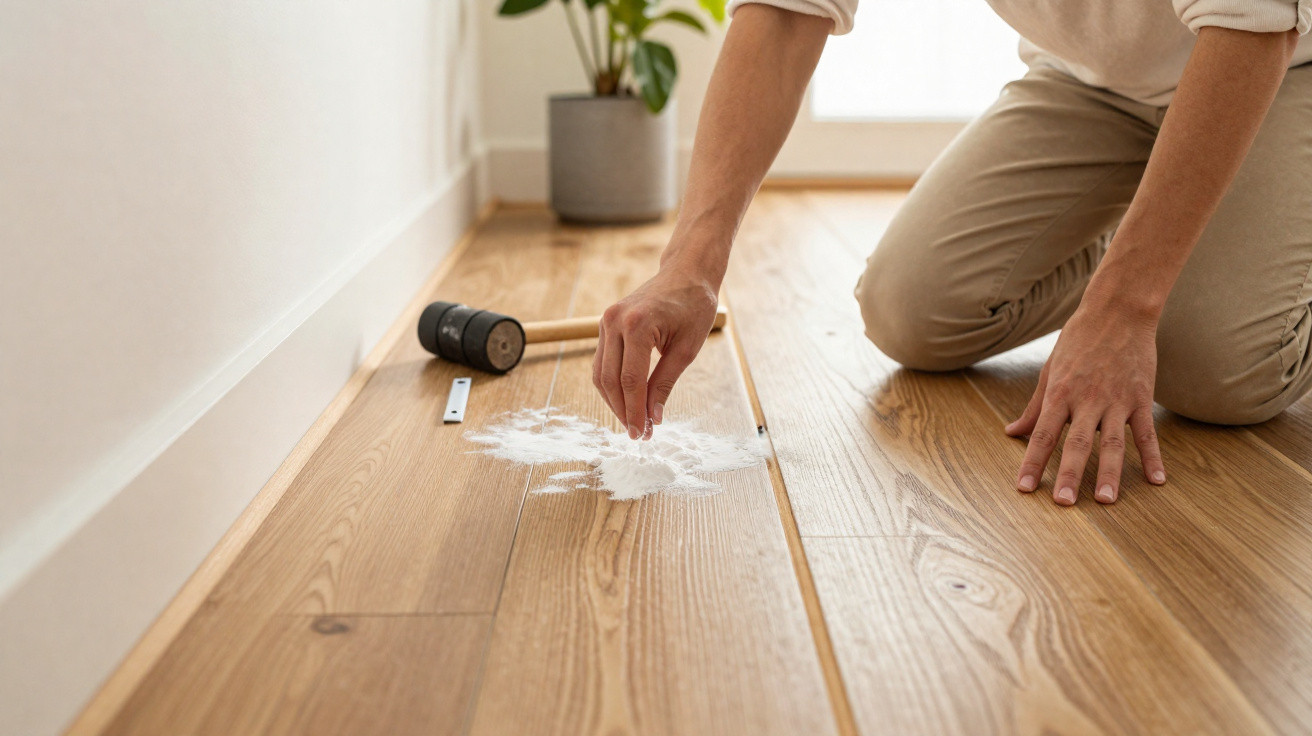
Does talcum powder remove sound between the boards?
Talcum powder can be applied to small gaps to temporarily lessen friction between boards, but it does not correct an uneven subfloor, inadequate expansion clearance or damaged click joints. The powder also tends to come out of the joints through foot traffic and cleaning, allowing the noise to return.
When is it better not to dismantle the floor?
If the flooring is stable, with no raised sections and only a faint click in a few places, dismantling it may cause more damage than the noise itself. Older or glued boards can break during removal, and matching replacements for damaged pieces are not always available.
Laminate floor repair should begin by identifying the cause rather than using makeshift solutions. Adjusting the expansion gap, controlling humidity and correcting the subfloor address the source of the squeaking, whereas powders and lubricants only mask friction for a limited time.





Comments
No comments yet. Be the first to comment!
Leave a Comment