
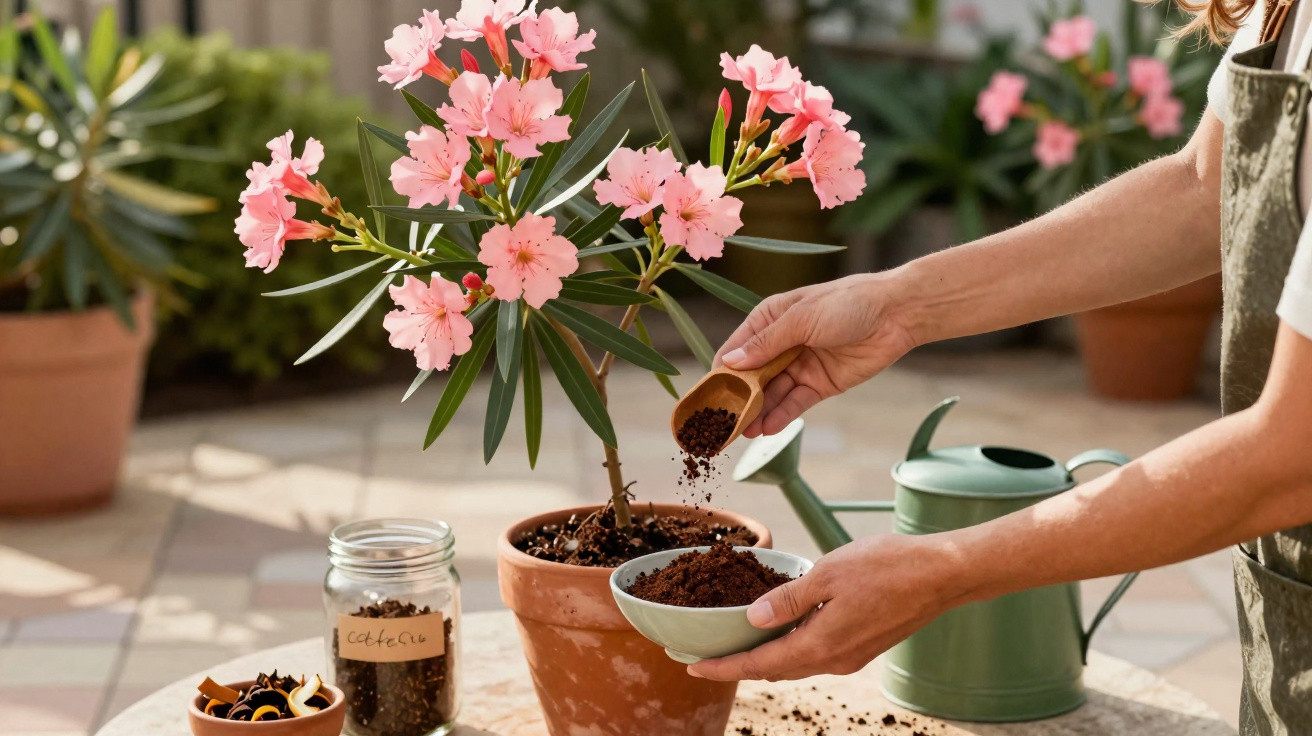
Advice to put coffee grounds straight onto oleanders has been circulating in social media groups and gardening forums for months. It sounds convincing: a natural fertiliser that is free and sustainable. Yet this Mediterranean flowering shrub is more sensitive than many people realise. Miss one important point and, instead of treating your plant, you may weaken it.
Why oleander is so sensitive to coffee grounds
Oleander originates from the Mediterranean region, where it grows in free-draining, predominantly mineral soils that are often slightly calcareous. It thrives in warmth and sunshine, as well as in a growing medium that drains water quickly. Waterlogging and permanently damp soil are disastrous for its roots.
Coffee grounds, by contrast, are an organic residue containing nutrients:
- Nitrogen – essential for leaves and shoots
- Phosphorus – supports roots and flower formation
- Potassium – strengthens plant tissue and improves resilience
Their pH is around 6.5, making them slightly acidic. This is precisely the crucial issue: oleander prefers soil that is neutral to slightly alkaline, at roughly pH 7 to 8. If excessive coffee grounds gradually make the soil more acidic, the plant may struggle to absorb nutrients.
“The soil may still look ‘rich’, but the oleander suffers as though it were on a diet: the nutrients are there, but unavailable to it.”
Common consequences of an unbalanced pH level include:
- Leaves turning yellow while their veins may remain green
- Shoots growing more slowly and staying thin and short
- Flower buds failing to form or dropping prematurely
How to use coffee grounds correctly for oleander
The most frequent mistake is simply scattering a thick layer of fresh, still-moist coffee grounds over the soil. They quickly form a crust that dries poorly, starts to go mouldy and effectively seals the surface.
Always prepare coffee grounds – never apply them fresh
For coffee grounds to benefit rather than harm your oleander, they need a small amount of preparation:
- Allow the coffee grounds to cool completely.
- Spread them in a thin layer on a plate or baking tray.
- Leave them to dry for several hours or a day, until they no longer clump together.
Only then should they be used around oleander, and even then only sparingly.
The right mix for healthy soil
Coffee grounds are most suitable when combined with other materials. A practical ratio is:
| Component | Quantity | Note |
|---|---|---|
| dried coffee grounds | 1 tablespoon | level rather than heaped, and well crumbled |
| mature compost | approx. 500 g | crumbly and not overly wet |
Mix both components thoroughly, then scatter the blend in a thin layer over the root zone. Lightly work it into the surface with a hand fork or your fingers afterwards, so that no crust remains on top of the soil.
How often oleander can actually tolerate coffee grounds
During spring and summer, when oleander is growing and flowering, a small coffee-ground-and-compost mix every two weeks is entirely sufficient. It is not a substitute for a complete specialist fertiliser, but it can be a useful addition.
Plants grown in containers are particularly easy to overfeed. The following applies here:
- during peak flowering: a thin application at most every two weeks
- in winter quarters: no more than once a month, and only very sparingly
- for weakened or newly repotted plants: avoid coffee grounds altogether at first
“As a rule of thumb, less coffee grounds is almost always better for oleander than too much.”
Warning signs: how oleander shows that it has had too much coffee grounds
The plant itself remains the most reliable guide. A vigorous oleander has deep green foliage, produces long, sturdy shoots and continually develops new flower clusters. If this changes noticeably, inspect the soil.
Signs of excessive coffee use in the root area include:
- a dark, almost black crust on the soil surface
- small pale or grey patches of mould in the pot
- pale or yellowing leaves despite fertilising
- fewer flowers and stunted buds
If your oleander reacts in this way, take action straight away:
- Carefully remove and dispose of the top layer of soil.
- If necessary, top up with fresh, more mineral soil containing sand or expanded clay.
- Stop using coffee grounds completely for several weeks.
- Use a balanced liquid specialist fertiliser for oleander instead.
When coffee grounds are especially useful for oleander
Used properly, coffee grounds can certainly be helpful. Two situations are particularly suitable:
A light nutrient boost in summer
If you already feed your oleander regularly with a suitable fertiliser, you can use small amounts of coffee grounds as an occasional “snack”. The organic matter supports soil organisms, loosens the growing medium slightly and provides modest additional nitrogen.
Coffee residues as compost feed, not the main fertiliser
Rather than applying all leftovers directly to oleander, much of the material is better added to the compost heap. There, microorganisms and earthworms break it down, and it can later be applied to the shrub as mild, well-tolerated humus. This means the coffee grounds reach the root ball only in a heavily diluted form.
Common misunderstandings about coffee grounds in the garden
Several myths persist about coffee grounds. Gardeners repeatedly encounter these three:
- “The more, the better”: This is not true for oleander. Too much alters the pH and reduces flowering.
- “A pure organic fertiliser, completely harmless”: Organic does not automatically mean ideal. Natural substances can also upset soil conditions.
- “Coffee grounds replace every specialist fertiliser”: Oleander is a heavy feeder. It requires a balanced nutrient profile that coffee grounds alone cannot provide.
What else to consider alongside coffee grounds
Coffee grounds are only one small part of oleander care. Anyone wanting to keep their oleander performing at its best over the long term should also consider the following:
- Position: as sunny as possible and sheltered from wind, ideally beside a warm house wall
- Growing medium: free-draining compost for container plants with sand or expanded clay; do not use pure peat
- Watering: water generously in summer, but always allow excess water to drain away
- Pruning: lightly shorten faded shoots after flowering to encourage new buds
If you live in an area with very hard tap water, you may actually benefit from the slight pH-lowering effect of coffee grounds. In soft-water regions, however, the same quantity can become problematic more quickly. A simple soil pH test from a garden centre will give a reasonably reliable indication of your garden’s conditions.
Ultimately, coffee grounds can be a useful aid for oleander, provided they are used sparingly, thoroughly dried and always mixed with other material. By closely observing how your shrub responds, you will soon find the right balance between a gentle nutrient boost and an unwanted brake on the soil.






Comments
No comments yet. Be the first to comment!
Leave a Comment