
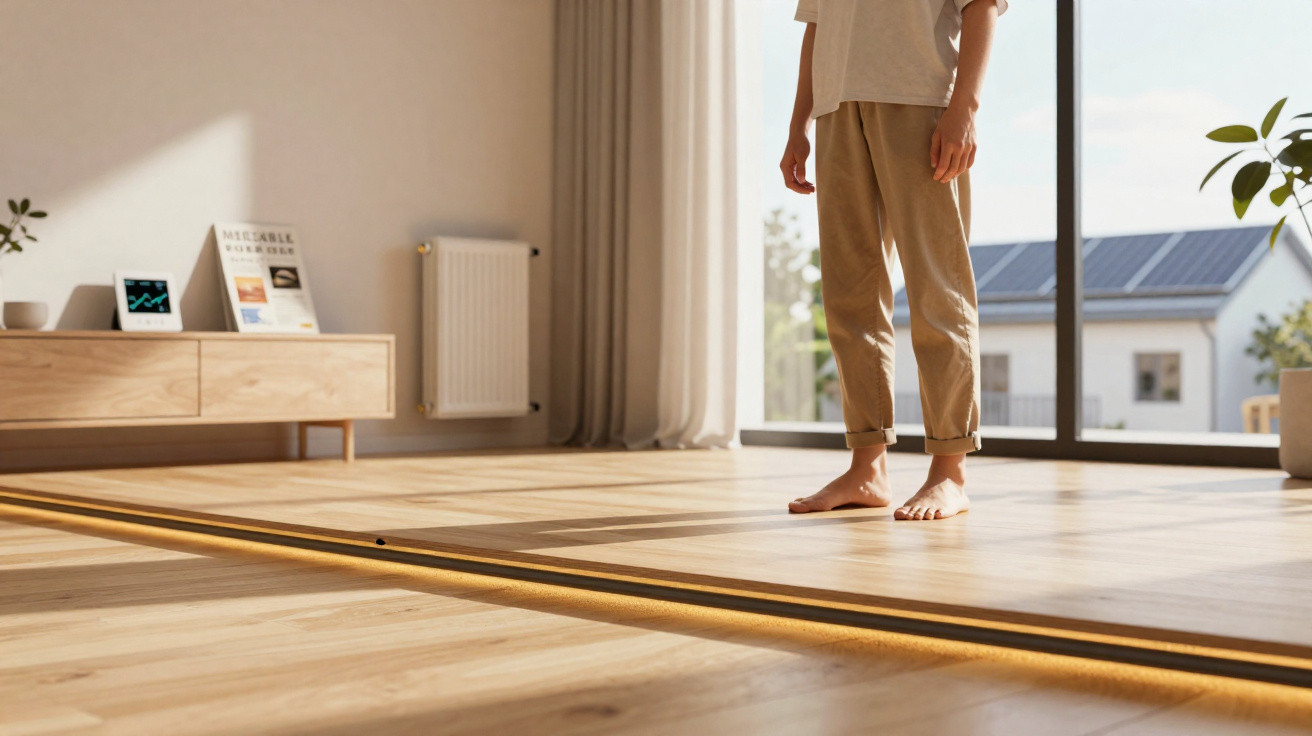
A research team in China has created a heating system that could completely reshape the way homes are heated. Rather than relying on conventional radiators or a hot-water circuit running throughout the property, it uses a floor that stores energy like an enormous flask and releases it gradually, around the clock. Although it sounds futuristic, the universities involved say it is already technically achievable.
Why conventional home heating is reaching its limits
Gas and oil heating systems are facing increasing pressure from the climate crisis, soaring energy prices and policy requirements, among other factors. At the same time, people expect comfort: warm homes with as little temperature variation as possible, at a manageable cost.
A common pattern can be seen in many countries. Buildings are frequently poorly insulated, ageing boilers continue operating long after their expected lifespan, and even up-to-date systems use substantial amounts of energy when a house lacks effective insulation. Any new solution therefore needs to address several requirements at once:
- low energy consumption
- the lowest possible CO₂ emissions
- steady warmth without continual adjustment
- affordable purchase and running costs
This is precisely where the Chinese researchers' innovation comes in, combining established technology in an unusual way.
The concept: a sand floor as thermal storage
At its heart, the system has three elements: a solar installation, a specially designed heat pump and a floor with a sand layer beneath it that acts as a heat store. The sand layer is around 20 centimetres thick and contains pipes able to absorb and release heat.
“The floor itself becomes the heating element – and at the same time an energy store that operates day and night.”
The principle is that sand can absorb significant amounts of heat before releasing it slowly. This makes the floor a slow-reacting yet highly even radiator. Instead of a radiator heating up intensely and then cooling down again, the room temperature stays stable.
How the components work together
The system can broadly be divided into two operating modes:
- Sunny operation: Solar panels on the roof generate electricity that powers the heat pump directly. The pump heats the sand layer beneath the floor, charging the thermal store.
- Cloudy conditions or night-time: When little or no sunlight is available, the heat pump does most of the work, drawing the required electricity from the grid or another energy store. The sand floor then releases its stored heat gradually into the room.
As a result, the room can remain warm for hours, even when outdoor weather conditions change suddenly.
Benefits: continuous warmth with fewer fluctuations
One of the system's main advantages is its consistent heat output. Traditional radiators and fan heaters often provide warmth in cycles: hot at first, then cooler again. This is not only uncomfortable; it can also increase consumption because people adjust the controls repeatedly or set the heating higher than is actually necessary.
This new approach works differently. The sand beneath the floor retains heat as a buffer:
“Heating output is spread evenly over hours instead of arriving in short, energy-intensive bursts.”
Underfloor heating is also considered particularly comfortable because it works upwards from the floor, gently warming the entire room. Provided the system is properly planned, cold corners and draughts can be reduced considerably.
How much energy could be saved?
The researchers have not yet provided specific percentage figures. However, comparable approaches, such as combined solar thermal systems with heat pumps and surface heating, are known to reduce fossil-fuel demand substantially, particularly in well-insulated homes.
The Chinese solution could be especially effective where:
- a solar installation already exists or is planned;
- floor structures need replacing in any case;
- the aim is to move away from gas and oil heating over the long term.
What is known about the cost – and what is not
The universities involved have so far revealed little about pricing. What is clear is that such a system is unlikely to be inexpensive initially, as it requires work to the floor structure and specially adapted control technology.
“The developers stress that they want to design the system so that it remains affordable for ordinary households in the long term.”
Two factors could help keep costs down:
- Sand itself is a very inexpensive material and is widely available.
- Solar panels have fallen sharply in price in recent years, while heat pumps are becoming increasingly widespread.
If the technology enters mass production, economies of scale could reduce its cost. Whether it can compete with a conventional gas boiler or an air-to-water heat pump will depend heavily on support schemes, electricity prices and construction costs in each country.
Where this heating innovation could be most useful
The greatest potential lies in new-build properties and major refurbishments. In these cases, the floor structure, insulation and technology can all be coordinated from the outset. Typical applications include:
- new detached homes with a solar electricity system;
- blocks of flats using a shared storage system;
- energy-efficiency refurbishments where the screed is being replaced anyway.
The concept is more likely to face limitations in older buildings with very poor insulation. Even the best storage system offers little benefit if heat immediately escapes through uninsulated walls or old windows. The building fabric would need upgrading first.
Technical barriers and unanswered questions
For now, this remains a system originating from laboratory work and test buildings. Several questions must be resolved before it can be widely adopted:
- How long does the sand floor remain efficient as a thermal store?
- How demanding are maintenance and repairs?
- How does the system perform in very cold or very damp regions?
- How can overheating be avoided in spring or autumn?
The final question is particularly important. A storage system must do more than provide heating; it also needs controls that prevent the floor becoming too warm when milder weather arrives unexpectedly.
What homeowners can take from this today
Although this particular system is not yet available from builders' merchants, several of its core principles can already be applied to current projects. Anyone building or renovating today can follow three guidelines:
- Choose surface heating rather than individual radiators, such as underfloor or wall heating.
- Combine a heat pump with solar electricity to increase on-site consumption.
- Incorporate thermal storage wherever possible to smooth peak demand.
The better insulated a house is, the more worthwhile such a concept becomes. An insulated building, an efficient heat pump and a well-designed storage solution reinforce one another and make heat supply more stable.
Key terms explained
Heat pump: A device that raises environmental heat from air, water or the ground to a higher temperature level. It works broadly like a refrigerator in reverse: instead of moving heat from an indoor space outside, it brings heat from outdoors into the home.
Thermal storage: A system that absorbs heat energy and releases it later. This may be a water tank, a concrete core or, as in the Chinese concept, a sand layer beneath the floor.
Surface heating: A heating system in which large areas, such as floors or walls, are gently warmed instead of using a small radiator. This allows lower temperatures for the heating medium, which works well with heat pumps.
The Chinese development illustrates the direction the heating market may take: away from localised fossil-fuel heat generation and towards systems that store renewable energy and distribute it as evenly as possible. Whether the sand floor from East Asia will actually be installed in German new-build homes remains uncertain. What is clear, however, is that anyone planning a home today should already be considering storage solutions and solar electricity as integral elements.





Comments
No comments yet. Be the first to comment!
Leave a Comment