
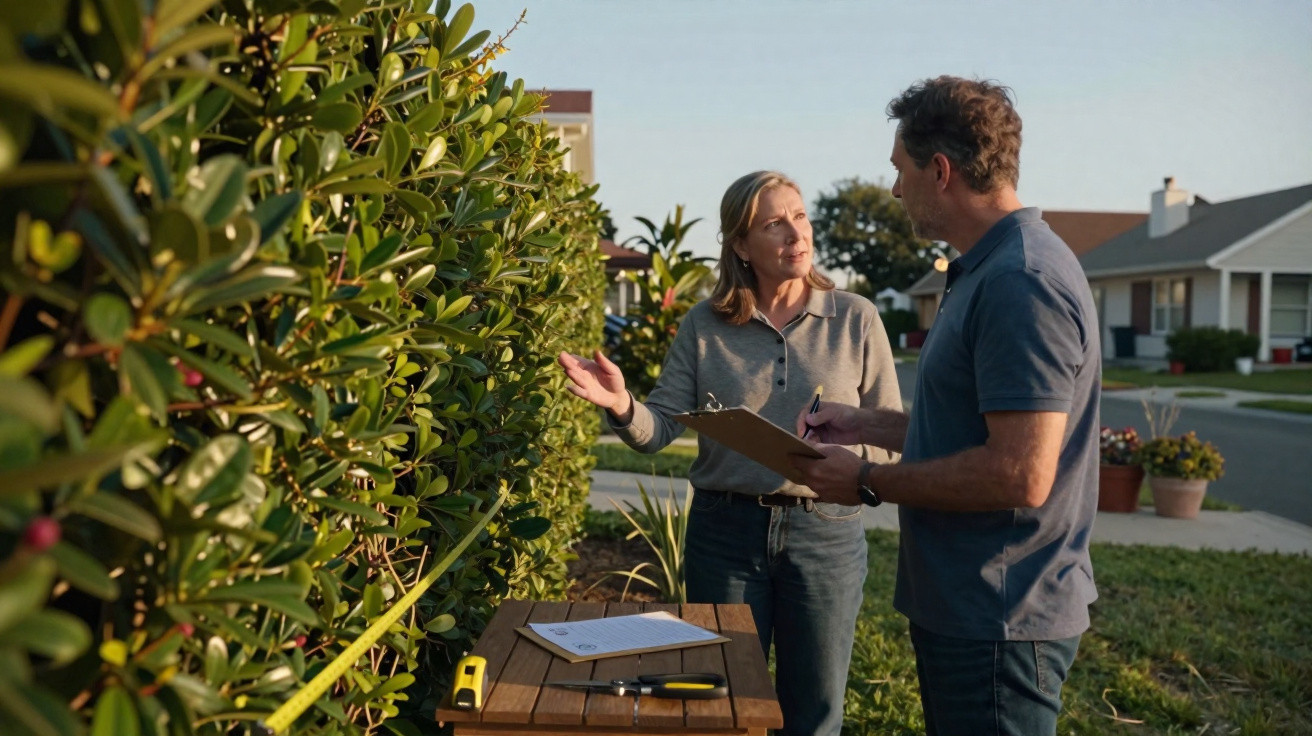
Anyone with a garden will recognise the issue: the hedge next door keeps getting taller, branches hang over the fence, and the patio is in shade for half the day. A polite request gets nowhere, while the neighbour responds irritably or not at all. Many people eventually give up in frustration, or take a saw to it themselves – risking a dispute in court. Yet the law provides a clearly defined route that surprisingly often works without triggering a full-scale neighbourly war.
When a hedge becomes a source of stress
An overgrown hedge is more than an eyesore. It takes away light and space, and eventually tests your patience too. Feeling hemmed in within your own garden can quickly seem like an intrusion into your private space. In densely built-up residential areas in particular, disputes of this kind can escalate faster than expected.
Common day-to-day situations include:
- The patio is in almost permanent shade.
- Branches extend far beyond the fence and obstruct access.
- The hedge blocks the entire view and resembles a green wall.
- Leaves, needles or fruit fall in large quantities into your own pool or flowerbed.
Many garden owners believe there is nothing they can do. Others assume they can simply cut off anything that crosses the boundary. Neither is entirely correct. Knowing the legal rules puts you in a much stronger position and allows you to apply focused pressure without becoming abusive.
Who owns the hedge – and what is actually permitted?
The first step is to establish what type of hedge is involved. From a legal perspective, this makes a significant difference.
A hedge directly on the boundary
Where a hedge stands precisely on the property boundary, it will generally be a shared hedge. In that case, each neighbour owns half of the plants. Both are responsible for maintaining it, and both must bear the costs. Anyone who entirely neglects their part is failing to meet that obligation.
“If the hedge stands on the boundary, each neighbour must maintain their section – the law treats it as jointly owned property.”
A hedge entirely on the neighbour’s land
If the hedge is clearly located on the neighbouring property, it belongs solely to that neighbour. Even so, they cannot do whatever they like with it. Two points are decisive:
- the hedge’s height
- its distance from the boundary
Civil-law rules broadly provide for the following model, which is specified further by local authority by-laws in many areas:
| Height of the hedge | Minimum distance from the boundary |
|---|---|
| over 2 metres | at least 2 metres |
| up to 2 metres | at least 0.5 metres |
Height is measured from ground level to the top, while the distance is measured from the centre of the trunk to the boundary. If a hedge is planted against a boundary wall, it can often stand directly beside it – but if it grows higher than the wall, that may again become an issue.
If the neighbour does not respond: your legal options
When a hedge complies with neither the required distance nor the permitted height, or causes serious disruption, those affected can demand more than simply “being good neighbours”. The law provides specific remedies.
A hedge that is too tall or too close
If the hedge is planted too near the boundary or has grown substantially too high, you may require the neighbour to cut it back to the permitted level or move it. In certain circumstances, it may even be possible to demand the removal of older plants where they clearly breach the requirements. However, having tolerated the situation for many decades can weaken that claim, as limitation rules may then apply.
Branches extending onto your property
Where branches hang over your fence, the law sets out a clear division of responsibilities:
- The hedge owner must cut back overhanging branches when you request this.
- As a rule, you may not simply remove those branches yourself without taking the proper steps.
The position differs for roots, runners or climbing shoots growing into your property: in many cases, you may cut these back at the boundary if they are causing a nuisance. This is an important detail, particularly with vigorously spreading hedges.
“Anyone who reaches for the saw without a legal basis risks having to pay damages – even if the hedge is objectively too high.”
A smart strategy: take action in stages
Legal advisers recommend not starting immediately with legal provisions and threats, but instead proceeding through three clear stages. This approach is often remarkably effective because it steadily increases the pressure while also presenting well if the matter reaches court.
Step 1: have a factual conversation
Speak to your neighbour calmly and matter-of-factly. Briefly mention the legal distance and height requirements, but avoid delivering a legal lecture. Show them exactly how the hedge is creating problems: shade, restricted access or damage to a fence. This conversation is often enough if the neighbour has previously underestimated the situation.
Step 2: send a formal recorded-delivery letter
If your neighbour does not respond at all or refuses to engage, take the next step: send a written request by recorded delivery with proof of receipt. It should:
- describe specifically how you are being affected;
- refer to the legal rules on distance and height;
- set a clear deadline for cutting it back, for example 4 weeks.
Keep this letter carefully. It later demonstrates that you did not threaten legal action out of nowhere, but acted fairly first.
The often underestimated secret weapon: mediation
The real game-changer comes at the third stage: formal conciliation through a neutral third party. This service is usually referred to as “conciliation” or “mediation in a neighbour dispute”.
The principle is simple: an independent person invites both parties to a meeting, hears each side, explains the legal position and tries to secure a written agreement. For many people, this is less daunting than going straight to court – yet it can still be highly effective.
“In a sober room with a neutral person, the mood can quickly change – a personal dispute becomes a practical problem that can be solved.”
How to prepare properly for conciliation
A well-prepared approach improves the chances that the neighbour will compromise. Four things are particularly important:
- Current, dated photographs taken from different angles, showing the height and overhang.
- Notes recording how long the dispute has existed and how often you have already asked for the hedge to be cut back.
- Copies of the key legal rules on hedge distance and pruning.
- The posting receipt and a copy of your recorded-delivery letter.
If the neighbour remains unwilling to cooperate or does not attend at all, a formal report on the hedge’s condition may be useful, as it can carry weight later in court.
When the court intervenes – and the consequences that may follow
If every attempt at discussion and conciliation fails, the final option is to apply to the district or regional court, depending on the value of the claim. You can ask the court to order the neighbour to cut their hedge back to a specified height or move it to the required distance from the boundary.
Courts issue clear orders in such cases. If the neighbour fails to comply, a daily financial penalty may become payable until the pruning has been completed. For many people who enjoy a dispute, that prospect alone is enough to make them eventually pick up the hedge shears.
At the same time, where the impact is severe – for example, permanent loss of light or damage – you may also seek compensation. However, you must prove that the hedge caused the problem and that the neighbour did nothing despite being asked to act.
Practical tips for a calm relationship while holding firm
People who rely on their rights can quickly be seen as difficult. How you present your case matters greatly. In practice, the best results come from combining clarity with fairness.
- Avoid emotional accusations such as “always”, “never” or “absolutely terrible”.
- Stick to specific facts: height, distance, shade and damage.
- Make realistic proposals, such as regular pruning once a year.
- Nevertheless, insist politely but clearly that the rules must be followed.
It may also help to create your own pruning plan. Someone who demonstrates that they maintain their own hedge properly has the stronger moral position. In many cases, neighbours then agree on an annual date when both sides trim their plants.
Why hedges so often cause neighbour disputes
Hedges mark boundaries – not only physical ones, but emotional ones too. They represent privacy, separation and sometimes territorial behaviour. That is precisely why they are a frequent cause of cases before conciliation services and courts. There is another factor: plants grow gradually. What looks harmless today may create lasting darkness in five years’ time.
Those who measure early, take photographs and politely draw attention to the hedge’s development can prevent many disputes from escalating. If matters do come to a head, the people in the stronger position are clearly those who have properly documented their actions and exhausted the legal options before putting the matter in others’ hands.






Comments
No comments yet. Be the first to comment!
Leave a Comment