
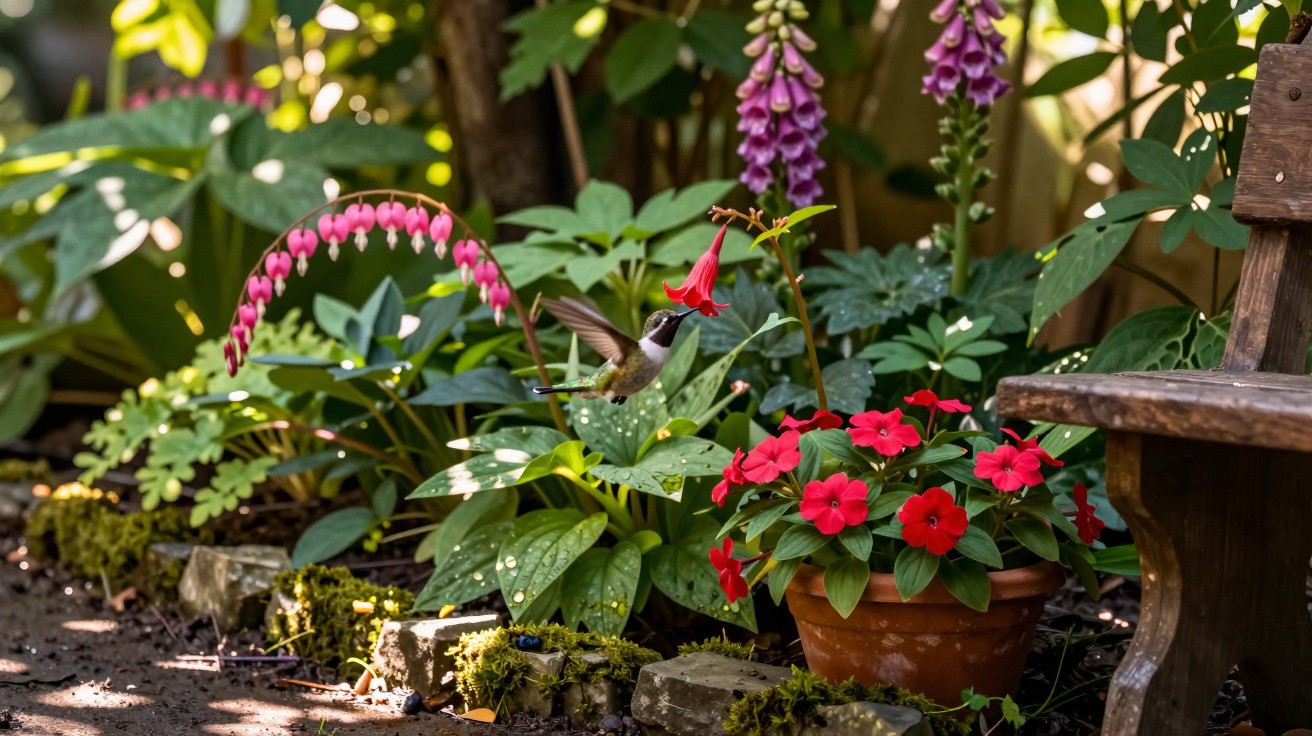
A forgotten corner of the garden, permanently in shade – yet it could be the very place where the most life moves in.
Many amateur gardeners write off dark spots too quickly: beneath the canopy of an old tree, on the north side of the house or on a balcony with no direct sunshine. Yet, with suitable shade-loving flowering plants, these areas can offer far more than a splash of colour. They can become genuine magnets for hummingbirds, butterflies and solitary bees – with surprisingly little effort.
Why hummingbirds thrive in shaded areas
Hummingbirds are often seen as tiny sun worshippers, constantly hovering around vivid red flowers or feeders. That picture is only partly accurate. These birds are high-performance fliers: their wings can beat up to dozens of times per second, their hearts race, and they use huge amounts of energy while also needing shelter and calm.
“Hummingbirds only stay where nectar, protection from the wind and safe resting places are close together.”
A thoughtfully planted shady area provides exactly that. Beneath trees and beside sheltered walls, the air is cooler and the light softer, while shrubs or climbing plants reduce the wind. Hummingbirds can pause there briefly, preen and replenish their energy before moving on.
When feeding, they are especially drawn to flower shape and colour contrast. Tubular or bell-shaped blooms are ideally suited to their long bills and extendable tongues. Bold reds are particularly eye-catching, but rich pinks, purples and coral shades also stand out beautifully in partial shade.
Turning a dark corner into a hummingbird refuge
For shade plants to flourish, it is worth first assessing the type of shade involved. A bed directly against a house wall is usually dry. Beneath a deciduous tree, the shade tends to be fresh to damp, while the outer edge of shrub planting often has partial shade.
- Dry shade: for example, at the base of a wall or beneath a dense roof overhang
- Fresh shade: beneath deciduous trees with humus-rich soil
- Partial shade: places receiving a few hours of sun each day or filtered light
Before planting, add a generous layer of well-rotted compost. It retains moisture, supplies nutrients and improves soil structure. Gardeners should avoid chemical pesticides. Hummingbirds do not feed only on nectar; they also catch small insects and spiders, so garden chemicals directly harm this food chain.
A small, shallow water feature is also highly useful: a saucer, tiny bowl or very low bird bath will do. Hummingbirds readily use these spots for short breaks, particularly when protective branches are nearby.
The 5 best shade plants to attract hummingbirds
One flower alone is rarely enough to keep the birds visiting for long. The real appeal comes from combining plants of different heights and flowering periods: climbers, perennials and low ground-covering plants. These five species provide a colourful foundation for any shady hummingbird garden.
Busy Lizzie: Impatiens for beds and window boxes
The classic plant for shaded beds is botanically known as Impatiens walleriana. It is commonly sold as Busy Lizzie or garden impatiens.
- Height: approximately 20 to 40 centimetres
- Spread: around 20 to 30 centimetres per plant
- Position: shade to partial shade, sheltered from wind
- Flowering period: from late spring until the first frosts
These plants form a dense cushion of glossy green leaves and countless flowers in white, pink, red, salmon or violet. Their colours appear especially vibrant in partial shade. In temperate regions, they are generally grown as annual seasonal plants because they tolerate only brief cold spells just below 0°C.
“A broad carpet of impatiens brings instant colour to any dark corner – ideal along paths, beneath trees or in a north-facing balcony planter.”
For continuous flowering, Busy Lizzies need consistently moist conditions without waterlogging. Humus-rich, lightly damp soil and a sheltered location free from draughts encourage vigorous growth. Regularly removing faded flowers helps promote new buds.
Lobelia with impact: red spires for damp sites
Cardinal flower (Lobelia cardinalis) loves moist soil and is ideal for pond edges or slightly boggy corners in partial shade. Its upright spikes of brilliant red flowers are almost impossible for hummingbirds to miss.
The blooms are arranged in rows along long stems, creating a kind of nectar ladder. This makes the plant especially appealing to fast-flying birds that dart from one flower to the next. In cooler regions, cover the root area with leaves or bark mulch in autumn to help the plant overwinter safely.
Bleeding heart: romantic spring flowers
Bleeding heart (Lamprocapnos spectabilis), still known to many by its former name, is one of the best-known perennials for partly shaded positions. Its elegantly arching stems carry rows of small heart-shaped flowers in spring, suspended like beads on a string.
It prefers soil that is humus-rich, loose and fairly cool. It performs particularly well beneath light tree canopies or beside shrubs. After flowering, bleeding heart often dies back somewhat, leaving space that can be filled by other perennials such as hostas or ferns. For hummingbirds, the hanging clusters of flowers provide an important early source of nectar in spring.
Coral honeysuckle: a climber with trumpet flowers
Evergreen or semi-evergreen coral honeysuckle, Lonicera sempervirens, produces bright trumpet-shaped flowers in red and coral tones. It climbs along trellises, pergolas and house walls, creating natural screens and canopies for hummingbirds.
A curtain of flowers offers several advantages:
- It provides visual cover and sheltered spaces among the foliage.
- It blocks wind and creates calmer flight zones.
- It supplies nectar at hummingbird eye and bill height.
In bright partial shade, such as against east- or west-facing walls, honeysuckle displays its full beauty. The soil should not become too dry, and a layer of mulch keeps the roots cool. Pruning regularly after flowering keeps the plant compact and encourages more blooms.
Foxglove: majestic flower spikes – with an important warning
Common foxglove (Digitalis purpurea) adds structure to any partly shaded area with its tall flower spires. The individual bell-shaped blooms are often speckled inside and resemble small feeding stations stacked one above another.
Important: foxglove is poisonous in every part of the plant. Anyone with young children or free-roaming pets in the garden should consider very carefully where it is planted, or choose a safer alternative instead.
“Foxglove belongs in many traditional wildlife gardens – but always with respect for its toxicity.”
In suitable spots, such as beside a lightly shaded fence or at the edge of a shrub border, it provides height and dramatic colour accents. After self-seeding, new plants often emerge in unexpected places the following year.
Combining the plants into a lively shade border
The planting becomes particularly effective when the plants are layered together. Honeysuckle can climb a trellis to create height and shelter. In front of it, bleeding hearts and foxgloves form the middle layer, while Busy Lizzies fill gaps at ground level. Add lobelia in particularly damp spots or near a water bowl.
A possible planting scheme for a shady corner could look like this:
| Layer | Plant | Function |
|---|---|---|
| Height | Honeysuckle | Shelter, climbing structure, nectar at an elevated level |
| Middle | Bleeding heart, foxglove | Spring and early-summer flowers, colour accents |
| Ground | Impatiens | Dense floral cushions, continuous carpet |
| Damp zone | Lobelia | Bright signal colour, nectar close to ground level |
Anyone adding feeders should avoid hanging them immediately beside the flowers. Otherwise, one dominant male may claim everything for himself. Spreading nectar sources around the area creates a calmer setting and increases the likelihood of seeing several birds.
Practical advice, risks and worthwhile benefits
Hummingbirds react sensitively to changes in their surroundings. Noise, reflective glass surfaces and free-roaming cats can quickly drive them away. Bright markings on large windows greatly reduce the risk of collisions. Shrubs or tall perennials near windows can also redirect flight paths away from the glass.
Many garden owners wonder how much maintenance is required. The good news is that, after the initial period of regular watering, most of the shade plants listed need only modest care. A yearly application of compost, watering during dry summer spells and a thin layer of mulch in autumn are generally enough.
Anyone inspired to improve their own shady space can start small: two pots of Busy Lizzies on a north-facing balcony, a bleeding heart in partial shade and a bowl of water. Over time, more perennials can be added to create a layered, flowering shade garden that provides nectar and shelter from spring to autumn.
As well as the pleasure of watching hummingbirds at close range, other wildlife benefits too. Butterflies and solitary bees gain additional food sources, the soil structure improves through greater root growth and fallen leaves, and the garden gains an area that remains pleasantly cool even on hot days – a quiet, living refuge for people and animals.


Comments
No comments yet. Be the first to comment!
Leave a Comment