
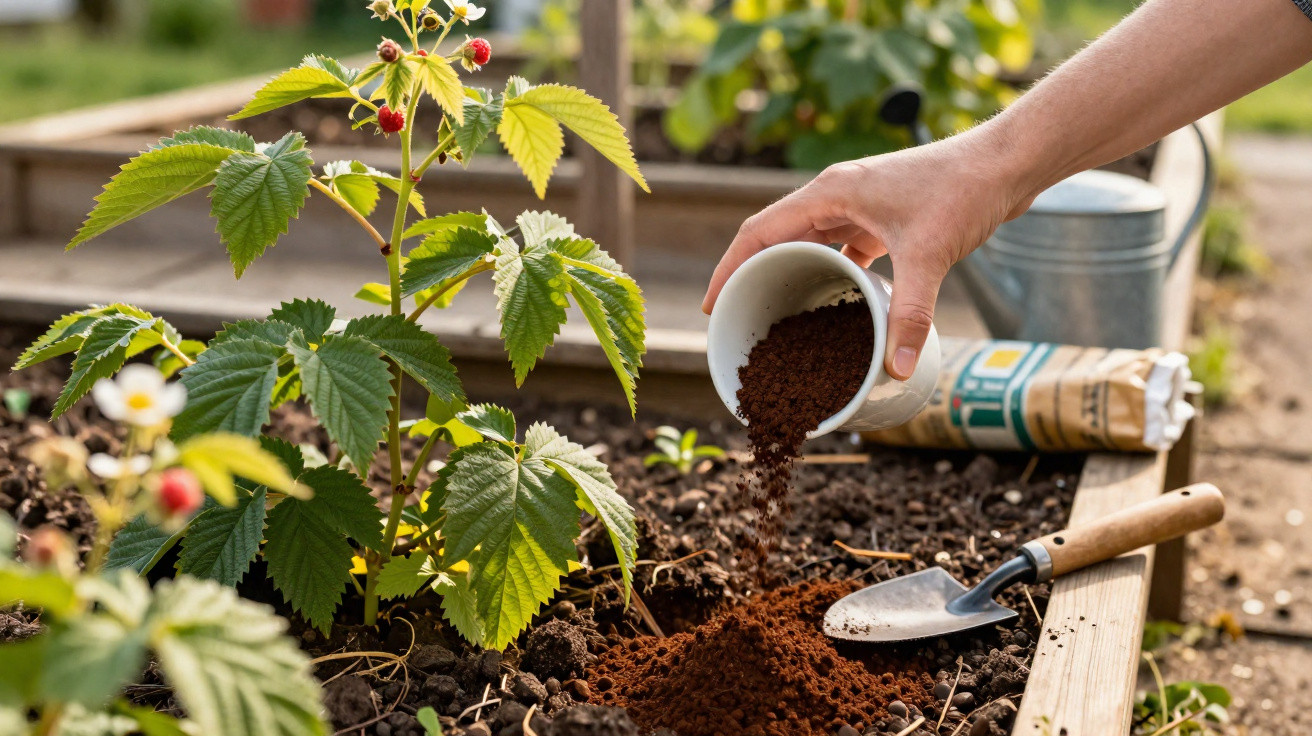
Anyone hoping to enjoy bowlfuls of fragrant raspberries in summer needs to start earlier than they may expect: in spring, using a remarkably straightforward method. Rather than buying costly specialist fertilisers, an everyday kitchen leftover is all that is needed – used properly, it can noticeably increase the harvest while helping plants become stronger, healthier and more resilient.
The idea behind the so-called ‘cup trick’
The principle is simple: instead of being thrown away, one cup of dried coffee grounds is spread at the base of a raspberry bush. This is where the name ‘cup trick’ comes from. Gardeners value this approach because it tackles several bed-related issues at the same time.
Raspberries thrive in soil that is slightly acidic, loose and rich in nutrients. Coffee grounds fit this need particularly well. They are produced daily anyway, cost nothing extra and contain a surprisingly high level of substances the bush needs.
A cup of coffee grounds per plant in spring can give raspberry bushes a considerable growth boost and noticeably increase the amount harvested.
The key is not so much the quantity as using the grounds correctly: tipping damp coffee grounds onto the soil in thick layers can cause mould and create a dense crust. When prepared and applied in the right amount, however, they act as a gentle natural fertiliser.
Why raspberries respond so well to coffee grounds
Coffee grounds are much more than kitchen waste. From a chemical perspective, they provide nutrients that are especially useful for berry bushes.
- Nitrogen: encourages vigorous, deep-green foliage and supports the development of fresh canes.
- Potassium: reinforces cell structure, improves plant resilience and aids fruit production.
- Trace elements: including magnesium and phosphorus, support root growth and flower formation.
Raspberries are sensitive to soil that is depleted or overly heavy. Coffee grounds gently open up the soil, improve its ability to retain water and can shift the pH towards a range that berry plants favour.
Coffee grounds work as a gentle all-rounder: they feed the soil, encourage soil life and help to keep pests at bay.
Many gardeners find that plants given coffee grounds regularly produce more new canes as well as larger, more aromatic fruits. The results do not appear overnight, but they become clear as the season progresses.
How to use the cup trick correctly for raspberries
A little preparation is required for the trick to work properly. Even so, the process is straightforward and perfectly manageable for beginners.
Preparing coffee grounds properly
- Allow them to cool: Fresh coffee grounds should be left until completely cool.
- Dry them: Spread the grounds thinly over an old baking tray or newspaper, then leave them to dry for several hours or days. This prevents mould from developing.
- Store them correctly: Collect them in an open container, fabric bag or paper bag. Airtight tubs are unsuitable because moisture can build up inside.
Anyone who drinks plenty of coffee will quickly accumulate larger quantities. In that case, it is worth drying the coffee grounds regularly rather than applying everything at once.
Using them in a bed or container
Whether raspberries are planted in garden soil or a large container on a balcony, the method is much the same:
- Allow roughly one small cup (about two to three tablespoons) of dried coffee grounds for each bush.
- Carefully loosen the soil surface around the bush.
- Scatter the coffee grounds in a thin layer rather than piling them up thickly.
- Work them lightly into the top layer of soil, or cover them with a little garden soil.
- Water well afterwards, so that the nutrients dissolve and reach the root area.
Less is more here: a thin layer of coffee grounds works better than a dense mat that seals the soil from the air.
Many gardeners repeat the application two or three times from spring to early summer, leaving several weeks between treatments. This is generally enough to visibly strengthen the plants.
The best time to use the cup trick
The ideal time is early spring, once prolonged frosts are no longer expected and the first buds can be seen. At this point, raspberries are about to enter a growth phase in which they require particularly high levels of energy.
Suitable timings include:
- First application: In March or April, as soon as the ground is frost-free.
- Second application: Shortly before or during flowering.
- Third, optional application: After the first harvest for varieties that crop more than once.
For very sandy soil, the interval can be slightly shorter because nutrients are washed out more quickly. With heavy clay soil, less frequent applications will usually be sufficient.
More than fertiliser: pest protection and improved soil structure
Coffee grounds also have mildly deterrent properties against certain garden pests. Slugs and some other crawling creatures avoid areas where coffee grounds have been applied generously but thinly. This does not provide complete protection, but it can reduce pest pressure in the bed.
Many soil organisms, including earthworms and micro-organisms, also benefit from organic material. They break down the coffee grounds, move them into deeper soil layers and thereby improve the structure over time. Active soil life produces loose, aerated earth – exactly what raspberries need.
| Benefit of coffee grounds | Advantage for raspberries |
|---|---|
| Nitrogen, potassium and trace elements | Stronger growth, improved flower and fruit formation |
| Mildly acidic effect | A soil environment that suits berry bushes |
| Organic matter | More active soil life and a looser structure |
| Naturally deterrent smell | Less feeding damage from certain pests |
Common mistakes when using coffee grounds in a raspberry bed
Despite their many benefits, too much of a good thing can harm the plants. Several pitfalls occur repeatedly in everyday gardening.
- Layers that are too thick: The soil can no longer breathe, the surface becomes crusted and water runs off.
- Damp, clumped coffee grounds: These increase the risk of mould and attract unwanted insects.
- Areas of pure coffee grounds in pots: This quickly becomes problematic in containers because the roots receive less oxygen.
- Over-fertilising: Applying very large amounts at once can disrupt the nutrient balance.
By applying coffee grounds sparingly and treating them only as a supplement to compost or well-rotted mulch, you will stay on the safe side.
Combining coffee grounds wisely: mulch, compost and watering
The cup trick is particularly effective when it forms part of a well-balanced approach to soil care and watering.
This combination has proved effective:
- Apply a thin layer of dried coffee grounds around the bush.
- Cover it with mulch made from grass clippings, shredded prunings or straw.
- Water regularly without making the soil waterlogged, ideally close to the ground.
Combined with mulch, coffee grounds gradually reach the soil, nutrients remain available for longer and the earth stays evenly moist.
If you have a compost heap, some of the coffee grounds can be added directly to it instead. Once the compost is ready, the grounds will reach the raspberry bush in a heavily diluted form – ideal for anyone unsure about applying coffee grounds on their own.
What beginners should also know about raspberries and soil care
Many people underestimate how strongly the site determines the size of the harvest. Raspberries do not like waterlogged, compacted soil. A gently sloping bed, loose earth and protection from wind often achieve more than any specialist fertiliser.
Those just starting out should check the following:
- Is the bush positioned in sun or partial shade?
- Can excess water drain away properly?
- Are old, spent canes removed in autumn or early spring?
Pruning is especially important: only young, vigorous canes crop well. The cup trick using coffee grounds supplies these canes with the nutrients they need for strong growth. Combined with regular pruning and considered watering, it creates a system capable of delivering reliable, and often surprisingly abundant, harvests year after year.
Anyone who makes coffee every day already has the key to more berries in their hands. A simple cupful of coffee grounds, spread in the right place at the right time, can achieve more in a raspberry bed than many an expensive specialist fertiliser from a garden centre.




Comments
No comments yet. Be the first to comment!
Leave a Comment