
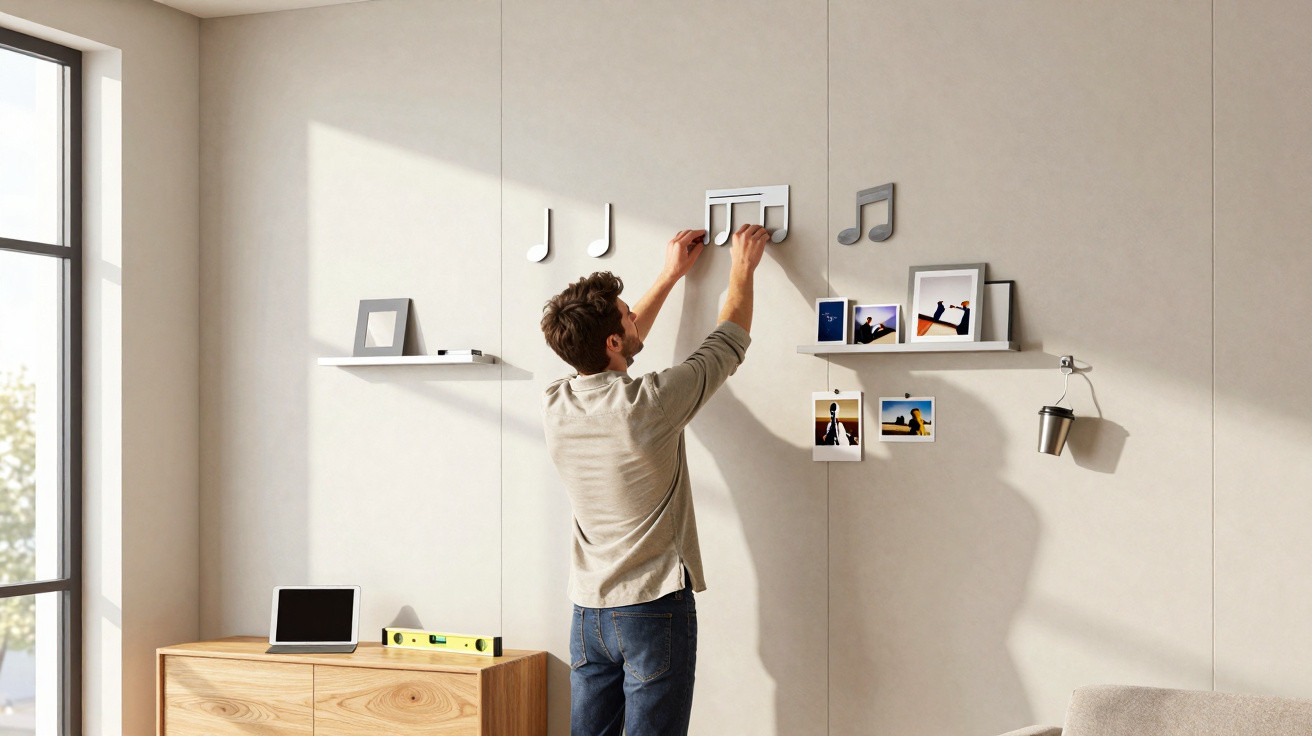
A surprising development from South America is reshaping residential interiors. A young Argentinian student has developed technology that turns ordinary surfaces into magnetic areas, eliminating the need for drills to hold pictures or utensils securely.
How does the innovative Ironplac system work?
Named Ironplac, this engineering solution works as a highly versatile and innovative construction system. The material operates passively, meaning it produces no magnetism of its own and relies entirely on magnets attached to the suspended objects.
Its innovative practical application has been designed to fit seamlessly with both conventional systems and dry construction methods. This adaptability enables a clean installation in homes, standing out chiefly because of the following structural features of this new wall covering:
- Drill-free fixing: Allows tools and pictures to be hung without using drills.
- Passive structure: The wall does not emit magnetism; it responds only to the object's magnet.
- High versatility: Compatible with traditional thin-bed mortar and plasterboard structures.
What are the main benefits for users?
For end users, the clearest advantage is the exceptional convenience of regularly rearranging rooms. By avoiding the usual nuisance of dust and crooked holes, residents can alter the position of pictures and kitchen holders with complete ease.
Beyond the home, this technology provides effective commercial solutions for offices, vehicle repair workshops and modern classrooms. Being able to reconfigure a space quickly protects the structure of buildings and lowers the cost of maintaining surfaces damaged by screws.
What environmental impact does this construction material have?
Although it is not classified as a low-emission eco-cement, the product makes an active environmental contribution. The global construction industry produces tonnes of waste every year, making the emergence of solutions centred on the longevity of internal structures essential.
Sustainability in Construction
Alarming global data on emissions and waste
According to figures from international bodies, buildings and construction activities use roughly 32% of the world's energy and account for 34% of global carbon dioxide emissions into the atmosphere.
In addition, key materials such as steel and conventional cement are responsible for 18% of these emissions, highlighting the serious impact that repeated small-scale refurbishments have on the eventual disposal of rubble.
By limiting frequent wall damage, this innovative wall covering helps prevent premature refurbishment in rented and commercial properties. This protection considerably reduces rubble disposal, creating positive ecological effects through the following social and environmental advantages of the new product:
- Reduced waste generation resulting from continual repairs to structures.
- Less need for filler and paint to cover old holes.
- Longer-lasting surfaces in educational and corporate settings.
Which stages does the project still need to overcome?
As it remains under development, the material faces important practical questions concerning its durability. Early laboratory testing and prototypes in pilot installations are promising, but the market requires rigorous proof of resistance under severe everyday impact.
The inventor is currently seeking strategic funding and commercial partners to scale up industrial production of the mortar. Moving from laboratories to tool retail outlets depends on assessing crucial factors, reflected in the following outstanding technical challenges for establishing the patent:
- Precisely determining the weight capacity supported by different types of magnet.
- Assessing the material's physical behaviour when exposed to excessive moisture.
- Establishing the final production cost compared with traditional plasters.
How does this invention redefine the role of walls?
The most impressive aspect of this innovative project lies in its conceptual transformation of architectural partitions in modern homes. Rather than remaining a merely passive element of structural separation, the wall becomes a valuable, dynamic and flexible tool for users.
If this innovative wall covering demonstrates genuine durability in upcoming commercial tests, decorating habits will change permanently. Drilling into solid surfaces to hang a simple picture will become an outdated memory thanks to the success of this revolutionary magnetic fixing technology.
References: IronPlac – Magnetisable Construction System


Comments
No comments yet. Be the first to comment!
Leave a Comment