
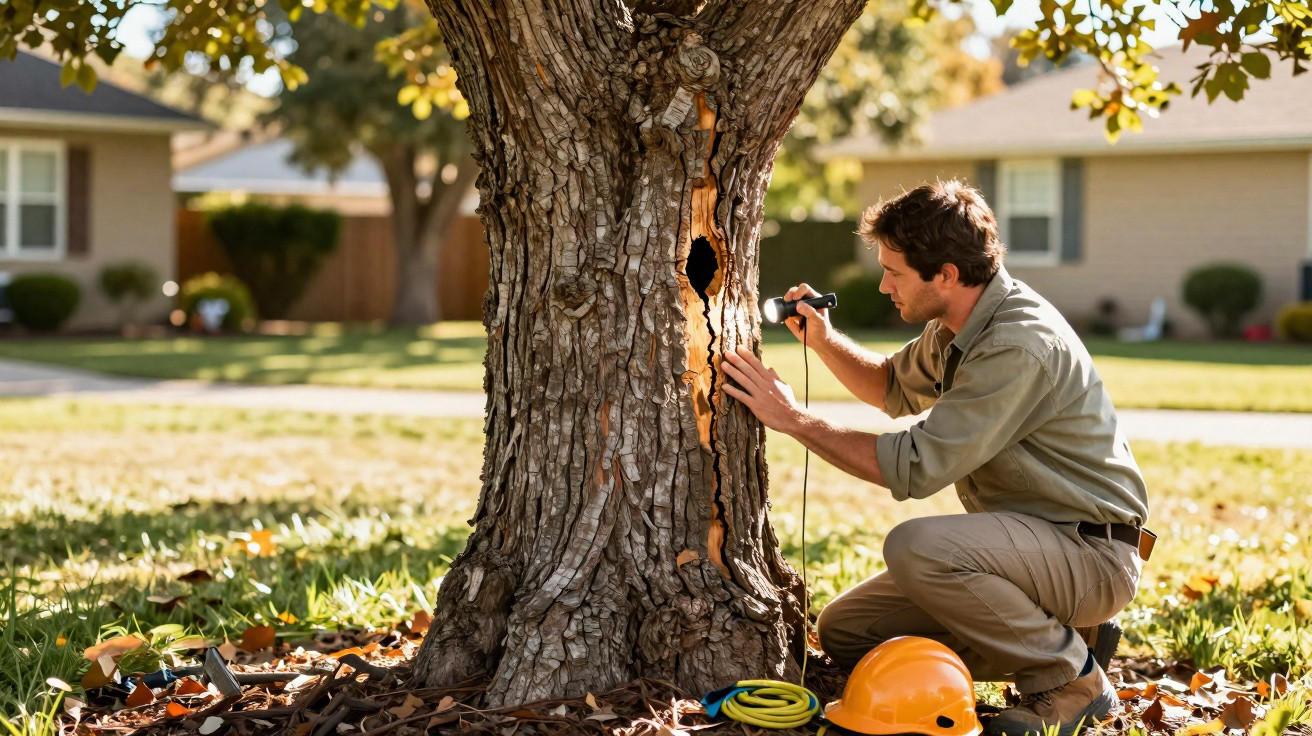
The tree trunk can show changes before more obvious problems become visible in the canopy. Cracks, sunken patches, loose bark, marks, cavities and fungal growth are among the signs worth noting during a visual inspection. However, these clues alone do not identify a particular cause and must be considered alongside the tree’s overall condition.
Why does a crack in the trunk need attention?
Not every split means that a tree is unhealthy. Cracks can develop for several reasons, including growth expansion, mechanical damage, weather-related stress, and movement caused by wind or weight. However, splits that extend into the wood may indicate a structural issue and require closer assessment.
The concern is greater where two or more cracks occur close together, where there is a deep opening, or where a split passes through the bark and into the wood. In these situations, the size, position and progression of the change should be monitored, particularly if the defect affects the main trunk.
What can a sunken or darkened area indicate?
A section of bark that appears darker, sunken, swollen or cracked may be a canker, a term for areas of dead or damaged tissue on branches and trunks. Such signs may enlarge over time and can affect the tree’s woody tissue.
Marks, exudates or small dot-like structures may also develop in the affected area. Since different diseases and injuries can produce similar signs, the cause cannot be established from the external appearance alone. Observation is chiefly useful for recognising changes that warrant further investigation.
Which other signs should be checked on the bark?
As well as cracks, look out for loose bark, cavities, bark-free areas, fungal growth, unusual marks, swellings and sap exudation. These signs may be linked to wounds, insects, disease or processes that cause wood decay.
Mushrooms or other fungal structures on the trunk are particularly significant because they may point to internal deterioration. Even so, the absence of visible signs does not confirm that the inside is sound: some structural problems can remain concealed.
When does a change in the tree trunk require professional assessment?
A deep crack, a large cavity, a leaning tree, dead branches or fungi growing on the trunk can raise concerns about the tree’s stability. These signs require particular attention when they occur on the main trunk or near the union of large branches.
Where the tree is close to a house, vehicle, pavement or an area used by people, structural changes should be assessed by a qualified professional. Noticing signs on the tree trunk does not mean diagnosing a disease at home; it means recognising changes that may justify investigation before other symptoms become apparent.






Comments
No comments yet. Be the first to comment!
Leave a Comment