
I used to carry a large briefcase stuffed with books and exercise books filled with written quavers, semibreves and clefs. At three o’clock in the afternoon, beneath the fierce sun of Jequié, I would happily make my way to piano lessons. I was seven years old and, although it was a provincial city in Bahia, navigating the dangers of the streets alone was no simple task. I followed that route for years, and it was there that my love for and commitment to music took shape. Nice to meet you: I’m Eveline, though you can call me Eva.
Growing up on the outskirts shapes us differently. Whether through violence and neglect, or through the creativity demanded by scarcity, those experiences leave their mark. It is often precisely because access is limited that inventiveness and a sense of community can emerge.
I learned to achieve a great deal with very little, to be adaptable and to improvise in order to make things happen in life. Journalism happens to value those qualities.
At 18, I left Jequié for another inland city, Vitória da Conquista, and enrolled in Journalism at the State University of Southwest Bahia in 2003. I was the second generation in my family to reach university. My ambition was to write for the Culture section.
Journalism, television and the world of reporting
Two years later, while I was still studying, I passed the selection process for the Television Journalism module. For the first time, I held a microphone in front of live cameras, broadcasting three nights of the Bahia Music Festival. That was how television chose me. From then on, I worked at three stations affiliated with TV Brasil, Globo and Record.
I became a hard-news reporter because that was where I found work. I often say that reporting explained the world to me. It broadened my humanity and knowledge, while reaffirming the causes I stand for. Whenever I was able to take on Culture and Music stories, I relished them, but it was never possible to work exclusively in those sections.
For years, I did the job I loved, yet insecurity, low pay, increasingly serious risks and relentless harassment gradually wore me down. I tried to negotiate, make the case and suggest changes, but newsroom teams quickly began to see me as more of a problem than a solution.
After enduring so much strain, suffering and illness, I resigned. It was the hardest moment of my life up to that point. I had invested enormous effort, sacrifice, time, money and study. I looked around and did not have long to think: I needed work, the beans were on the stove and bills were arriving. The only accessible option was to try to turn a hobby into a profession: Interior Design. Between odd jobs and freelance work, I managed to fund a short technical course. I found an internship, qualified and entered the market despite having a limited education in the field.
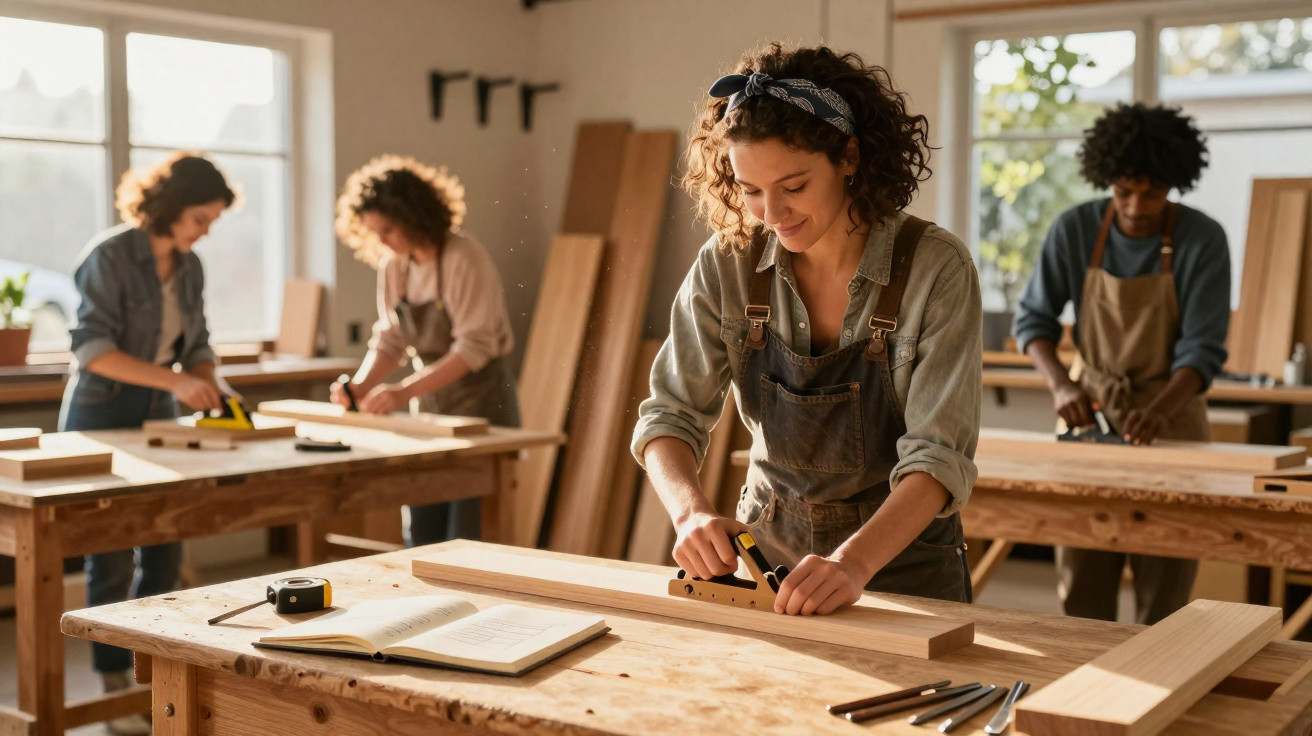
Creating a carpentry workshop for women
I began my business with R$ 500 in my account. Even though I was exhausted, I built a client base and developed an aesthetic signature rooted in bold colours, mixed textures and Brazilian identity. I opened my small creative studio. At the same time, I launched my blog and returned to Digital Communication, having come from the Fotolog era.
The blog would place my work on the national circuit, even as I wrote from the interior. I appeared in newspapers, magazines and websites across Brazil. That gave me the foundation to leave my own territory: I had already prepared the ground on which I would walk.
Interior design served as a bridge. My desire to understand how furniture was made led me into carpentry workshops. I taught myself and was constantly asking professionals questions. After years of this, I requested information and, in return, received a request for sexual favours.
That moment of fury gave me an idea: I wanted to learn carpentry in a safe way. If that did not exist in Bahia, I would find a way to create it. How? I did not know. I found just one course in the entire state and, although it was not what I was looking for, I went to Salvador for a few months. I returned certain that I wanted to develop further. And there is nothing better than getting stuck in. With the tools I had, I created a programme and, on 16 December 2017, announced the first Introduction to Carpentry Workshop for Women.
Autonomy through carpentry
At first, I was unsure how it would unfold. Today, nearly nine years, more than 1000 women, 97 in-person groups and an online course available in 53 countries later, I know. I know very well.
“Carpentry became a practical and urgent way of living my feminism.”
Before furniture is created, the Workshop is about autonomy, encouragement and income generation. It means being in a space where learning happens with warmth and enjoyment. It is a difficult project: expensive and demanding on the body. Bringing women into a carpentry workshop every month is not easy. Yet every woman who is transformed turns my temporary exhaustion into renewed faith.
View this post on Instagram
I have lived in São Paulo for eight years. I moved here to study carpentry and work as a freelance journalist. The transition was extremely difficult. I came to forge my own path here and realised that I am entirely self-employed. I built my own realities.
I returned to television in São Paulo and had my own programme on the national Discovery/Warner Bros. network. I chose not to continue with the project, but I am deeply proud of the little Evinha from Jequié appearing on television screens throughout Brazil and Latin America. The chances of that happening in a country like ours are tiny.
The Workshop’s module 2 is now being produced. And, 23 years later, I was able to study Music Journalism at PUC/SP, while setting my sights on a postgraduate course in Culture at UERJ. After all, “dreams do not grow old”, do they?
Who is Eva?
I am Eva Mota, from Bahia, a journalist graduated from the State University of Southwest Bahia (UESB) and a designer trained at the Bahian School of Art and Decoration (EBADE). I research and write about Culture and Music, and have taught introductory carpentry classes for women since 2017. I live in São Paulo.



Comments
No comments yet. Be the first to comment!
Leave a Comment