
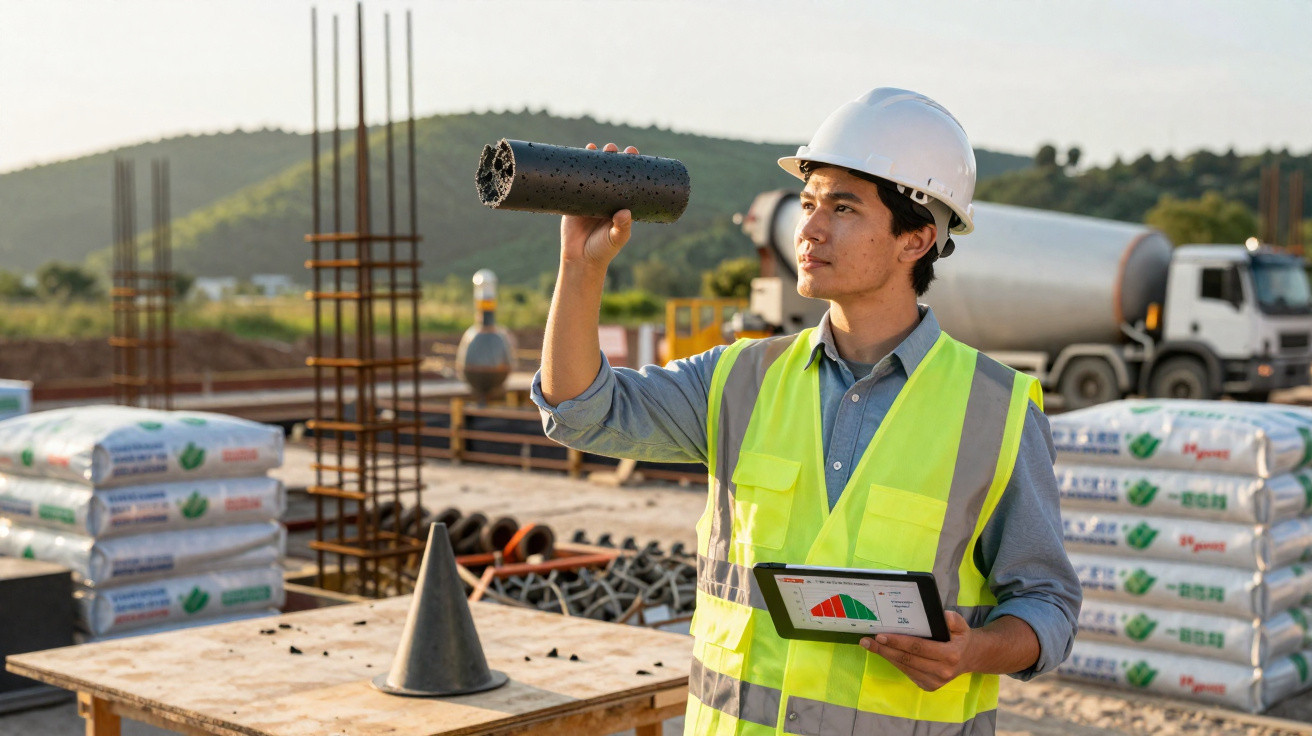
The construction industry faces ongoing environmental challenges, and the search for sustainable materials has produced a groundbreaking innovation. Graphene concrete could reshape building sites by delivering lighter, longer-lasting structures that rely less heavily on traditional cement, thereby reducing environmental impact.
How does graphene work in a concrete mix?
This carbon nanomaterial is only one atom thick and acts as an exceptionally strong, invisible mesh. Added in minute quantities, it substantially improves the bonding within the cement paste during the chemical hydration process, producing a highly solid material.
A denser internal structure makes it harder for harmful external agents, including water and air, to penetrate. As a result, the technology limits the development of unwanted cracks and provides excellent long-term protection against serious corrosion issues.
- High density: Makes it more difficult for water and air to pass through structures.
- Fewer cracks: Significantly reduces the appearance of fissures in the material.
- ⏳ Greater durability: Extends the useful service life of concrete components.
What practical results have real-world tests delivered?
The best-known real-life example took place in England when the floor of a commercial gym in Amesbury was laid. Researchers from the University of Manchester tested the Concretene additive across a large area of approximately 697 m².
This pioneering project achieved an impressive 30% saving in the volume of materials used in the slab. In addition, the builders were able to eliminate conventional steel reinforcement entirely while retaining the excellent performance originally specified by the engineers.
Why does reducing cement benefit the environment?
Global cement production has severe consequences, accounting for around 8% of all worldwide carbon dioxide emissions. Cutting demand for this industrial material is an essential step towards reducing hidden pollution and lessening the ecological footprint of construction.
Embodied Carbon
Retained Ecological Impact
Embodied carbon covers all pollution produced from raw-material extraction through to transport and use on the building site.
With the Concretene additive, this harmful measure is estimated to fall by 20% to 30% in compatible applications.
Reducing the total volume of concrete also creates substantial logistical savings for construction companies. Fewer heavy lorry journeys lower operating costs and cut vehicle emissions, which are among the principal ecological advantages of this sustainable compound.
- A significant reduction in carbon dioxide emissions released into the atmosphere.
- Less need for mineral extraction of conventional raw materials.
- More efficient transport of heavy loads to the construction site.
Why does steel remain essential in graphene concrete?
Conventional concrete offers exceptional resistance to compressive forces, such as those affecting walls and columns. However, it is highly brittle when exposed to tensile and bending stresses, which historically established steel as a reinforcement material.
Although graphene can reduce the amount of metal required in ground-bearing floors and slabs, some elevated structures still depend on this traditional support. Structural engineers stress that safety codes must be followed rigorously, identifying the following factors as crucial to the stability of buildings.
- Suspended beams require metal to withstand high tensile loads.
- Building columns need ductility to protect against sudden mechanical collapse.
- Fire-safety technical standards impose stringent checks that require conventional reinforcement.
What challenges restrict large-scale adoption?
For this innovation to gain ground in the commercial property market, stable supply chains and formal certifications must be secured. Incorrect dispersion of microscopic carbon particles can cause residue to clump together, compromising the consistency required from the compound on site.
Rigorous laboratory tests for compression and shrinkage remain the principal safeguards of modern engineering safety. Only practical validation and affordable pricing will enable this innovative technology to expand, ensuring more efficient construction and full protection of lives.




Comments
No comments yet. Be the first to comment!
Leave a Comment