
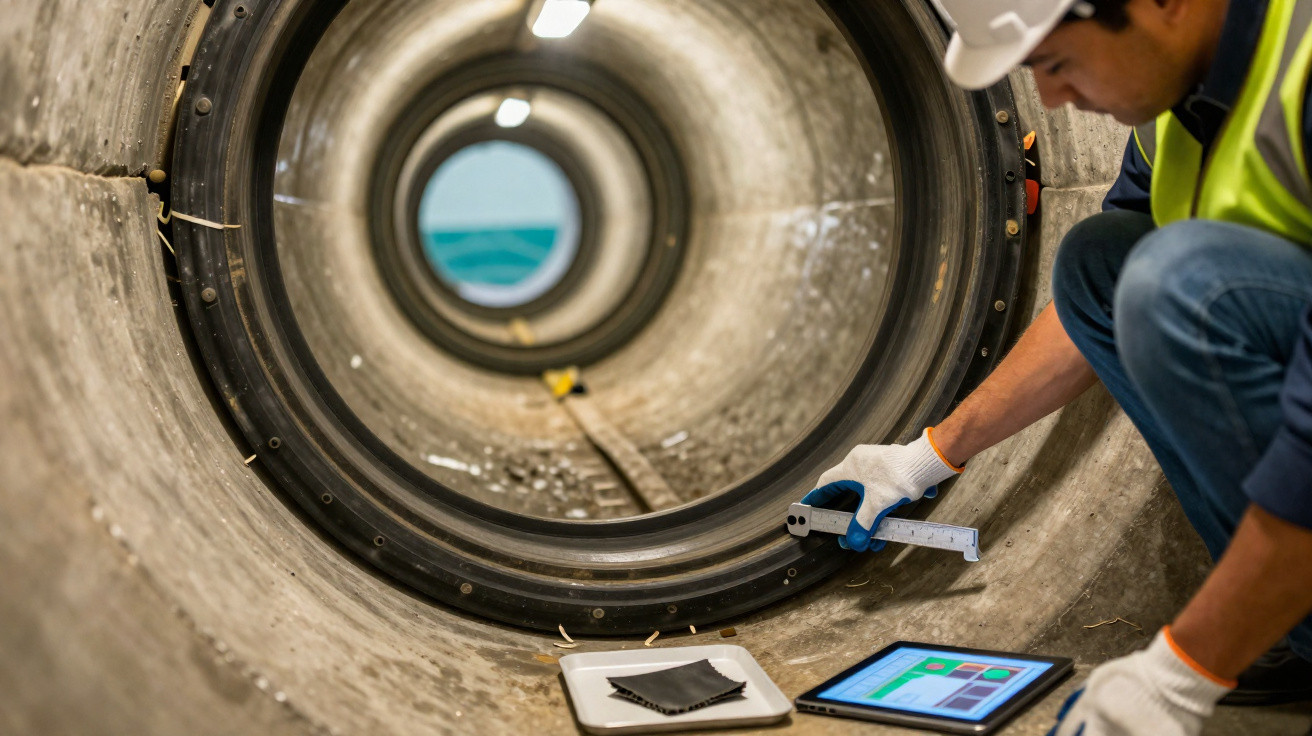
Engineers once expected rubber used to keep immersed tunnels watertight to last for at least 100 years. Yet, under the pressure and seawater conditions experienced in service rather than in laboratories, it can rapidly surrender 67.66 percent of its sealing force.
The result reframes tunnel longevity: the central concern is concealed loss of force, rather than merely deterioration that can be seen.
Rubber seals in tunnels
Where individual tunnel sections are pushed together, a compressed rubber seal provides the load that prevents seawater entering.
Engineers from Shijiazhuang Tiedao University (STDU) used specimens from China’s Yuliangzhou tunnel to examine the combined ageing effects of pressure and saltwater on the seal.
Their analysis found that the GINA gasket, the primary rubber seal, grew harder and denser even as its sealing force continued to decline.
This distinction is important: an inspection may suggest that a seal has become tougher while it is actually losing the property that keeps water outside.
How tunnel joints remain watertight
Immersed tunnels consist of prefabricated sections that are floated into position, sunk into a trench and connected beneath the water.
After a joint is closed, the gasket remains compressed between steel surfaces. This compression generates contact stress, the pressure that prevents leakage.
Previous research on the same tunnel identified the lower edge as the vulnerable area because pressure is lower there. A reduction in this pressure may allow water to create a route through the joint long before the rubber appears seriously damaged.
What the tests revealed
When subjected to both compression and seawater, the seal followed a three-stage ageing pattern rather than declining smoothly.
Its force dropped rapidly initially, then entered an extended period of moderate reduction before moving into a slower final decline.
After 90 days of accelerated ageing, the chemical links within the rubber had already diminished and the material had become less flexible.
This initial loss may be the key part of the finding, as it determines the rate of deterioration over the decades that follow.
Why rubber becomes harder
Seawater exposure and continual compression altered the gasket from its exterior inwards, making surfaces rougher while disrupting the network that enables rubber to recover its shape.
Saltwater and oxygen attacked the outer surface, whereas damage below it broke long molecular chains into shorter fragments.
As these chains became shorter, elasticity at room temperature declined and the point at which the rubber stiffened increased by around 3.2 °C.
By the end of testing, hardness had increased by 14.18 percent and density by 5.88 percent, further showing how a tougher surface can conceal damage beneath it.
Where sealing force is lost
The clearest warning was not simply cracking, but the continuing reduction in the pressure that the gasket could maintain against the steel.
The new projection indicates that this pressure will fall to 1.51 megapascals after 100 years.
In contrast, an earlier seawater-only study by the same research group projected 2.32 megapascals after a century.
Including sustained compression alongside seawater demonstrated that the actual operating environment depletes sealing capacity more severely.
Tunnel leaks caused by rubber seals
Leaks commonly begin at the gasket’s lower edge, where tunnel movement can reduce pressure sufficiently for water to penetrate.
The opening between tunnel sections was the most significant factor, with earlier tests placing the waterproofing failure limit at approximately 4.70 cm.
Rotation also increased the danger because it altered the seal’s position within the joint and reduced pressure along its lower edge.
These factors show why chemical ageing alone cannot assess the risk: geometry determines where a weakness develops into a leak.
Why assess 100 years?
Despite the predicted reduction, the gasket remained above the waterproofing index, meaning the minimum pressure required to prevent seepage.
That limit is 0.61 megapascals, leaving a substantial safety margin in the forecast.
For tunnel operators, the result makes the 100-year point less of a simple pass-or-fail issue and more a question of maintenance planning.
The greater challenge is identifying when a seal that still works has begun to lose its cushioning ability more quickly than expected.
Why forecasts are important
Since engineers cannot test a gasket for 100 years, they accelerate deterioration and use shorter trials to estimate long-term performance.
In this case, 90 days of accelerated ageing produced sufficient change for the team to chart the gasket’s early chemical degradation.
Such a projection can never fully replicate waves, sediment shifts, pollution and construction tolerances encountered during operation.
Nevertheless, the work provides something unusual: an estimate spanning the gasket’s full service life that is directly linked to the joint keeping an immersed tunnel dry.
What engineers monitor
Future inspections may need to give less weight to surface hardness and greater attention to whether a joint continues to retain adequate pressure.
Maintenance crews could prioritise the lower edge, where geometry and ageing concentrate stress in the same limited area.
Meanwhile, designers may apply findings of this kind to alter rubber formulations, compression requirements and inspection schedules before faults emerge.
This is the practical value of research conducted close to real tunnel conditions instead of examining rubber in isolation.
What endures underwater
Tunnel gaskets do not deteriorate along a single straight path: they become harder, chemically degrade and lose sealing force at differing speeds.
This more detailed understanding gives engineers a stronger opportunity to protect ageing joints before early, hidden losses become visible leaks.



Comments
No comments yet. Be the first to comment!
Leave a Comment