
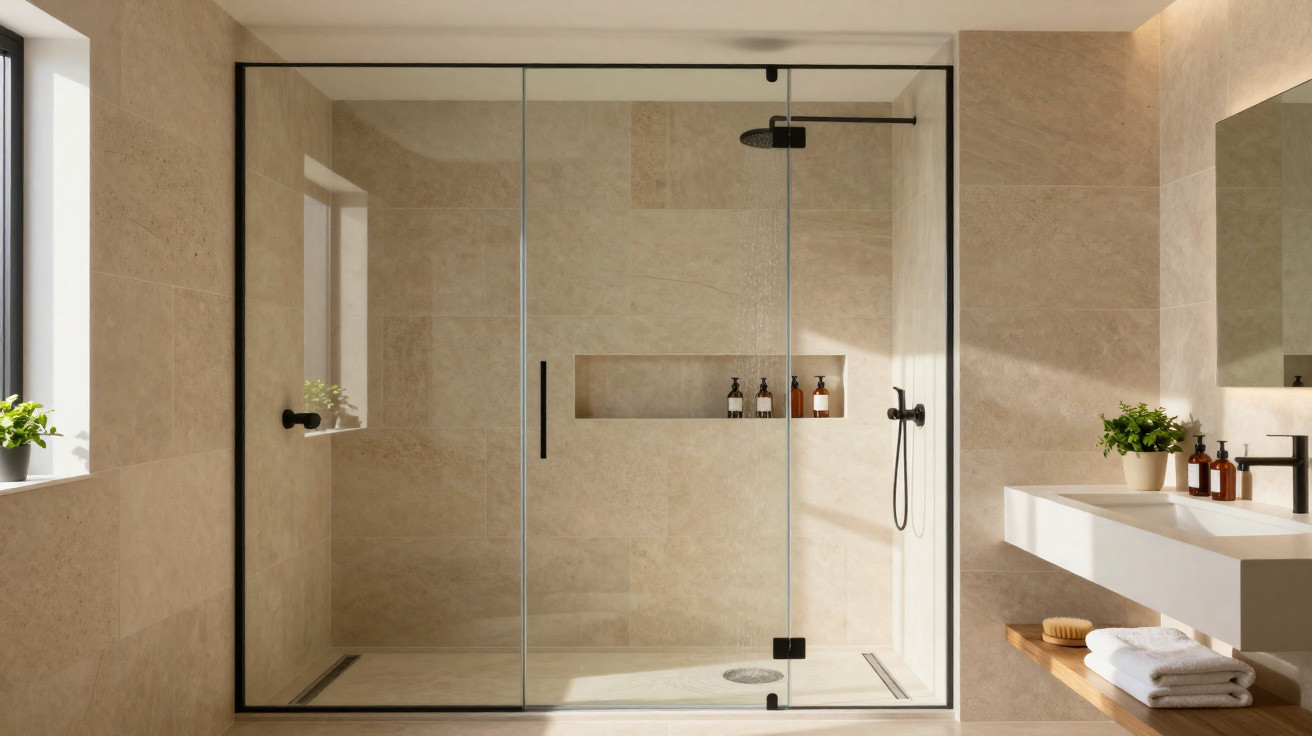
The traditional shower enclosure, with its doors, tracks and numerous corners, is still found in Brazilian bathrooms, but it has lost ground to more open solutions. Fixed panels and simple partitions offer a feeling of space and cleanliness, with fewer places for soap to build up.
Why has the traditional shower enclosure lost space in the bathroom?
The issue is not solely the material, but the design, which is full of gaps, rollers and tracks. These components collect lather, moisture and hard-to-reach residue, making upkeep more demanding in bathrooms with daily use.
Glass remains popular for its light appearance, yet the trend is towards fewer moving structures. Rather than enclosing the entire shower area, many designs use a fixed partition to separate the wet zone with less hardware, greater practicality and visual continuity.
The distinctions are clearest in the following areas:
- Standard shower enclosure: generally includes doors, tracks, rollers and more damp corners.
- Fixed panel: uses less hardware and makes cleaning after showering easier.
- Open look: creates a greater sense of space in small bathrooms.
- Correct dimensions: prevent splashing beyond the shower area.
- Installation: must take the floor gradient, sealing and fixings into account.
What is the practical difference between a shower enclosure and a fixed panel?
An enclosed shower enclosure aims to contain water on every side, using sliding or hinged doors. A fixed panel, by contrast, acts as a partial barrier, leaving an open entrance and reducing areas of friction and build-up.
This difference becomes evident during cleaning. Without lower tracks or the meeting point of sliding doors, it is easier to reach both the glass and floor with a cloth, reducing the build-up of soap, body oils, mould and trapped moisture.
What should you consider before installing an open partition?
Before making the change, assess the bathroom size, shower position, water pressure and floor gradient. A panel that is too short can allow splashes to spread, whereas a well-designed piece improves comfort and functionality.
Fixed shower panel
Fewer components, fewer difficult corners
The idea is to retain only a well-positioned glass barrier, with secure fixings and straightforward access for cleaning.
The outcome depends on accurate measurements, effective sealing and sufficient distance between the shower, drain and dry area.
It is also important to remember that toughened glass must not be cut once it has been made. Holes, edge finishing and dimensions must be established before toughening, since subsequent damage may compromise the panel and its safety.
Before choosing, check the following points:
- The distance between the shower, drain and panel opening.
- The floor slope that directs water back towards the drain.
- The recommended thickness and fixing method for the chosen glass.
- Enough clear space to enter and leave comfortably.
How do cost, cleaning and maintenance work day to day?
The upfront cost varies according to dimensions, thickness, hardware, installation and finish. In many cases, a fixed panel uses fewer components than a complete shower enclosure, but it requires precise planning to prevent leaks, splashing and later rework.
Maintenance is usually simpler because there are fewer moving parts to adjust, replace or unblock. The main benefit is felt every day, as cleaning is focused on the glass, the fixing edges and the wet floor.
To keep the bathroom cleaner:
- Use a squeegee on the glass after showering.
- Prevent products from collecting along the panel edges.
- Dry the fixing corners with a soft cloth.
- Check for marks, looseness or sealing failures.
Why does this option make the bathroom feel more contemporary?
The desire for a more open bathroom reflects a preference for simple, easy-to-maintain surfaces. As the concept of a more practical shower alternative shows, fewer barriers can bring lightness and functionality.
Toughened glass remains relevant because it is stronger than ordinary glass and breaks into small pieces if damaged. The change lies in the shower enclosure design, which gives priority to space and maintenance.


Comments
No comments yet. Be the first to comment!
Leave a Comment