
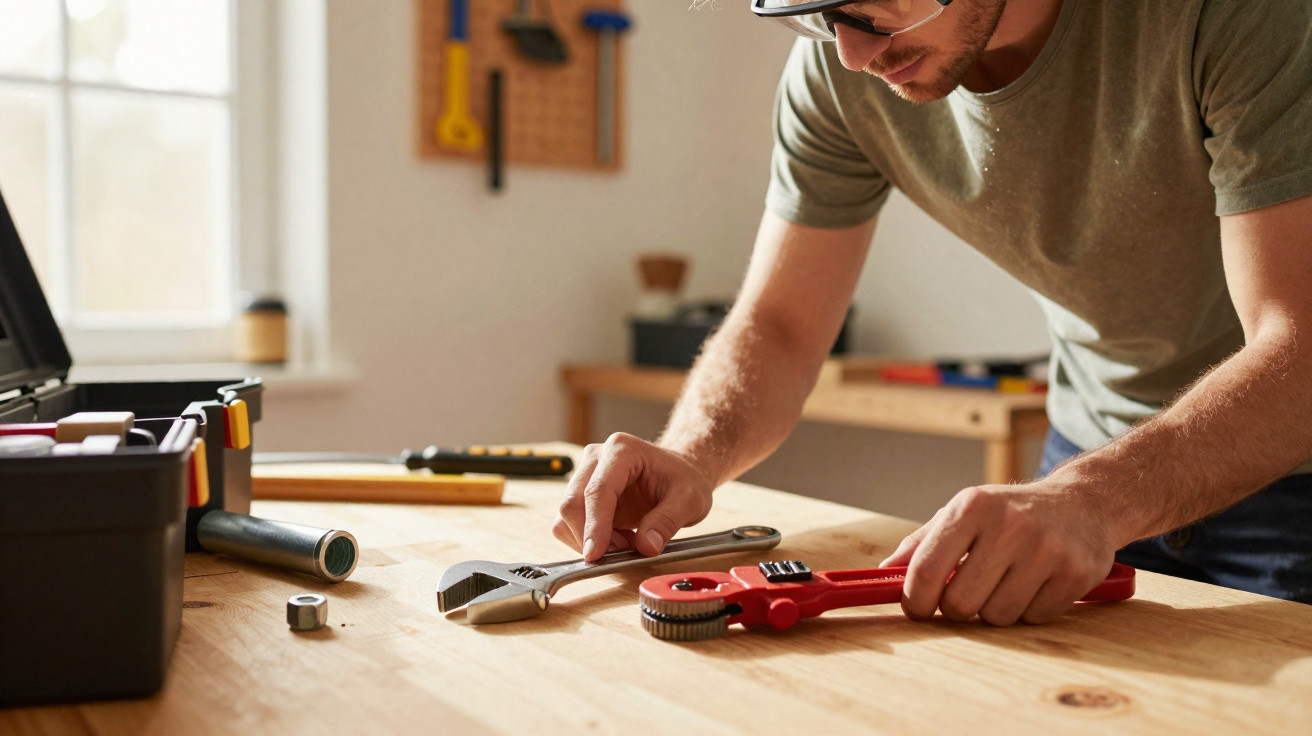
An adjustable wrench and a French wrench may look alike at first glance, yet they are not always intended for the same job. Knowing the difference helps prevent damage to nuts, pipes and fittings, while making minor household repairs more safe and precise.
Why are these two wrenches so often confused?
Both tools feature a handle, a fixed jaw and a movable jaw, which is why many people regard them as the same item. The confusion is greater because each tool has an adjustable opening, although they perform better with different materials and uses.
When considering the difference between an English wrench and a French wrench, the key distinction lies in the type of work involved. One is more commonly linked to pipes and fittings, while the other is better suited to nuts, bolts and household fastening adjustments.
The main differences can be seen in the following areas:
- Shape: both have a fixed jaw, a movable jaw and a supporting handle.
- Pipes: the English wrench is commonly used for plumbing repairs.
- Nuts: the French wrench is suitable for tightening and loosening fasteners.
- Opening: the adjustment must fit securely before turning.
- Toolbox: both can be useful for straightforward repairs.
What is an English wrench used for at home?
An English wrench is generally associated with work on pipework, fittings and parts that need a firm grip while being turned. It can assist with basic repairs, provided that the jaws are adjusted properly to avoid slipping and marks.
The main precaution is to avoid applying unnecessary force when the tool does not fit correctly. If the jaws are loose, the wrench may round off the part or slip from your hand, making the repair less practical and safe.
What is a French wrench used for in everyday tasks?
A French wrench is usually used to tighten and loosen nuts and bolts, particularly when a fixed spanner in the exact size is unavailable. Its adjustable opening makes it easy to adapt the tool to different sizes.
Adjust before applying force
A correct fit prevents damage
Before turning, move the adjustable jaw close against the nut or bolt so that no visible gap remains.
If the tool slips, stop, readjust the opening and only then continue with controlled, firm movement.
For this reason, it is useful for furniture, bicycles, brackets, minor repairs and household assembly. Although versatile, it does not replace every type of spanner, as delicate parts require a more accurate and stable fit.
To use it more effectively:
- Set the opening before applying force.
- Keep the jaws aligned with the part.
- Avoid sudden pulls while turning.
- Readjust it if you notice any looseness in the fit.
Which mistakes cause the most damage to nuts, pipes and tools?
The most frequent mistake is using any wrench simply because it appears to fit. When the tool is loose, the turning force is not distributed evenly, which can distort edges, scratch pipes and damage metal threads.
Another issue is persisting with seized parts without checking for rust, dirt or the correct position. During plumbing repairs, it is also important to turn off the water supply before working on fittings, preventing leaks, haste and unnecessary mess.
Before starting any simple repair, check:
- Whether the tool fits the part without any looseness.
- Whether the nut or fitting is clean and visible.
- Whether there is enough room to turn the handle.
- Whether the water supply needs to be turned off first.
Which one is worth keeping in a toolbox?
For a basic household toolbox, it is worth having tools that deal with different situations without unsafe improvisation. The French wrench is useful for nuts and bolts, while the English wrench may be better for fittings and components related to pipes and repairs.
The best choice depends on the task rather than the popular name. When the jaws fit properly, the handle provides support and the movement is controlled, either tool becomes more useful, durable and safe for household maintenance.



Comments
No comments yet. Be the first to comment!
Leave a Comment