
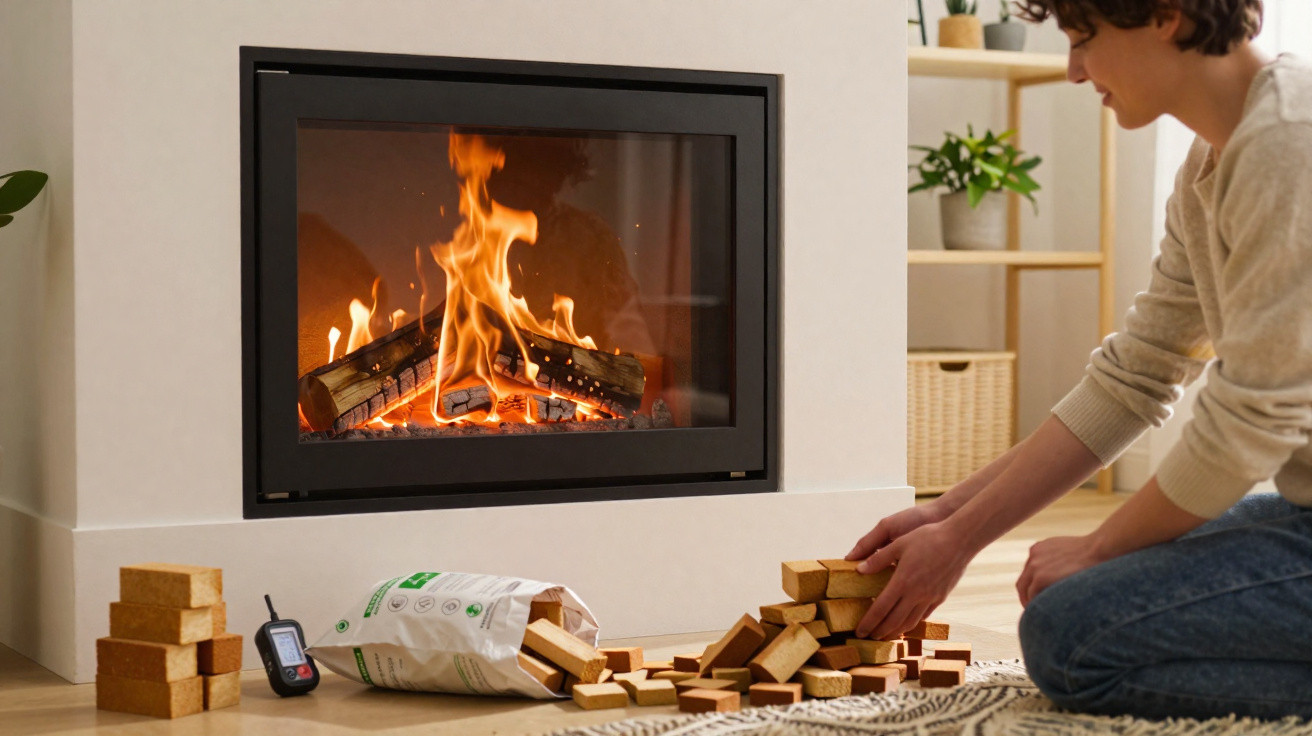
Many households routinely rely on ordinary firewood. Yet a closer look reveals a fuel that delivers substantially more heat from every kilogram, burns more cleanly and takes up less cellar space. It is made up of compressed wood briquettes: pressed residual wood rather than bulky logs.
What compressed wood briquettes are made from
Compressed wood briquettes are produced from sawdust and wood offcuts generated by sawmills or furniture manufacturing. The leftover material is dried, then compressed under extremely high pressure.
Loose sawdust becomes a solid, dense fuel – without glue, without chemicals, using only the wood’s natural resin as a “binding agent”.
The result is compact cylinders or blocks that are easy to stack, produce very little debris and create a remarkably even flame when burned. They are generally sold as “wood briquettes”, “pressed wood briquettes” or “wood heating briquettes”.
Up to 300 per cent more heat per kilogram
The key benefit: calorific value
The major advantage of briquettes is their exceptionally low moisture content. While air-dried logs often still contain 20 to 30 per cent moisture, good wood briquettes are usually below 10 per cent. Less water means more usable energy from each kilogram.
Typical comparative figures are as follows:
| Feature | Wood briquettes | Ordinary logs |
|---|---|---|
| Calorific value | approx. 4.8–5.2 kWh/kg | approx. 2–3 kWh/kg |
| Moisture content | < 10 % | 20–30 % |
| Ash quantity | low | significantly higher |
| Storage requirement | up to 4× less volume | bulky, requires plenty of space |
In practical terms, this often means that only a fraction of the fuel is needed to achieve the same room temperature. Households that previously ordered entire cubic metres of wood can manage with considerably fewer pallets of briquettes.
Clean, consistent combustion
As they are compressed into such a uniform form, briquettes burn more predictably than an uneven mixture of thick and thin logs. The flame remains relatively steady, with fewer sparks and less smoke when lighting the fire.
Less smoke means: the chimney becomes tarred more slowly, the glass on the wood-burning stove stays clear for longer, and fine-particle emissions fall.
This can noticeably reduce the burden on air quality, particularly in densely built-up residential areas, and help to prevent disputes with neighbours when the wind is blowing in an unfavourable direction.
A space-saving solution for the cellar or garage
Anyone living in a semi-detached house or rented flat with a fireplace knows the issue: where should all the logs go? Wood briquettes address this storage problem very neatly.
- Compact shape: Cylinders or blocks can be stacked like building bricks.
- Less volume: The same amount of energy requires roughly a quarter of the storage space needed for logs.
- Cleaner storage: There is no bark shedding, hardly any pests and far less wood dust.
They are usually supplied in plastic-wrapped packs or cartons that can be carried much like crates of drinks. For anyone who does not want huge stacks of wood in the garden, briquettes are often the more convenient choice.
How wood briquettes are made – and why they make environmental sense
From an environmental perspective, wood briquettes make use of raw material that is already produced: sawdust, planer shavings and smaller wood remnants. Otherwise, these materials would have to be disposed of or burned with low efficiency.
The usual process is:
- Wood residues from sawmills and industry are collected.
- The material is dried until its moisture content is very low.
- Large presses compact the shavings under high pressure into firm briquettes.
- The finished products are cooled, packaged and delivered on pallets.
Because no added binding agents are required, the fuel remains entirely wood-based. As with ordinary firewood, the CO₂ balance depends on forestry practices; however, using residual materials means forests are at least not felled specifically for this purpose.
How to use wood briquettes correctly in a fireplace or stove
Lighting: start small, then add dense fuel
Wood briquettes need heat to get going cleanly. Anyone treating them like light kindling is likely to be disappointed, because they take longer to catch fire. The following approach has proved effective:
- Build up a strong initial fire with small pieces of very dry firewood and a firelighter.
- Only place one or two briquettes on the fire once a stable bed of embers has formed.
- Set the air supply slightly higher at first, until the briquettes are burning strongly.
Many users report that, after a short settling-in period, they need to refuel far less often: one briquette will often burn considerably longer than an ordinary log.
Set the airflow correctly
Because this fuel is so dense, the fire is more sensitive to both insufficient and excessive airflow. Too little air produces a dark, sooty flame, while too much air causes the fuel to burn through unnecessarily quickly.
Useful rules of thumb are:
- Open the air supply fully while lighting the fire.
- Reduce the airflow slightly once the briquettes are glowing well.
- Make adjustments in small increments and observe the fire for several minutes.
What are the drawbacks – and who benefits from switching?
Despite their many advantages, wood briquettes are not suitable for every household or appliance. Three points should be checked beforehand:
- Price: The cost per kilogram is usually higher than that of loose firewood bought directly from a woodland owner. However, when energy per pound is considered, the cost is often similar or may even be lower.
- Availability: In rural areas with extensive woodland, logs are often easier to source, whereas briquettes are more commonly available from DIY retailers or fuel merchants.
- Appliance suitability: Some older fireplaces or open fires are designed for logs. Check with a chimney sweep or consult the stove’s instruction manual first.
For owners of modern wood-burning stoves who value convenience, less mess and predictable heat, wood briquettes are often a very appealing option. Anyone already having fuel delivered by the pallet can easily try both types and compare them.
Practical storage and buying advice
To ensure the theoretical advantages are realised in everyday use, proper storage matters. The most important requirement is keeping them dry. Just a few weeks in a damp corner can cause briquettes to swell and crumble.
- Choose a storage area that is dry, well ventilated and protected from splashing water.
- Do not place pallets directly on the floor; stand them on battens or Euro pallets instead.
- Open the packaging film only at the top and keep the sides closed wherever possible.
When buying, it is worth checking certification and the details printed on the packaging. Reputable manufacturers state the moisture content, calorific value and wood species used. Blends of softwood and hardwood often offer a good balance between a quick flame and long-lasting embers.
What many people do not realise: effects on health and neighbours
Burning unsuitable or damp wood is among the largest sources of fine particulate matter during winter. Briquettes with a low moisture content reduce this effect considerably, especially in modern stoves with well-managed airflow.
Less smoke from the chimney does not only mean greater efficiency – it also reduces the strain on the airways of children, older people and people with pre-existing health conditions.
Some local authorities are increasingly issuing guidance and requirements for wood-burning stoves. Those able to demonstrate that they use high-quality, dry fuel are in a considerably stronger position during inspections.
Practical conclusion: when switching is particularly worthwhile
Wood briquettes are especially worth considering for households that:
- have limited storage space;
- use their wood-burning stove daily or frequently;
- want to heat as cleanly as possible and with low emissions;
- are prepared to pay a little more per kilogram when the energy yield is right.
Anyone unsure can order one or two packs to try first, rather than committing to a full pallet. This quickly shows whether the fuel suits their own stove better than traditional logs – and whether the promise of “up to 300 per cent more efficient” can genuinely be felt in their own living room.

Comments
No comments yet. Be the first to comment!
Leave a Comment