
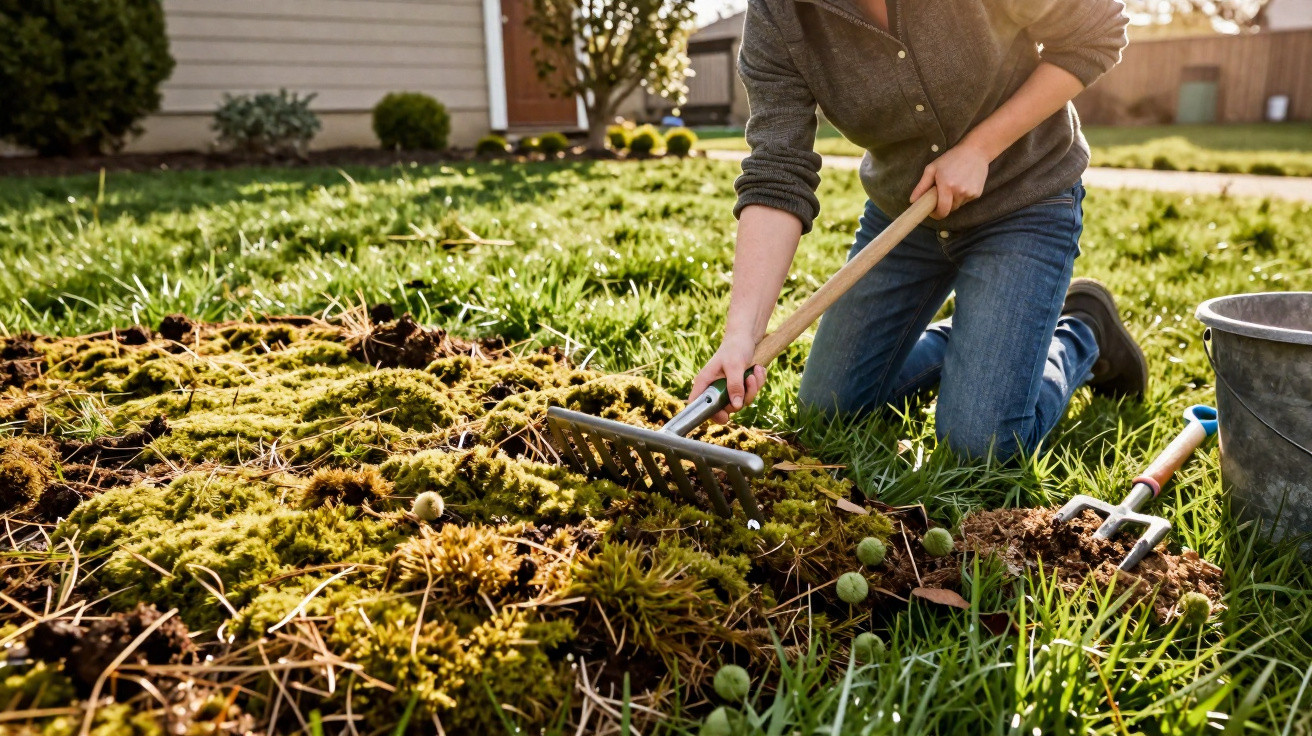
After winter, lawns often look tired, patchy and covered in moss – but three focused jobs in March can turn things around.
Many gardeners are dismayed by their first look at the lawn in spring: yellow blades, puddles and cushions of moss instead of lush green turf. Rather than immediately buying costly products, an afternoon with a garden fork, sand and rake will usually do the job. Starting properly in March creates the foundations for a dense, hard-wearing lawn with virtually no moss.
Why moss in the lawn is a warning sign
Moss in a lawn is seldom the actual issue; it is a symptom. It signals that the soil has become depleted. Standing water, shade and compaction caused by rain and foot traffic are common reasons.
Grass needs soil that is well aerated and free-draining. As the ground gradually becomes more compacted, water and air can barely penetrate to deeper levels. Grass roots effectively suffocate, whereas moss thrives in this damp, poorly ventilated layer.
Moss in the lawn is not an enemy, but the soil’s cry for help: “I need air and structure!”
Simply reaching for chemical moss killers therefore treats the consequence rather than the cause. The result does not last long, and a brown patchwork lawn is often left behind. It makes far more sense to work the soil thoroughly every year in late winter or spring.
Step 1: Aerate the lawn properly with a garden fork
The key job in March is to get oxygen into the soil. Although that may sound technical, it is actually straightforward. A sturdy garden fork or digging fork is all that is needed.
How gardeners should aerate the lawn
- Wait until the soil has dried out slightly – it must not be frozen or soaking wet.
- Push the fork tines 8 to 10 centimetres into the ground.
- Gently press the handle backwards to create fine cracks beneath the surface.
- Move roughly 15 centimetres along and repeat the process.
This produces a grid of numerous small air channels. Take particular care over areas where puddles formed during winter or where the ground sounds “hard” when walked on. These are typical compacted areas.
For a very large lawn, a mechanical aerator or hand-operated lawn aerator can be hired from a DIY shop. For small to medium-sized gardens, using a fork by hand is entirely sufficient.
Step 2: Light topdressing makes the lawn denser
Once the soil has been loosened, the second stage follows: applying a thin layer of sand and organic matter, known as topdressing. This coating permanently improves the soil structure and helps grass roots branch more effectively.
A simple mix for healthy lawn topdressing
Anyone with time can prepare a small batch of soil improver themselves:
- 1 part fine topsoil (sieved)
- 1 part coarse sand or river sand
- 1 part mature, sieved compost or leaf mould
Spread this mixture lightly across the previously aerated surface. A stiff outdoor broom or a rake with a broad edge works well for distributing it. The aim is to fill the holes as far as possible while leaving only a very thin coating on the blades.
Topdressing works like a mini treatment for the soil: it improves drainage while also supplying nutrients for strong new growth.
If compost is not available, coarse sand alone can initially be applied. This will at least help to counter standing water in problem areas. The organic component can be added later with compost tea, lawn feed or a thin layer of mature compost.
Step 3: Rake out moss thoroughly and mow higher
Only after the soil has received air and a fresh surface layer is it time to tackle the moss. No machine is necessary: in most cases, a sturdy leaf rake with metal tines is enough.
Scarifying by hand correctly
Use firm pulling strokes to rake the lawn across and lengthways. This loosens moss, old thatch and dead grass blades. The lawn may look rather sorry for itself at first – that is part of the process.
Collect all debris thoroughly and add it to the compost heap. Then carry out the year’s first mow. The rule here is to choose a higher cutting height. Cutting the lawn too short in March weakens it further.
- First cut: leave the grass at around 4 to 5 centimetres.
- Keep the cut slightly higher in shaded areas.
- The lawnmower blade must be genuinely sharp.
After the first raking and cut, the lawn often looks “bare”. Within one to two weeks, however, noticeably more fresh green shoots will emerge.
The right timing: neither too early nor too late
These three tasks work only when soil conditions are suitable. In very mild areas, it is possible to begin as early as late February. In areas with harsher winters, mid-March is usually ideal, once the ground has noticeably warmed up.
| Region | Recommended starting time |
|---|---|
| Mild wine-growing areas, towns and cities | Late February to early March |
| Central Germany, lowland areas | Mid-March |
| Higher-altitude areas, colder regions | Late March to early April |
It is important to avoid frozen or completely waterlogged soil. Forking or raking in these conditions can actually worsen compaction. One dry, frost-free afternoon is generally enough to complete all three steps.
What else helps after the three tasks
The lawn often appears patchy after aerating, topdressing and raking. This is the time for targeted overseeding of bare areas. Special overseeding mixes germinate quickly and fill the gaps before moss can establish itself again.
At the same time, the lawn can receive its first modest feed of spring. Organic or organo-mineral lawn fertilisers are ideal, as they release nutrients slowly rather than hitting the plants like an espresso shock. They support new root growth without scorching the lawn.
Common mistakes that encourage moss in the lawn
To reduce moss over the long term, it is worth reconsidering some habits. Many issues develop over years through small, seemingly harmless decisions.
- Cutting too low over a prolonged period weakens the grass.
- Permanent shade from dense hedges or high walls encourages moss.
- Repeatedly parking trailers or placing paddling pools in the same spot compacts the soil.
- Failing to aerate regularly causes a lack of oxygen around the roots.
Sometimes, lightly thinning a hedge, moving a piece of garden equipment or deliberately switching to shade-tolerant grass or ground cover in heavily shaded corners can help. Not every square metre needs to be a traditional lawn.
Why the effort in March is genuinely worthwhile
Anyone who takes these three jobs seriously will benefit throughout the summer. Well-aerated soil with a good structure absorbs rainwater and irrigation water more effectively. The lawn withstands foot traffic better, recovers more quickly and remains green for longer even during hot spells.
A dense lawn largely crowds out weeds and moss by itself. Its blades form a carpet that leaves little space or light for invaders. This reduces the need for specialist products and makes maintenance easier overall.
At the same time, a healthy lawn protects the soil: it retains water, prevents surface sealing during heavy rain and provides a habitat for small animals and insects. Spending a few hours now with a fork, sand and rake therefore creates far more than an attractive green space – it establishes a resilient, long-lasting system that improves year after year.
Comments
No comments yet. Be the first to comment!
Leave a Comment