
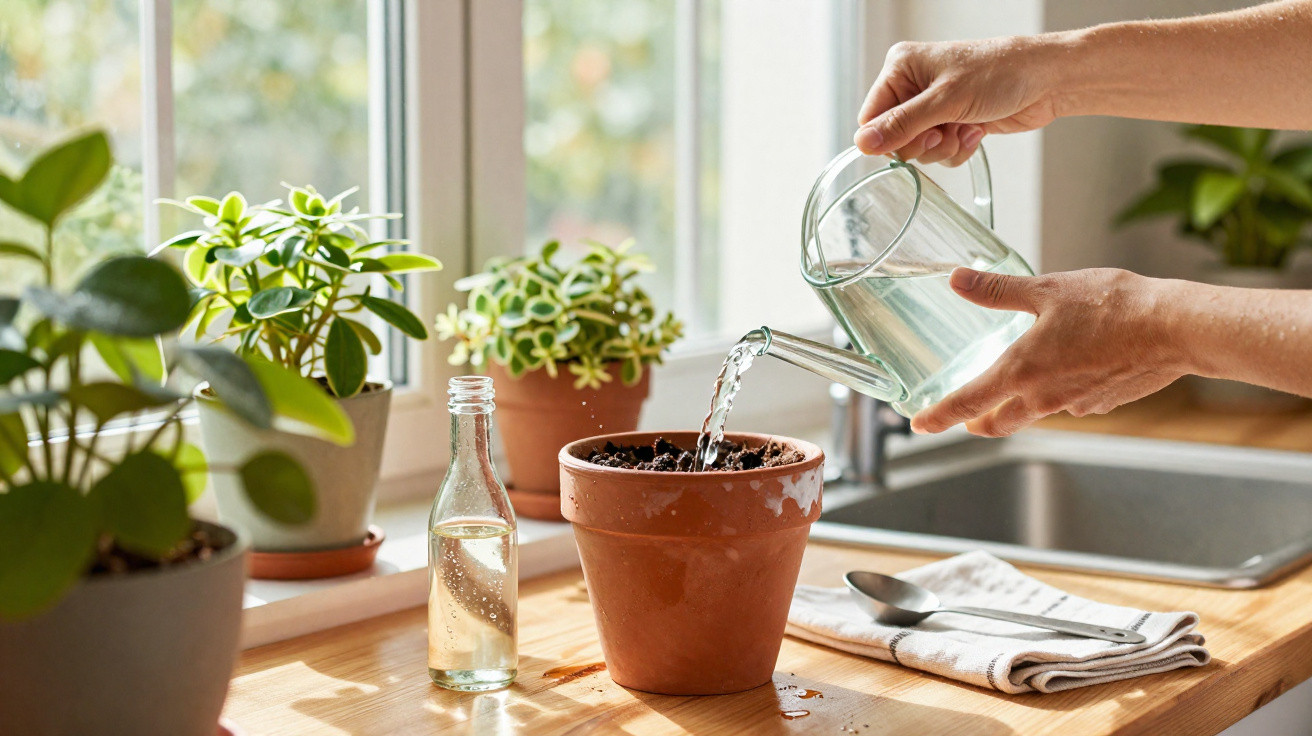
In many homes, houseplants are watered straight from the tap without any prior treatment. Although this seems harmless, it is often associated with a familiar issue: a whitish layer appearing on the potting mix, around pot rims and occasionally even on leaves. What may look like mould or disease is usually a build-up of mineral salts, which can quietly hinder plant growth.
Why does tap water create white crusts on plant pots?
Where tap water contains high levels of calcium, magnesium and other dissolved salts, these minerals are left behind in the potting mix after each watering. Some water evaporates, the plant takes up part of it, and surplus salts remain in the pot. This creates the white crust, raises the soil pH and makes it more alkaline.
At a higher pH, roots struggle to take in nutrients such as iron, phosphorus and potassium. This can lead to yellowing leaves, slow growth, dry leaf edges and plants that respond poorly even to regular fertilising. As a result, many people apply too much fertiliser, further increasing the salt build-up.
How can vinegar in watering water help?
Using vinegar sparingly when diluted in watering water is a household tip often mentioned by florists. In small amounts, acetic acid can slightly lower the water's alkalinity, making the potting-mix environment less favourable for carbonate accumulation and gradually reducing the white crust.
A common dilution is around 1 teaspoon of vinegar in 3 litres of room-temperature water. Apply it only to the potting mix, following the usual watering schedule. Over several weeks, the white layer generally becomes thinner, the soil looks cleaner and roots can once again absorb existing nutrients more effectively. Vinegar is not, however, a replacement for balanced fertiliser.
What precautions matter when using vinegar for watering?
Before making vinegar part of the routine, check whether the species can tolerate a slightly more acidic pH. Some plants from arid climates, certain succulents and some orchids may react badly to frequent use. Too much vinegar may also burn fine roots and reduce the activity of beneficial soil microorganisms.
To avoid unnecessary harm and test this approach safely at home, follow these practical recommendations:
- Start on a small scale: try it on one pot and monitor the leaves and potting mix for at least a week.
- Keep it off the foliage: apply the solution to the soil only, preventing marks or burns on delicate tissues.
- Do not increase the dose: stick to the stated ratio, as stronger doses will not speed up results and may damage roots.
- Alternate waterings: use the mixture only once or twice a month, alternating it with ordinary or filtered water.
How should watering routines be adapted in hard-water areas?
In areas with consistently hard water, long-term results are unlikely from adjusting the pH with vinegar alone. It is more effective to combine methods, such as setting aside filtered water, boiled and cooled water, or correctly collected rainwater kept away from contaminants.
Watching how plants behave is also an essential part of the routine. Persistent marks on pots, dull leaves, soil that becomes waterlogged easily, and very dark roots when repotting can all point to excessive salts. Where the build-up is advanced, it may be necessary to flush the potting mix with better-quality water or even repot the plant, replacing some of the soil so the pots can regain their vigour over the seasons.
Comments
No comments yet. Be the first to comment!
Leave a Comment