
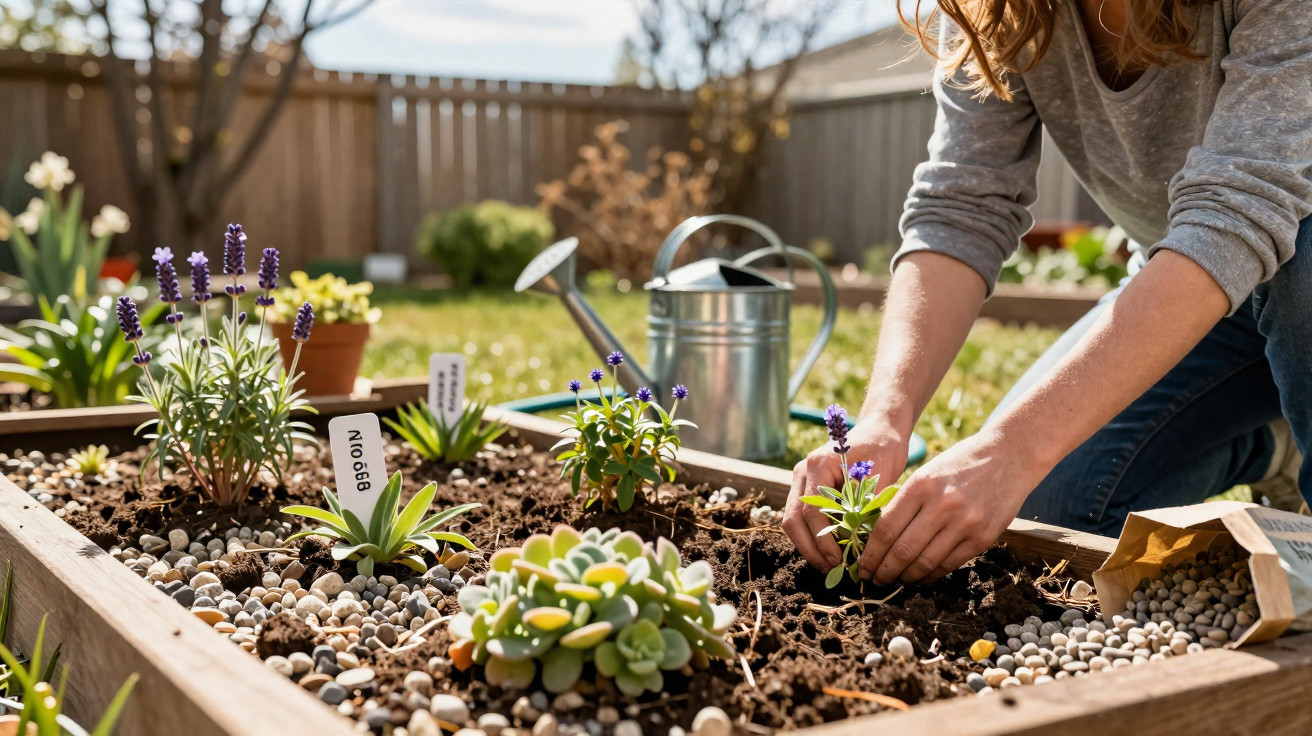
Plant drought-tolerant perennials by 31 March and, for much of the summer, you can simply watch the border cope with rainfall alone. The answer lies less in costly irrigation systems than in timing, plant selection and a slightly different planting approach.
Why 31 March is the deadline for perennials
More is happening beneath the soil in spring than is immediately apparent. By late March, plants in many areas are emerging from winter dormancy. Sap begins to rise and fresh roots push into the still-cool, moist ground.
“Planting drought-resistant perennials by 31 March makes use of the soil’s natural moisture and saves hundreds of litres of watering water in summer.”
This period is especially favourable because winter rain or snow has left the soil thoroughly moist. Perennials planted early in these conditions develop fine root hairs before temperatures consistently climb above 25 °C. Those root hairs later determine whether a plant takes heat in its stride or wilts under pressure.
Planting in May means the plant must establish itself in its new border while also dealing with heat. The perennial is fighting on two fronts: producing roots and supplying its leaves at the same time. It then suddenly needs regular watering – precisely what many people want to avoid because of costs or water restrictions.
Five “camel perennials” for a nearly water-free summer border
A summer border that does not need constant watering relies not on exotic plants, but on dependable garden classics. Five species are particularly well suited.
Perovskia – the Russian perennial for bone-dry sites
Perovskia, often called Russian sage, thrives in sunshine and lean soil. Its finely textured grey foliage loses little water through evaporation. As a result, it manages surprisingly well without watering, even in fully sunny and windy locations.
- Position: Full sun
- Soil: Dry to moist, with very good drainage
- Benefit: Tolerates heat, calcareous soil and nutrient-poor sites
In a border, Perovskia adds violet clouds in high summer and combines well with ornamental grasses or globe thistles.
Sedum ‘Autumn Joy’ – water storage in every leaf
Sedum ‘Autumn Joy’ is a classic perennial for dry corners. Its fleshy leaves hold water like small reservoirs, allowing the plants to withstand extended dry spells without wilting straight away.
Flowering late, from August to October, it attracts numerous insects. Anyone who dislikes bare patches in the border during autumn should choose this stonecrop. Once established, it generally gets through even hot summers without additional water.
Gaura lindheimeri – butterflies on stilts
Gaura appears delicate but is actually remarkably tough. It forms a deep taproot that draws water from lower soil layers, making it an excellent companion for dry, light soils.
From June into autumn, countless white-pink flowers hover above the border on slender stems. The plant copes well with heat provided the soil remains loose and waterlogging does not occur.
Echinops ritro – blue spheres for poor soils
The globe thistle (Echinops ritro) makes a spectacular summer display, with steel-blue balls held on sturdy stems. It is at home where other plants have long since given up: in dry, lime-rich and fairly infertile soil.
Once it has settled in, Echinops prefers to be left alone. Excess water or overly rich soil tends to make it less stable. For a troublesome sunny slope, it is therefore a loyal long-term resident.
Lavandula angustifolia – lavender, if the soil is right
English lavender fits perfectly into a Mediterranean-style dry border. It is fragrant, flowers generously and acts as a magnet for bees. There is just one requirement: the soil must drain reliably.
In heavy, wet clay, its roots can easily rot during winter. If your soil is clay-rich, work in coarse sand, gravel or grit, and plant lavender on small raised mounds rather than in dips.
“All five perennials love sunshine and soil in which water drains away quickly but never lingers.”
Garden trick: planting perennials so they need hardly any water later
Avoiding summer watering starts in the planting hole. Careful preparation takes a little more time initially, but pays off for years.
- Before planting, immerse the root ball in water for around 15 minutes, until no more air bubbles rise.
- Dig a planting hole roughly three times the width of the pot and loosen the soil at the bottom.
- In heavy clay soil, mix in around one fifth coarse sand or gravel.
- After planting, water in thoroughly with around 10 litres per plant, even if it is raining at the time.
- Cover the surface with about 7 cm of mineral mulch, such as gravel, grit or lava rock.
This one-off “starting drink” does not contradict the aim of a “summer without watering”. Plants need it to close air pockets and establish root contact with the surrounding soil. After that comes a far longer period in which nature takes care of irrigation.
How much water earlier planting can really save
A simple calculation illustrates how much difference the calendar can make. A Gaura planted in mid-May often needs water every two days during a hot summer. At a typical 10 litres per watering, that can quickly add up to 200 litres or more per season – for each plant.
“The same perennial, planted in March, will usually cope with summer heat using far less additional water, or even none at all.”
Early planting moves the critical establishment phase to a period when soils are still cool and rainfall is more frequent. This not only reduces the water bill but also fits with increasingly strict regional watering bans.
| Planting date | Summer water requirement (Gaura example) | Risk during heatwaves |
|---|---|---|
| by 31 March | very low; watering is sometimes unnecessary | roots are deeper and plants remain stable |
| mid-April | occasional emergency watering in the first year | more vulnerable during early heat spikes |
| from mid-May | regular watering, for example every 2 days | high risk of losses during watering bans |
What if you cannot plant until April?
Missing March does not mean postponing everything until autumn. April planting can still work if you make a few allowances. During the first season, several rescue waterings will be needed, particularly soon after planting and during the first hot spells.
Consistently free-draining soil then becomes essential. Heavy ground can be structurally improved with grit, gravel or coarse sand. Mineral mulch keeps the soil cooler for longer and limits evaporation. This gives even later-planted perennials a fair chance of coping largely on their own in the second year.
How to compose a dry border that also looks good
A low-water border does not have to look like a survival exercise. A considered layering scheme creates a calm, clearly structured result:
- Background: Globe thistle (Echinops) and Perovskia provide a taller framework.
- Middle: Gaura and Sedum fill the space with flowers and structure.
- Foreground: Lavender runs in loose bands along the edge.
To fill gaps, you can add versatile garden plants such as robust hardy geraniums. Many varieties cope with both sun and partial shade, survive frost without protection and cover the ground effectively. In late winter, simply remove the dead growth by hand; the rest will sprout again naturally.
Why mineral mulch works so well in dry borders
Many gardeners automatically reach for bark mulch. For Mediterranean perennials, it is rarely the ideal choice. Organic mulches tend to retain moisture for too long in the upper soil layer and can encourage rot there, especially around lavender and Perovskia. They also break down and make the soil more acidic, which lime-loving species dislike.
Mineral coverings such as grit, gravel or lava rock work differently. They allow rain to pass through, warm the soil moderately by day and release that warmth slowly at night. Insects benefit from the dry, warm gaps, while unwanted weeds find it harder to establish themselves.
What a low-water border feels like in everyday life
Anyone switching from a conventional “thirsty border” of hydrangeas and water-hungry summer flowers often has a moment of realisation during the first summer. Where the hose once lay every evening, a quick check is suddenly enough: are any leaves drooping? Does the soil beneath the grit still look slightly moist?
During dry weeks, a single thorough soaking every 10 to 14 days can achieve more than daily light watering. This encourages deep-rooted perennials to search in lower layers of soil instead of “begging” at the surface.
Risks, mistakes and how to reduce them
A dry border is not entirely risk-free. Three issues commonly arise in everyday gardening:
- Too much winter wet: Lavender in particular can suffer from root rot. Plant it higher and plan for drainage.
- Choosing the wrong plants for shade: The “camel perennials” listed above love light. In partial shade, choose complementary species instead.
- Overfeeding: Drought specialists do not need heavy fertiliser applications. A small amount of compost once in the planting year is usually enough.
If you are unsure, create a small trial border. One square metre planted with the five perennials named above will show within a year whether the soil and site are suitable. If one species fails, you can make targeted adjustments without having to redesign the entire garden.
Over the long term, the combination of early planting, suitable species and mineral mulch reduces not only water use but also maintenance. A cut-back in late winter, an inspection in spring and the occasional top-up of grit are often all a well-designed dry border needs to remain stable, even in hot summers.



Comments
No comments yet. Be the first to comment!
Leave a Comment