
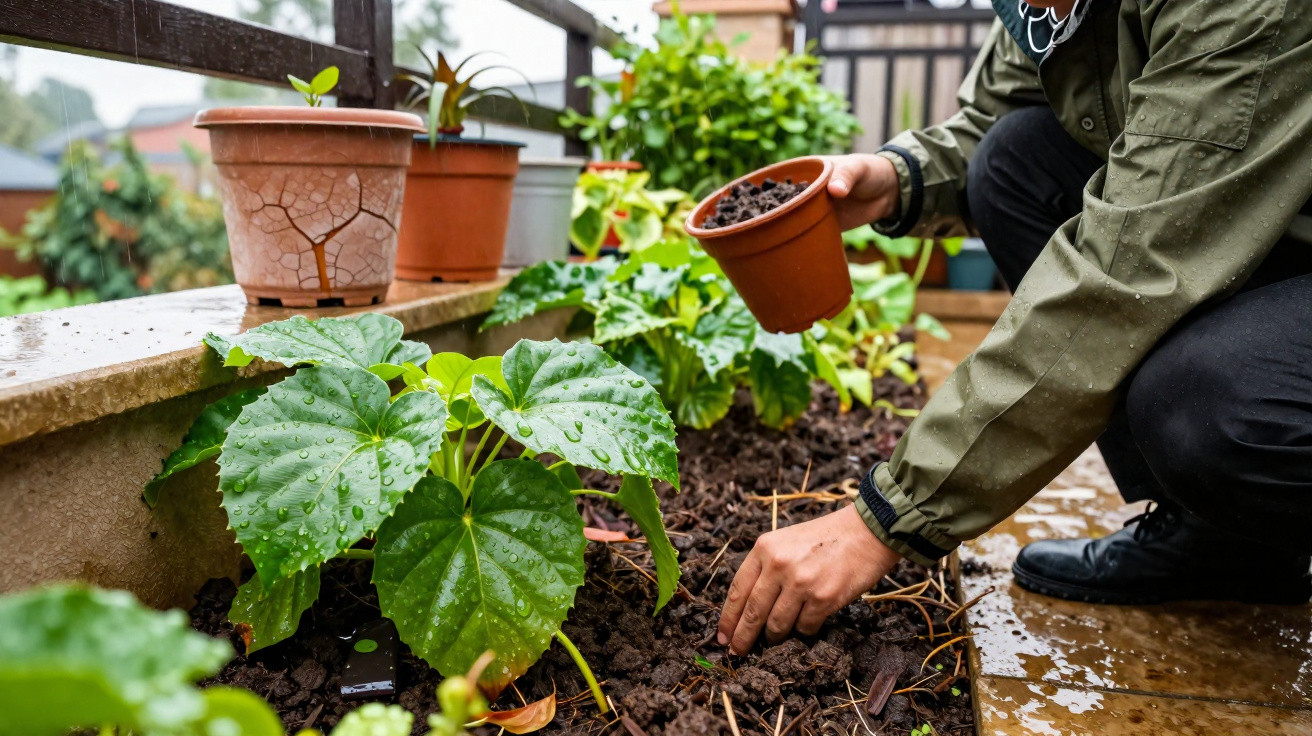
Looking out of the window at driving rain can quickly make you feel relieved of the daily watering routine. Paths gleam with water, water butts are filling up and everything appears thoroughly soaked. Yet this impression is misleading in many cases. One crucial question is often overlooked: how much of that rainfall actually reaches your plants’ roots, and how much runs off the surface or is caught by leaves and roofs?
The misleading impression: when heavy rain barely reaches the roots
Why a heavy shower does not necessarily water thoroughly
Many amateur gardeners assume that a decent thunderstorm will supply the garden for several days. The soil looks muddy, puddles gather on paving slabs – watering can dealt with, or so they hope. In practice, things are often different.
Heavy showers hit the ground with considerable force. Particularly in spring, when the soil is still cold and frequently compacted, water struggles to penetrate it. A kind of surface “film” forms, allowing water to run off quickly. As a result, the top few centimetres look wet while the soil beneath remains dry.
“What matters is not how heavily it rains, but how much water slowly seeps into the root zone.”
For plants, prolonged light rain is often more valuable than a brief downpour. The droplets land gently, enabling the soil to absorb moisture gradually instead of letting it all flow away sideways.
Why looking at your garden can easily mislead you
Many people rely on what they can see: if paving, lawns and flower beds are dark and glistening, there must be enough moisture, surely? That is exactly where the trap lies. Surface conditions reveal nothing about whether there is sufficient moisture 5 to 10 centimetres below, around the roots.
Wind is another factor. In spring especially, wind can dry soil very rapidly even when the air is cool. Moisture that was visible only moments ago can disappear again within a few hours, particularly in loose, sandy soil or raised beds.
- Heavy showers: a large amount of water in a short time, with substantial surface run-off
- Fine, persistent rain: slower absorption and deeper wetting
- Wind: greatly speeds up soil drying
- Compacted soils: allow rain to penetrate less effectively
The “umbrella effect”: when leaves keep the soil dry
Large leaves act as natural rain covers – unfortunately on the wrong side
As spring progresses, many plants develop dense, broad foliage: pumpkins, courgettes, large perennials, shrubs and hydrangeas. This abundance looks wonderful, but in the rain it behaves like a huge umbrella. Drops bounce off and run towards the outer edges of the leaves.
The ground immediately around the stem or main shoot, where the most important roots are found, often stays almost dry. This applies equally to vegetable plots and ornamental borders. Even after several rainy days, the upper few centimetres beneath a dense shrub may contain a layer of bone-dry soil.
“Large leaves catch the rain – from the roots’ perspective, that is often a disadvantage.”
Spotting hidden dry patches in the garden
The following are especially at risk:
- dense shrubs with numerous branches close to the ground
- large-leaved vegetables such as pumpkins, courgettes and chard
- perennial borders with luxuriant foliage and closely spaced plants
- evergreen woody plants with compact growth
Anyone who only sees the wet foliage from outside can easily miss the fact that hardly any water reaches the ground below. A quick check with your hand or a small hand trowel at the base of the plant often reveals that it is dry just a few centimetres down. This puts stress even on otherwise robust, undemanding species.
Balcony, terrace and roof overhang: when rain simply passes by
How building features stop droplets reaching pots
One key issue affects anyone gardening on a balcony, loggia or beneath a canopy. Most rain does not fall vertically from above; it arrives at an angle depending on wind direction. The balcony overhead, a roof overhang or an awning housing acts like a permanently fixed umbrella.
From indoors, it may look as though there has been “a proper downpour”, but the drops are diverted. They strike the balcony edge, bounce against the railing or land on the street beyond the parapet. Pots placed directly by the house wall can remain dry even while a heavy shower is raging outside.
“Even if you get wet on the balcony, the window boxes against the wall may still be completely dry.”
Why container plants slip into drought stress particularly quickly
Plants in a border can draw on deeper layers of soil, whereas pots and boxes cannot. They contain only a few litres of growing medium. This limited volume warms up quickly and dries considerably faster in wind and sunshine.
If a roof overhang prevents rain from falling directly into the container, only humidity remains. That is rarely enough to soak the root ball properly again. Plants in heavily rooted containers can experience severe drought stress within just a few days – even in the middle of a rainy spell.
| Location | Effect of rain | Is it sensible to check watering? |
|---|---|---|
| Open border without cover | Rain usually reaches the soil directly | Yes, especially after heavy rain and in windy conditions |
| Balcony with an overhang | Rain often reaches only the outer edge, scarcely the wall area | It is essential to check |
| Loggia or covered terrace | Very little direct rainfall | Watering is almost always needed |
The simplest check: finger in the soil, pot in your hand
The finger test as a reliable moisture check
Rather than relying on weather apps or a glance through the window, a very hands-on approach helps. Push one or two fingers roughly five centimetres into the soil around the plant. If it feels cool and slightly damp, there is no need to act for the moment. If it feels warm, crumbly or dusty, the plant needs water – regardless of how grey the sky may be.
“The finger test usually provides better information than any look at the water butt.”
This small routine also improves your feel for different soil types. Sandy soils dry out faster, clay soils retain moisture for longer, and potting compost behaves differently again. Those who check regularly will begin to recognise patterns and can adjust watering intervals more effectively.
How the weight of a pot reveals its water level
For container plants, particularly on balconies or windowsills, the so-called “lifting test” is also useful. Lift the pot or briefly hold it in both hands. With a little practice, you can immediately tell whether the root ball still contains enough water.
- Heavy pot: the growing medium is well moistened, so watering can wait
- Noticeably lighter pot: water reserves are almost exhausted
This method also prevents overwatering. Anyone who waters solely according to a schedule can easily pour too much into the pot. That damages roots and wastes water. Checking the weight gets you closer to your plants’ real needs.
Why watering in the rain can sometimes make particular sense
Rainy weather as an opportunity for dried-out growing media
Anyone who has gardened for a while will know the problem: potting compost can dry out so severely that water initially runs around the outside of the root ball rather than soaking in. This is known as “water-repellent” growing medium. Damp rainy weather has a major advantage precisely in this situation.
When the air is humid and temperatures are moderate, very little water evaporates. If you water slowly with room-temperature water during these periods, the dried-out root ball can absorb moisture again. The surrounding air supports the process by slowing evaporation and giving the growing medium time to take up the water.
“Beneath a rain front, stubbornly dried-out soil can be revived particularly gently.”
Water precisely where rain never reaches
While the garden is shining in the rain, it is worth taking a watering can to all the places that gain little from natural rainfall: directly at the stems of densely leafy shrubs, beneath spreading perennials and to every container under a roof overhang.
Direct the stream of water straight at the root area rather than the foliage. That way, every litre reaches where it is needed. Many plants reward this “extra supply” with noticeably stronger growth and fewer signs of stress, such as yellow leaves or limp shoots.
Practical guidance for staying alert to watering needs
How to recognise watering needs despite rain
Before leaving the watering can in the shed, use the following questions as a small routine check:
- Was the plant positioned beneath a roof, balcony or dense foliage?
- Have I deliberately checked the soil around the roots in the past few days?
- Does the soil feel cool and moist 5 centimetres below the surface?
- Does the pot feel noticeably lighter than usual when lifted?
As soon as two or more of these points indicate “dryness”, targeted watering is worthwhile – even if rain is currently pattering against the window.
Risks of soil that stays damp on top but is never properly soaked
One frequently underestimated problem is soil that is “wet on top, dry underneath”. Plants respond by developing shallow roots because only the top few centimetres receive occasional moisture. These roots then suffer particularly badly during heat or wind.
Conversely, continual light watering without checking can quickly lead to waterlogging in pots that lack good drainage. Waterlogged roots harm many species just as much as drought stress does. Watering deliberately but thoroughly produces better saturation of the root ball and encourages roots to grow deeper.
Rain may reduce a gardener’s workload, but it does not replace attentiveness. Regularly checking where moisture is truly reaching will save water in the long term, strengthen plants and prevent the disappointing sight of wilting leaves – even after days of seemingly “perfect” watering weather from above.
Comments
No comments yet. Be the first to comment!
Leave a Comment