
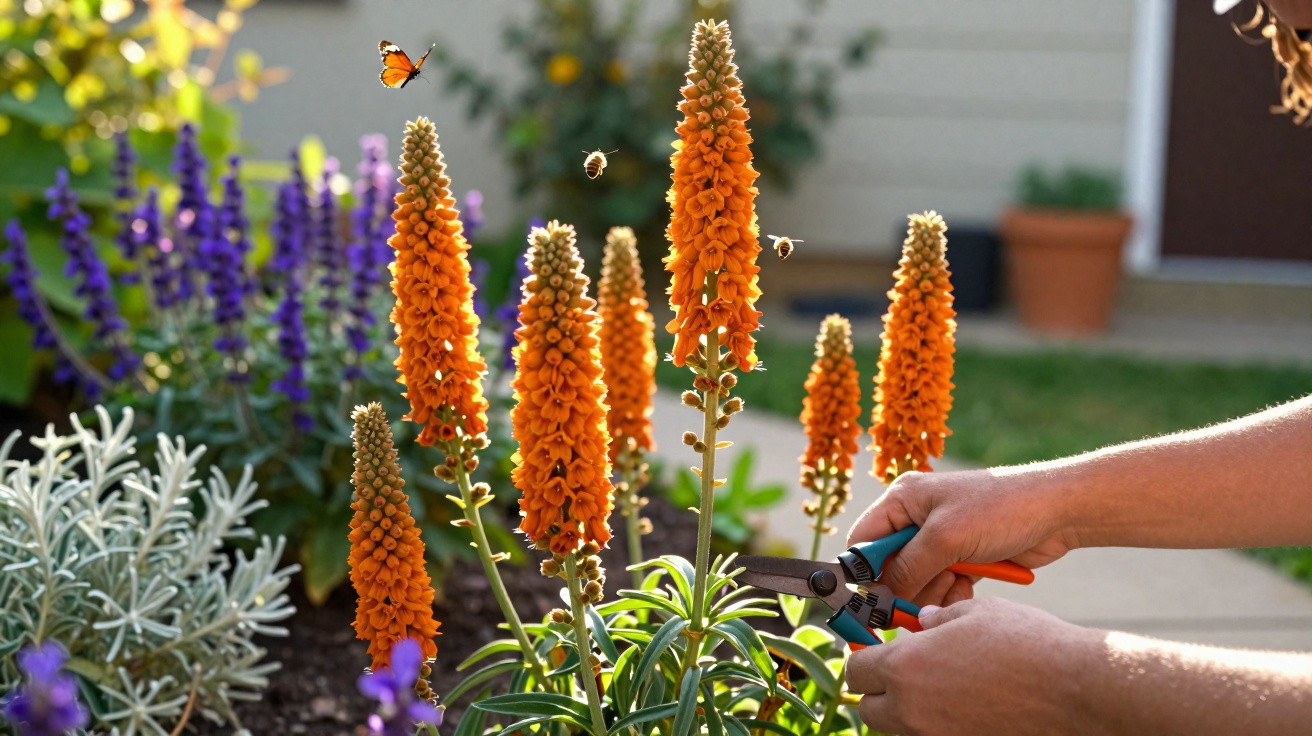
Many garden beds look perfectly fine, yet they can also feel a little uninspiring. Anyone wanting a true showstopper often turns to roses, dahlias or luxuriant classic perennials. However, there is an almost unknown plant that can transform a border into a glowing garden scene with very little maintenance: Leonotis leonurus, also known as lion's ear.
A showstopper straight from an exotic film set
Native to South Africa, Leonotis leonurus brings the presence of a star performer to a perennial border – but without any fuss. It grows rigidly upright to around 1.80 metres, rising above even the most conventional edge planting. Its stems are sturdy and almost architectural, while the foliage is narrow and crisply defined.
The real display starts when the flowers emerge. Ring-shaped whorls of blooms are spaced along the stems. Each whorl is made up of velvety, tubular individual flowers in a rich, almost glowing orange. Visually, they resemble stylised flames or a luminous sculpture placed in the middle of the border.
Tiers of orange flower whorls make Leonotis look like a living candelabra in the summer garden.
By high summer, the effect is a vertical firework display, with several “tiers” of flower heads floating one above another. This unusual structure adds depth and definition, even to beds that previously appeared rather flat or uniform.
A paradise for bees, butterflies and other visitors
The striking shape of Leonotis leonurus is not simply for show. Its tubular blooms are packed with nectar and attract pollinators. Bees and butterflies readily use them as a refuelling stop. In the warmer regions of its native countries, hummingbirds are even regarded as regular visitors.
Anyone creating a wildlife-friendly garden, or simply hoping for more activity in the border, benefits twice over: visually impressive flowers and noticeably more insect visitors.
The ideal position for Leonotis leonurus: sun, sun, sun
Leonotis leonurus essentially has just one real requirement: a site in full sun. At least six hours of direct sunlight each day is ideal if the plant is to thrive and flower freely.
The soil should be:
- nutrient-rich, so it can grow vigorously;
- loose and free-draining;
- unlikely to become waterlogged, particularly in winter.
It performs especially well in light, sandy, humus-rich soil. Heavy clay can be improved with sand or fine grit. Working in some well-rotted compost also gives lion's ear a strong start.
A drought-tolerant plant with surprising resilience
Leonotis leonurus is perfectly suited to increasingly hot summers. It copes with dry spells far better than many traditional border perennials. Once established, it needs moderate but fairly infrequent watering. When planted in the ground, it handles short periods without water remarkably well.
Garden owners with little time benefit from a plant that loves heat and tolerates missed watering.
With good winter protection, it is considered hardy down to around –8 degrees. In areas with harder frosts, it is worth applying a generous mulch around the base in autumn, using leaves or bark chippings, for example. In exposed locations, growing it in a container is a sensible option; it can then overwinter in a frost-free but bright place.
Five practical rules for an impressive planting
To help Leonotis leonurus realise its full potential, a few straightforward principles are useful:
- Choose an extremely sunny site: without plenty of light, flowering remains modest and the plant becomes leggy.
- Provide good drainage: standing wet in winter is the most common reason for losses – incorporate sand or gravel.
- Work in humus: a mixture of garden soil, compost and some structural material encourages quick establishment.
- Water moderately after planting: water regularly during the first few weeks, then gradually switch to longer intervals.
- Protect the root area in winter: apply a thick layer of mulch in borders with cold winters.
How Leonotis leonurus transforms every border
What makes this plant so exciting in garden design is that it offers more than colour: above all, it provides structure. Its upright habit introduces a clear vertical line into a planting scheme. That instantly creates more drama, especially when it is paired with softer, flowing companions.
It is particularly effective in modern, more restrained planting schemes. Here, it can stand among grasses with airy panicles or narrow leaves. The orange flowers then push through the pale veil of the grasses like a bright colour signal.
Strong partners for an unforgettable play of colour
Leonotis can be combined deliberately with contrasting plants to make a border far more exciting. Suitable companions include:
- blue or purple varieties of salvia;
- dark-leaved cannas with bronze-coloured foliage;
- black-red dahlias;
- delicate ornamental grasses such as fountain grass or feather grass.
Among these plants, it can perform either as a soloist or as part of an ensemble. The orange picks up warm tones in the border, while violet and blue provide a cool counterpoint – an effect many design professionals use very deliberately.
Design ideas for everyday gardens
In a terraced-house garden, a group of three to five Leonotis plants can be placed at the back of a border. Lower blue and white perennials work well in front, such as catmint or small cranesbills. The result is a kind of glowing backdrop that looks almost like a painting when viewed from the seating area.
In a drier front garden, Leonotis can be used alongside Mediterranean plants: lavender, Perovskia, globe thistles and thyme create a drought-tolerant yet highly lively ensemble. Those who enjoy using colour accents can repeat the orange of the flowers in accessories such as cushions, pots or a garden bench.
Care, pruning and minor risks
During the growing season, maintenance is limited. You can remove faded tiers of flowers as required, although this is not essential. Cutting the plant back in early spring, just above ground level, encourages strong new growth.
Its greatest weakness is not heat, but moisture and severe frost. In regions with heavy winter rain and soils that dry slowly, a slightly raised bed or a sloping site, where water drains away more effectively, can help. In a container, surplus water must be able to run away freely, so the drainage hole must not be blocked.
Why this exotic plant is worth choosing
Anyone looking to plant a new perennial in spring that stands out clearly from standard offerings will make an excellent choice with Leonotis leonurus. It provides:
- a striking, almost graphic growth habit;
- unusual, multi-tiered flower whorls in intense orange;
- a strong attraction for insects;
- good heat tolerance and relatively low maintenance needs.
This combination makes it something of an insider tip for anyone wanting to create a garden that is not merely “pretty”, but genuinely full of character. If a border has so far lacked that final touch, this fiery plant may be exactly the component that lifts the scene from pleasant greenery to a summer garden work of art.



Comments
No comments yet. Be the first to comment!
Leave a Comment