
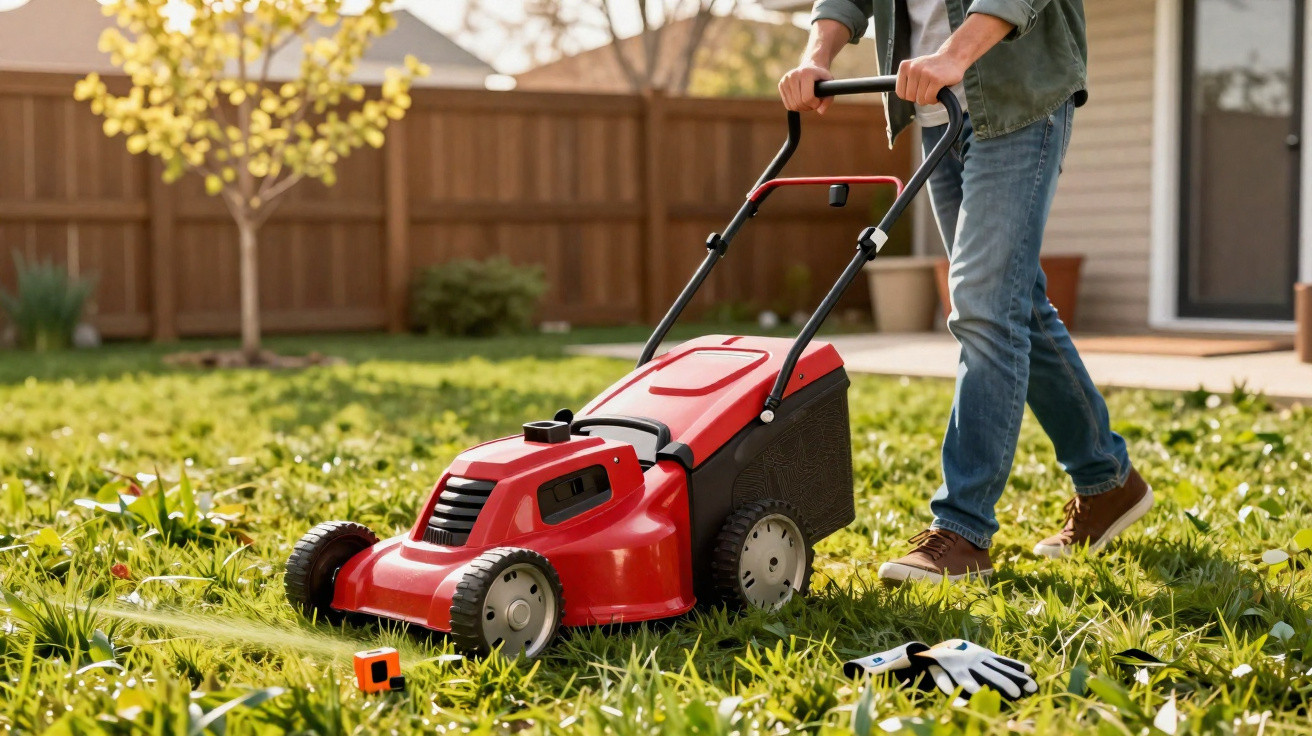
Many amateur gardeners do not properly begin the lawn-care season until April or May. Yet the crucial course is set much earlier. Incorporate one modest ritual in March and your lawn gains an advantage that is noticeable underfoot throughout high summer. It has nothing to do with fertiliser, costly specialist products or high-tech equipment.
Why the first cut in March shapes the entire summer
After winter, a lawn will usually look tired and flattened. The blades are pressed down, leaves are stuck amongst them, and grey or yellow patches may appear here and there. Although it can look like a building site, the grass is already biologically restarting.
This is the moment for the key technique: give it a very high, gentle first mow in March or early April. It is not a drastic cut, but more of a “wake-up call”.
This early, high cut allows air and light to reach the base of the grass blades, strengthens the roots and makes the lawn denser – creating the basis for rich green growth in summer.
With this light trim, gardeners remove only the dead tips at the top of the blades. This produces several benefits:
- More light reaches the base of the plants, encouraging stronger new growth.
- The turf becomes denser, so gaps fill more quickly.
- Better shade covers the soil, meaning it dries out more slowly in summer.
- Weed seeds find it harder to establish themselves and take hold.
Cutting too low in spring, by contrast, can cause the dreaded “scalping” effect. The blades tear into the turf, expose bare soil and significantly weaken the lawn. Sun and wind then dry out the ground, weeds make use of the open space, and a later cold snap can damage the exposed crown of the plants. The result is patchy grey or brown areas that remain an eyesore all summer.
The right time: let your lawn decide, not the calendar
Every year, many people ask: “When can I mow for the first time?” There is no fixed date. Nature does not follow the calendar; it responds to temperature, moisture and growth.
A few straightforward signs indicate that the lawn is ready:
- The blades are standing upright again rather than lying flat as they did in January.
- The lawn has regained an overall fresh green appearance instead of looking dull grey.
- The ground is no longer muddy, and your shoes do not sink into it.
- Daytime temperatures are regularly in double figures.
In practical terms, lawns in milder areas are normally ready towards the end of March, while cooler regions or higher upland areas tend to follow in early April. More important than your postcode is the height of the grass: the first cut is worthwhile only once the blades have reached around 11 to 12 centimetres.
A useful guide: mow only when the grass reaches just below the middle of your calf – by then, the plant is stable enough to use the gentle trim as a signal to grow.
How to set your lawnmower correctly for March
Do not simply pull the mower out of its corner before its first use of the year. A quick inspection makes a noticeable difference to the quality of the cut.
A brief equipment check prevents trouble
- Sharpen the blades: Blunt blades tear grass, whereas sharp ones make a clean cut. Smooth cut edges are less likely to dry out or turn yellow.
- Clean the mower deck: Remove old grass and soil from underneath the mower so that nothing obstructs it or forms clumps.
- Check that it works: Test the motor, battery or cable before you find yourself stranded halfway across the lawn.
Next comes the most important adjustment: cutting height. One basic principle applies at the start of spring: set it as high as possible.
The one-third rule: how much can be removed in March
For the first mow, gardeners often follow the one-third rule: remove no more than a third of the current blade length. If the lawn is 12 centimetres high, the mowing height should therefore be about 7 to 8 centimetres.
| Blade length before cutting | Maximum removal (1/3) | Recommended cutting height |
|---|---|---|
| 10 cm | approx. 3.5 cm | 6–7 cm |
| 12 cm | approx. 4 cm | 7–8 cm |
| 14 cm | approx. 4.5 cm | 8–9 cm |
Following this approach avoids putting the plants under stress. Rather than looking weakened, the lawn responds with dense, compact growth.
How to carry out the first cut step by step
A clear order of work helps ensure that the March ritual does not become stressful for the lawn.
- Wait for dry weather: Both the grass and the soil need to be dry. Damp blades stick together and are more likely to be torn by the mower.
- Clear away larger debris: Collect branches, large leaves and stones beforehand, either by hand or with a rake.
- Set the mower to its highest setting: Do not cut any lower for the first pass.
- Move slowly: Avoid rushing; instead, mow in calm, even lines.
- Check the clippings: Fine clippings can remain on the lawn, but thick clumps should be collected or spread out with a rake.
Fine grass clippings from the first mow can be left behind as a natural mini-fertiliser – they break down quickly and return nutrients to the soil.
What the first cut cannot do – and what you can add
The March cut is not a cure-all. It does not replace occasional fertilising or maintenance for heavily thatched areas. If you can see clear carpets of moss or dense thatch in the lawn, consider scarifying or aerating as well – but only once the grass has recovered strongly after its first cut.
A typical spring schedule may look like this:
- A high, gentle first mow in March or early April
- Light spring fertiliser a few days later when rain is forecast
- Scarifying, if needed, from late April once the lawn has grown back vigorously
- From then on, regular but not overly low cuts every one to two weeks
Common mistakes that ruin the start of the lawn-care season
Certain misunderstandings occur in almost every garden, costing lawns density and colour year after year.
- Mowing too early: If the soil is still cold and wet, the root system suffers and the lawn becomes more prone to damage.
- Cutting too low: The neat, closely shorn look soon results in brown patches and greater weed pressure.
- Using blunt blades: Ragged cut edges create entry points for fungal disease and other stresses.
- Using a heavy mower on muddy ground: Deep wheel marks and compacted tracks often remain visible for months.
Why this single March trick has such a noticeable effect
The real strength of the first high mow lies in its timing. It takes place precisely when the lawn is once again directing its energy into growth, but has not yet exhausted itself. The light trim channels that energy into new shoots, builds denser turf and covers the soil with a close green network.
Miss this window, or use it incorrectly, and you will spend the rest of the year trying to catch up with lawn care: more weeds, more problems with drought and more bare patches. Use it well, and even during hot summer weeks you will benefit from a tougher, more hard-wearing lawn that stays green for noticeably longer.
In the end, neither professional equipment nor a specialist course is required. A sharp mower, attention to the weather and soil, and the willingness to mow high once in March are often all that lie behind your neighbour’s “green carpet”.






Comments
No comments yet. Be the first to comment!
Leave a Comment