
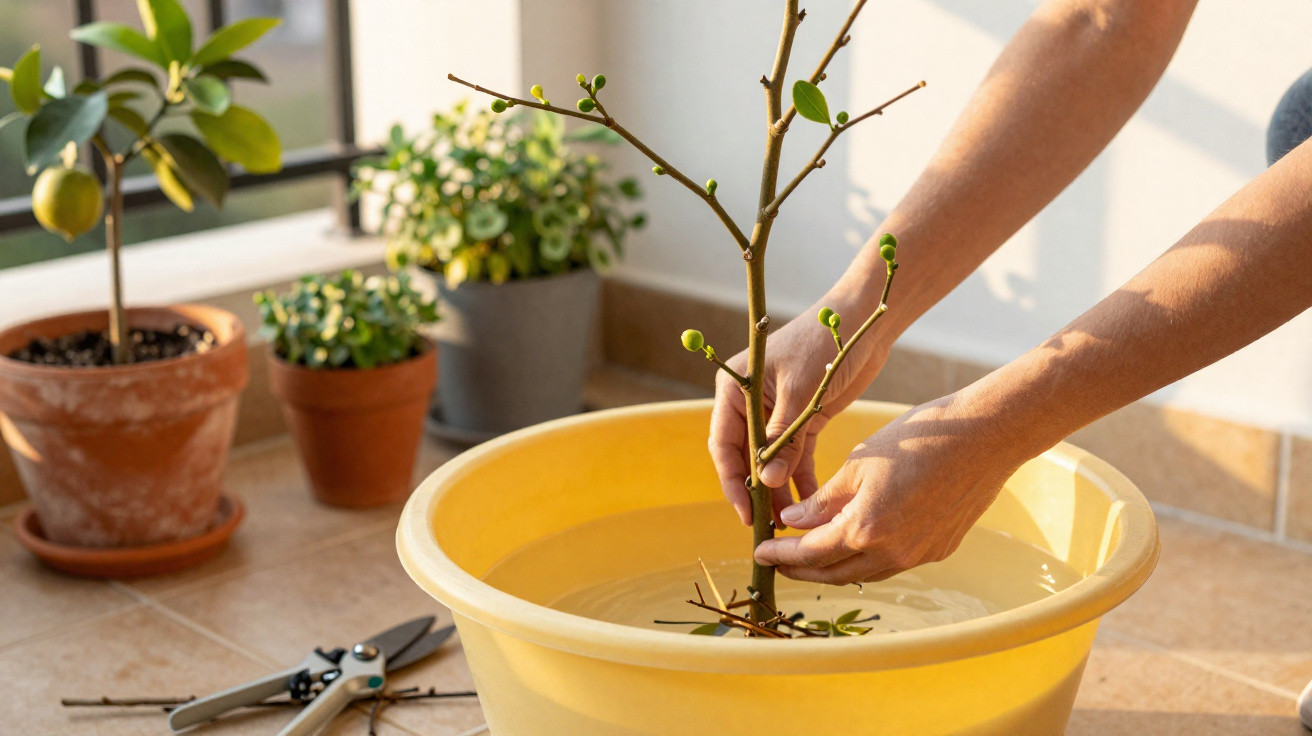
A potted citrus tree that looks limp, leafless and almost weightless can quickly alarm amateur gardeners. Many people throw the plant away too soon. Yet the apparent disaster is usually not irreversible damage, but a serious watering mistake. An established method that costs nothing can restore the tree’s strength in a surprisingly short time.
Is a dry, leafless lemon tree really dead?
It is a familiar scene: you walk onto the balcony or into the conservatory and lift the pot. It feels light, while the branches seem hard and brittle. Not a single leaf remains and every shoot is bare. Although it looks final, it often is not.
In many cases, the cause is straightforward lack of water. The root ball has dried out so severely that it has pulled away from the pot sides. When watered, moisture simply runs down the inside of the pot instead of soaking into the compost. The fine roots receive nothing, so the plant sheds all of its leaves as an emergency measure to conserve water.
“A lemon tree without leaves is not automatically beyond saving – as long as green tissue remains beneath the bark, it is worth attempting a rescue.”
Diagnosis comes before rescue. Lightly scratch the bark on the tip of a thin branch with your fingernail. If moist green tissue appears underneath, that part is alive. If it remains brown and dry, the branch has died. Check several points, including lower down on the main stem. The living sections provide the foundation for renewed growth.
Day 1: Grandma’s zero-cost rescue plan for the lemon tree
Pruning directs energy where it is needed
If the tree still has green areas, begin with the secateurs. A decisive prune greatly improves the chances of fresh shoots. Reduce the crown by roughly one third.
- Use clean, disinfected secateurs.
- Remove all clearly dry, brittle branches back to dead wood.
- Then cut back gradually until the wood is green again inside.
- Thin out fine, dried-up twigs and any remnants of old leaves completely.
A wound sealant may be useful on larger cuts, but it is not essential. What matters more is retaining only firm, healthy framework branches. The tree can then direct its limited energy towards fewer, more promising buds.
A water bath rather than a watering can: the crucial step
Ordinary watering is rarely enough when the compost has dried out completely. The water passes straight through without genuinely rehydrating it. This is where a water bath is needed – often known in gardening as soaking the root ball.
- Fill a bucket, tub or bath with lukewarm water at around 20°C.
- Place the entire pot in the water, with its rim sitting just above the water level.
- Leave it for at least 15–20 minutes; very dry compost may need 1–2 hours.
- Keep it submerged until no more air bubbles rise to the surface.
The bubbles show that water is gradually entering the root ball and displacing trapped air. Once they stop, the compost has absorbed enough water. Remove the pot and let it drain thoroughly in a shaded place – ideally for 24 hours without a saucer, so it is never left standing in water.
Then give the lemon tree a ‘sickroom’ position: bright but out of direct sun, at 15–18°C and, where possible, free from draughts. Water only very sparingly over the first few days. The priority is stabilisation, not flooding.
Why this method works
As compost shrinks and separates from the pot edge, gaps form around the root ball. Water from a watering can follows the easiest route and drains away unused. The fine root tips, known as root hairs, dry up and can no longer take up either nutrients or moisture.
A water bath works like submerging a sponge completely: the entire root ball becomes evenly saturated, including its centre. This allows the remaining roots to recover and function again.
A simple trick involving a transparent plastic bag provides an extra boost. It creates a warm, humid microclimate that significantly reduces evaporation:
- Loosely place a clear plastic bag or garment cover over the crown and pot.
- Secure it close to the pot at the bottom with an elastic band or string.
- Open it for around 10 minutes every two days to prevent mould forming.
“The improvised ‘mini greenhouse’ bag creates almost tropical air – allowing the tree to produce new leaves even while its roots are still weak.”
In these conditions, humidity and temperature remain high while moisture loss is low. The plant uses less water, yet the leaves and buds have sufficient moisture to resume growth. In ideal circumstances, the first delicate shoots can appear after just one to two weeks.
The first 15 days: what matters now
Days 2 to 7: observe closely and intervene as little as possible
During the first week after the water bath, the rule is to leave the tree alone. Keep the bag over it, opening it only for the brief ventilation periods. The compost may dry slightly on the surface, but it should still feel noticeably moist beneath.
Use a simple finger test as a guide: push your index finger around three centimetres into the compost. If it feels dry at that depth, water the tree thoroughly. If the root ball remains damp inside, wait before watering again. Constant small splashes from a watering can can easily cause waterlogging lower down – precisely what harms the roots.
At this stage, do not repot the tree or move it outdoors. Changing its position creates additional stress. It now needs stable conditions and gentle light.
Days 8 to 15: gradually leave the ‘intensive care tent’
Once buds begin to swell visibly or small new leaves emerge, the strictly controlled stage is over. Now open the bag gradually:
- Days 8–10: open the bag a little further each day, or tear small openings near the top.
- Days 11–13: leave the bag resting only loosely over the crown.
- Days 14–15: remove the bag completely.
At the same time, the temperature may rise to 18–22°C. More light is beneficial, but avoid intense midday sunshine initially. Moving the tree directly outdoors too early risks leaf scorch and renewed stress.
Once several new leaves have grown and fully developed, you can use a specialist citrus fertiliser for the first time – at half strength and only every three weeks. The roots are still rebuilding, and too much nutrient salt could burn them.
What to do after the rescue programme
Repotting: yes or no?
A new pot is not automatically the answer. The condition of the root ball is what matters. If the tree slips easily from its pot and only a few roots are visible around the outside, gently roughening the surface and adding fresh compost at the top and sides is often enough.
Repotting is particularly worthwhile if:
- roots are growing in circles around the edge;
- the root ball feels extremely hard and compacted; or
- water immediately pools on top rather than slowly soaking in.
In that case, choose a slightly larger container and free-draining citrus compost, optionally mixed with some expanded clay or coarse sand. Always include a drainage layer at the base and promptly pour away any standing water in the saucer.
Common mistakes that weaken the lemon tree again
After saving a tree, people often make fresh mistakes through worry:
- Too much water: Permanently wet compost encourages root rot. Water less often, but water generously.
- Sun scorch after ‘intensive care’: The tree needs time to adjust to direct sunlight.
- Overfeeding: Strong fertiliser applied before there are enough leaves and active roots can easily cause salt damage.
By paying close attention to the plant’s signals, you can act in time. If leaves hang limp despite wet compost, there is usually too much water in the pot. If young leaves curl and look yellowish, the cause is often either insufficient light or a modest need for nutrients.
Why a rescue attempt is almost always worthwhile
Citrus plants have a reputation for being delicate, but they are actually tougher than they appear. A completely bare lemon tree can be alarming, yet its inner wood often still holds impressive reserves. Many specimens produce stronger growth after total leaf loss than before – provided the roots are given a fair chance.
Anyone who has watched an apparent ‘stick’ turn back into a green, fragrant tree will approach watering gaps, heatwaves and holidays differently in future. Regularly checking the pot’s weight and feeling the compost replaces any high-tech sensor. And it is worth remembering that a water bath and a simple plastic bag can achieve more than any expensive specialist fertiliser.
Comments
No comments yet. Be the first to comment!
Leave a Comment