
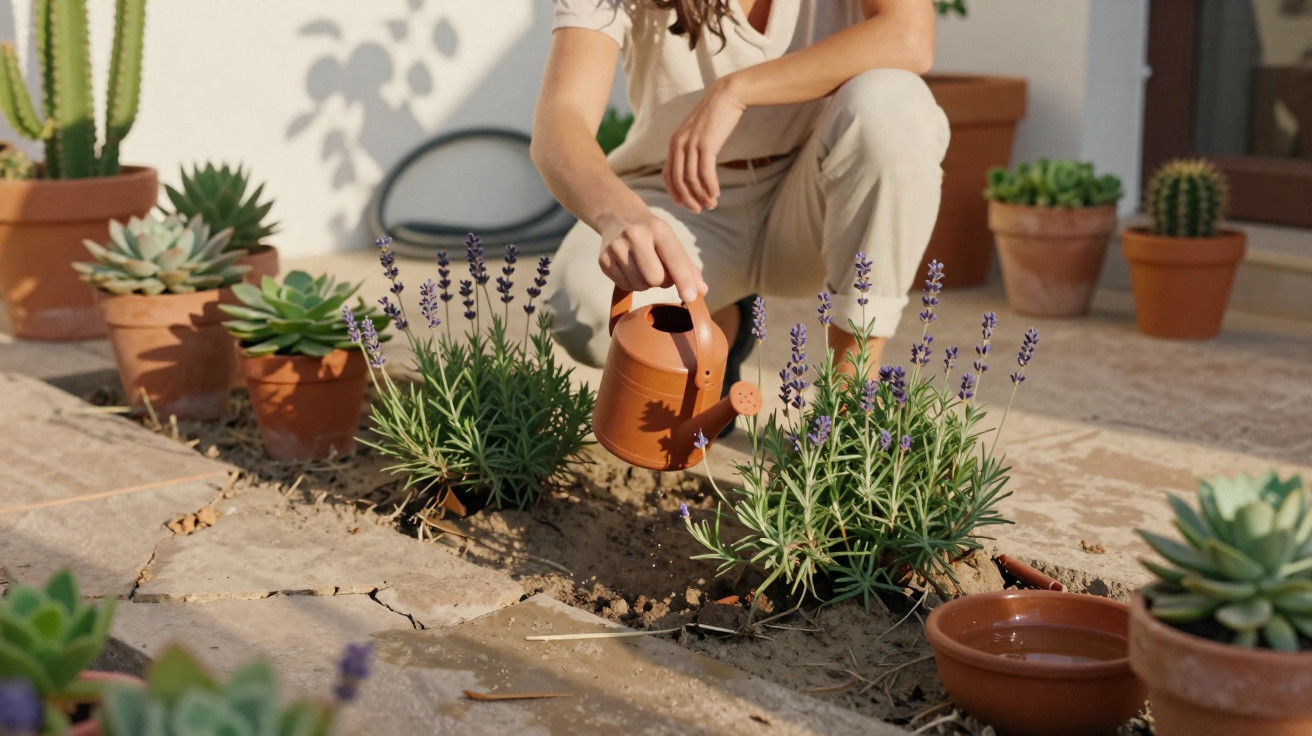
On one of those summer evenings when the heat still hangs over the patio like a blanket, I walk through a small terraced-house garden on the edge of town. The lawn is yellow, the hose lies in the corner like a guilty conscience, and the water butt has been empty for weeks. Yet several pots shine out amid this dusty scene: silvery lavender, plump succulents and a miniature olive standard that looks as though it stayed behind on holiday while everything else returned to everyday life long ago. Not a drop of water for days – and these plants still look as if they have just had a spa day. At some point, you begin to wonder whether we have paired our climate with the wrong plants. And whether there is a quiet selection of plants that secretly loves heat.
The garden's quiet survival experts
We all know the sight: the pot of basil on the balcony that looked reasonably alive yesterday and today resembles yesterday's leftover salad. A few metres away, though, stands a container of rosemary that apparently cannot be bothered by drought. Its leaves remain aromatic, its stems firm – no drama. These plants are like people who still look effortlessly composed at 35°C while the rest of us are already melting.
Lavender, rosemary, thyme, sage, sedum, houseleek, olive trees, yucca and ornamental grasses such as fountain grass all originate in places where rain is more of a bonus than a given. Their leaves are often small and leathery, or thick and fleshy, while their roots grow deeply or spread widely. They take what is available and make a great deal from very little.
A neighbour of mine, who travels frequently for work, once told me about her “lazy balcony experiment”. She planted only varieties able to cope with heat and neglect: lavender along the edge, rosemary in a large pot, with sedum and houseleek in shallow bowls between them. During one record-dry summer, she watered perhaps once every ten days. Later, she showed me two photos on her phone: on the left were the neighbours' conventional balcony plants, drooping geraniums that looked as though they had endured a long night out. On the right was her own balcony: blue-grey foliage, flowers, bees and no drama. A study by the Technical University of Munich also found that certain succulents and Mediterranean herbs need up to 50 % less water than conventional bedding plants. Figures aside, her balcony was proof beyond argument.
The reasoning is straightforward: plants that naturally grow in sparse, rocky, sun-drenched places are adapted to dry spells. They hold water in their leaves or roots, close their stomata earlier and, if necessary, shed leaves to save themselves. Many also develop a fine, dense root network just beneath the surface to capture every brief shower. The contrast with “thirsty” plants is brutally simple: some expect daily care. Others work more on the principle of: water me when you remember – otherwise, I will manage.
Creating a garden with drought-loving plants
The best truth comes first: choosing drought-loving plants means starting not with watering, but with the soil. Lavender planted in heavy, wet garden soil is like a desert runner wearing wellington boots. The foundation, then, is light, free-draining soil mixed with sand and grit. For containers, herb or cactus compost combined with coarse material will do. Then come the heat heroes: lavender planted in groups, rosemary as a small shrub statement, thyme as a fragrant ground cover, sedum as cushioning filler, and an olive standard or yucca for vertical structure. Plant them well, water deeply once, and then leave them be. Rather than bothering them constantly with a watering can, water less often but thoroughly.
What many people underestimate is that drought-loving plants hate waterlogging even more than thirst. We are used to watering out of guilt when leaves droop slightly – and that is often when things go wrong. Let us be honest: nobody checks soil moisture with a finger every day. One simple rule helps, however: wait until the top layer of compost is genuinely dry before reaching for the watering can. A bright position is essential; most of these species can tolerate blazing midday sun only once they are well rooted. And yes, the first summer is always the test. Give them a little more attention then, and you will be rewarded with years that need almost no watering.
Gardeners keep telling me the same thing: “The biggest mistakes happen out of love.” Too much water, soil that is too heavy, pots that are too small. Or the classic error: placing a thirsty hydrangea right beside lavender, then wondering why one of them is always struggling. During a conversation with an urban gardener, one sentence stayed with me:
“Saving water does not start with the water butt, but with plant choice – everything else is merely treating the symptoms.”
Anyone making the change can use this straightforward list as a guide:
- Mediterranean herbs: lavender, rosemary, thyme and sage – fragrant, resilient and low in water needs.
- Rock-garden and succulent stars: sedum, houseleek, livingstone daisies and aloe in pots – they store water in their leaves.
- Shrubs and woody plants such as olive trees, rockrose, serviceberry or certain pines – ideal for dry corners.
- Ornamental grasses such as feather grass, blue fescue or fountain grass – they add movement without the thirst drama.
- For balconies and patios: larger containers, light-coloured pots and a mineral mulch layer – all of which significantly reduce evaporation.
What a “new” garden says about us
After several consecutive years in which summers seem longer, hotter and drier, it is inevitable that we start questioning how we use water. Anyone who has stood holding a watering can and thought, “Why am I doing this every evening?” is not alone. A garden that can cope with drought is not merely convenient. It also reflects a quiet shift: away from the English ideal of a green lawn and towards an image that is closer to the reality of our climate. And, incidentally, towards greater ease.
A bed of silvery lavender, warm stones and fragrant thyme, scattered with a few plants that attract insects, is not a sacrifice but a different aesthetic. Suddenly, you hear the buzzing, watch grasses move in the wind and realise that a garden can thrive without constantly fighting for survival. Switching to planting that loves drought gives you back a little freedom. You can go away for a weekend without arranging for someone to water. You can experience a summer of water shortages without carrying nothing but guilt on your shoulders.
Perhaps that is the quiet charm of these plants: they do not make a fuss, they grow slowly and they forgive pauses. They also suit an already busy life. The remaining question is this: if our climate is changing, why should our gardens stay the same? Anyone tempted to try can fill part of their trolley at the next garden-centre visit with species for which thirst is the exception. The moment you realise that beauty is possible with less watering changes more than just the balcony. It changes how you see the outdoors.
| Key point | Detail | Reader benefit |
|---|---|---|
| Selection of drought-loving plants | Mediterranean herbs, succulents, ornamental grasses, resilient shrubs | Practical ideas for species that genuinely manage with little water |
| Correct soil and container preparation | Light, free-draining soil, sand/grit, good drainage, larger containers | Helps to substantially reduce watering effort and losses caused by waterlogging |
| Everyday watering strategy | Water less often but deeply, pay attention during the first season, then relax | Less stress, lower water use, and more stable, resilient plants |
FAQ:
- Which plants survive longest without watering on a balcony? Houseleek, sedum, livingstone daisies, lavender, rosemary and thyme are particularly resilient. In larger pots with free-draining compost, they can easily cope for one to two weeks without water, even in hot weather.
- Can I replace a lawn with drought-loving plants? Yes, many people create a mosaic of herbs, low-growing cushion plants and ornamental grasses instead of a lawn. A thyme or herb lawn looks lively, needs less water and requires less frequent mowing.
- Do these plants really need no rain? They cannot manage entirely without water, especially in their first year. Once established, occasional deep watering or natural showers are enough to keep them healthy.
- How can I tell whether I am watering too much? Yellowing leaves, soft growth or plants that are “rotting away” despite damp compost are warning signs. Lift the pot: if it feels heavy and cold, the plant probably does not need water.
- Do drought-loving plants also work in shade? Most of these species love sunshine. For partially shaded areas, some sedum varieties, tough grasses or drought-tolerant perennials such as cranesbill are suitable, although they need slightly more water than plants in a bed with full sun.
Comments
No comments yet. Be the first to comment!
Leave a Comment