
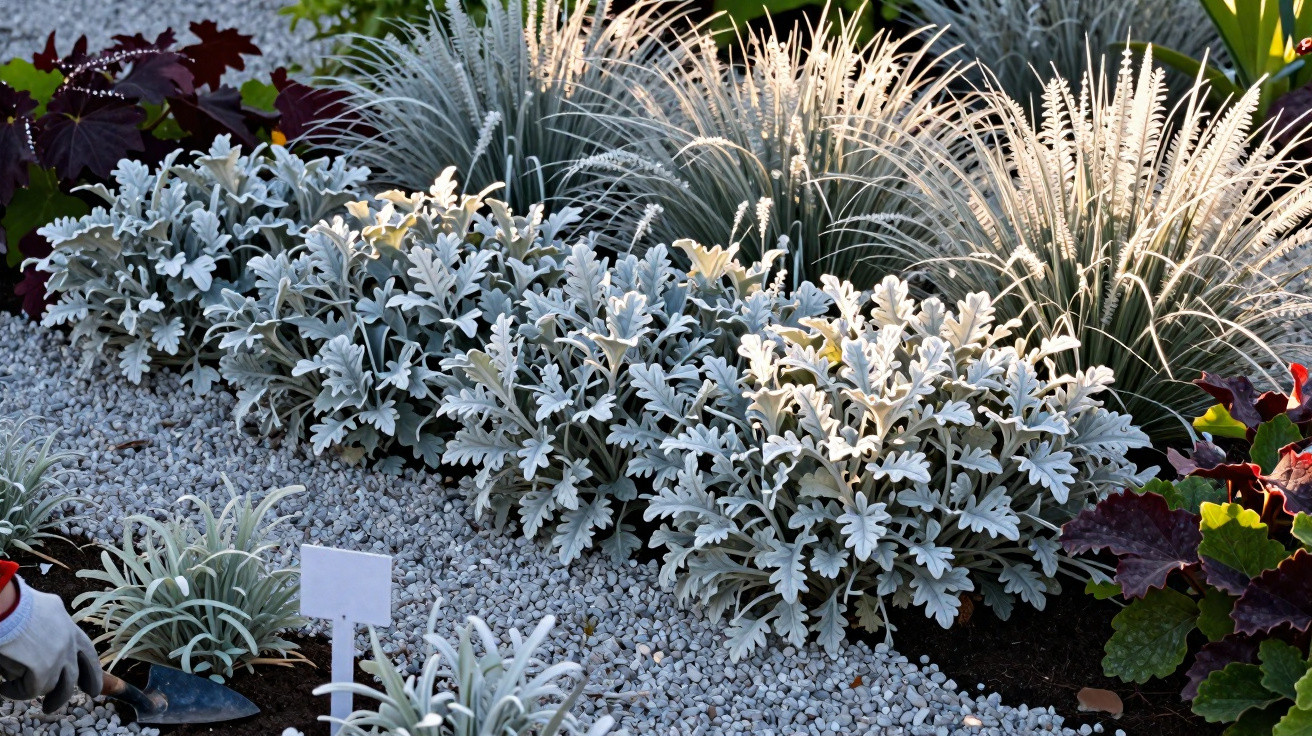
Spring is waiting in the wings, yet many flower beds still look more like November: dark soil, only a few shoots and nothing that truly catches the eye. In this in-between period, however, two hardy perennials and a mineral layer can create an effect resembling delicate hoar frost or lingering patches of snow – without frost, chemicals or an exhausting daily care routine.
Why a seemingly snow-covered bed is so captivating in March
Visual coolness that brings warmth to the garden
While everything around it still appears brown and sparse, pale, silvery foliage creates a striking visual break. Dark soil becomes the ideal canvas against which an almost white carpet suddenly shines. This unusual contrast immediately draws the eye during the seasonal transition.
Silver foliage at ground level and a grey-white veil above it make a bed look as though the frost has given up everywhere except here.
Even weak spring sunshine is enough to make the light areas glint. As a result, a small urban garden can feel larger and more alive. The edges of the bed appear to move forward visually, while bare patches recede into the background.
Contrast: the secret weapon against dull soil
The idea is straightforward: the darker the backdrop, the more powerful every pale texture appears. This works especially well in late winter. The finely textured, silvery-haired leaves reflect light, whereas brown soil tends to absorb it. The result is greater depth, almost like a landscape photograph enhanced with a distinctive filter.
For anyone who wants something pleasing to look at early in the year without waiting for flowers, this approach works far better than relying on traditional spring-flowering plants alone.
The dream pairing: velvety ground cover meets silvery spires
Stachys byzantina – “lamb’s ear” as a soft carpet
The foundation of this effect is Stachys byzantina, also known as lamb’s ear or woolly betony. This perennial remains low, spreads to form a carpet and produces thick, softly hairy leaves in a pale grey-green shade.
- exceptionally easy to maintain
- tolerates dry conditions once established
- ideal as a ground-covering layer at the front of the bed
- catches dew and raindrops like tiny pearls
Its velvety surface is precisely what creates the impression of fine hoar frost. Viewed up close, it looks as though a dusting of snow has settled in the leaves. The carpet spreads across the soil, conceals untidy areas and forms a calm, light-coloured expanse.
Artemisia – grey-white filigree with movement
Above the soft carpet, Artemisia provides the visual counterpoint: depending on the variety, it has finely divided, delicate foliage that resembles metallic lace. Its leaves gleam in very pale grey to grey-white tones, making the bed feel less heavy.
The plant offers several benefits:
- loose, bushy growth that adds height to the bed
- shimmering foliage that moves gently in the breeze
- high drought tolerance
- very little maintenance when planted in the right position
Together, the plants create an image made up of two layers: fur below, ice above. It is this combination of velvety texture and airy growth that makes the arrangement so appealing.
No “snow” without stone: the role of a pale gravel layer
Why 3–5 centimetres of light-coloured stone perfects the trick
Only a layer of pale chippings or fine gravel truly unites the plants and the illusion. A 3 to 5 centimetre layer of light-grey or almost white stones is ideal around the edge of the bed or between the perennials.
Where leaf and stone merge, the eye can no longer see the boundary – that is exactly where the apparent patch of snow takes shape.
The stones echo the foliage colour and resemble snowfields melting into the planting. Fine shadows cast by the leaves create an irregular, slightly shimmering look reminiscent of old snow beginning to thaw.
Mineral mulch protects the plants in two ways
This layer is not merely decorative; it serves a practical purpose:
- Temperature buffer: stones store warmth and release it gradually overnight.
- Dry plant bases: water drains more effectively, so the base of the stems does not remain permanently wet.
- Fewer weeds: germinating weeds face considerably less favourable conditions.
- No chemicals needed: fewer weeds mean less need to reach for a spray bottle.
Waterlogging is a real enemy of perennials with grey foliage in particular. Mineral mulch helps ensure they neither develop “wet feet” nor disappear beneath dense weed growth.
How to create your “snow bed” step by step
Prepare the position, soil and drainage properly
Silver foliage loves sun and dislikes persistent damp. A sunny to partially shaded site with relatively lean, free-draining soil is best. Before planting, a quick soil check is worthwhile: if water remains in the planting hole for a long time, the area needs improving.
To improve drainage, it is often enough to:
- loosen the top layer with coarse sand
- add small pebbles or expanded clay to the planting holes
- mix compost and sand into heavy clay soils
Anyone who takes this stage seriously can enjoy dense, healthy cushions for many years.
Plant spacing and spring care
For a bed of around one square metre, the following will usually be sufficient:
- 2–3 pots of Stachys byzantina to form the base carpet
- 1–2 Artemisia plants to provide taller structure
- one bag of pale decorative gravel or chippings, in a medium grade
In spring, carefully remove old, brown or soggy leaves. Usually, very little more work is needed. Patience is required only during the first year, while the carpet grows together. Afterwards, lamb’s ear can be kept in bounds when necessary by simply digging out shoots that spread too far.
Darker companions make the silver shine even more brightly
Colour contrasts that make the “snow” glow
Silver tones are particularly effective when framed by dark foliage. Perennials with almost black or deep purple leaves are ideal. They make the bright section of the bed appear as though it is lit by a spotlight.
Popular companions include:
- coral bells with burgundy-red foliage
- black mondo grass (Ophiopogon planiscapus ‘Nigrescens’)
- dark-leaved Sedum or Aster varieties
This combination creates a kind of “stage edge”. The eye naturally travels from the darker areas towards the shimmering, light-coloured centre.
What lies behind the fascination with silver beds
Silver foliage as an adaptation – and an opportunity for gardeners
Many plants with grey foliage originate from sparse, sunny regions. The fine hairs or pale waxy coating on their leaves protect them from intense sunlight and excessive moisture loss. These same adaptations are what create their distinctive effect in the garden.
Choosing such species therefore brings tough survivors into the bed as well. At a time of dry summers, that is a clear advantage. At the same time, they produce a modern, almost graphic look that stands apart from classic flower-filled beds.
Practical advice for lasting enjoyment of a silvery garden display
A few simple principles will help keep the “snow bed” attractive over the long term:
- avoid overfeeding, as many silver perennials lose their compact shape in overly rich soil
- during prolonged rain, watch for standing water and improve drainage afterwards if necessary
- loosen the chippings layer occasionally with a small rake to keep it looking neat
- cut back faded stems in summer to bring the foliage to the fore
Anyone who tries this approach will soon discover that a garden does not have to be green from top to bottom. Silver areas bring calm, structure and a touch of “moonlight” to flower beds – especially when the rest of the garden is still in winter dormancy.




Comments
No comments yet. Be the first to comment!
Leave a Comment