
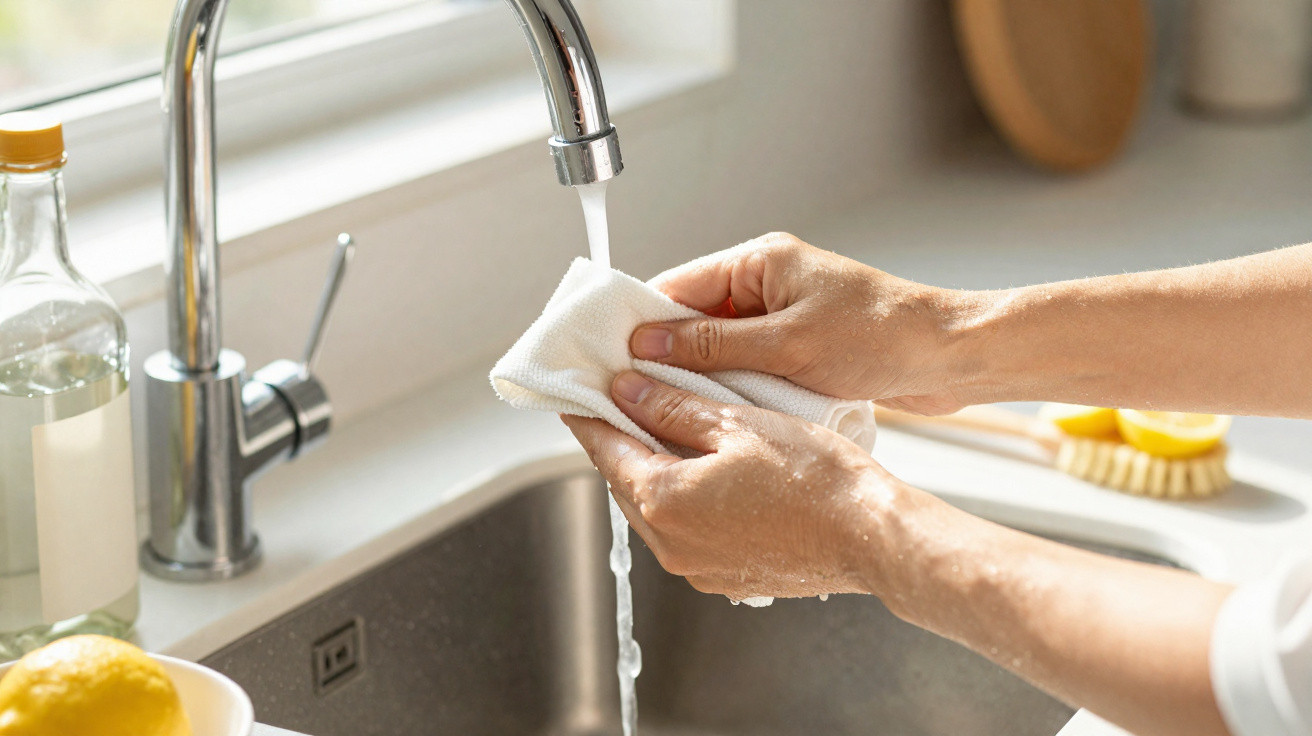
Over the months, whitish marks and hard crusts commonly develop around the water outlets in bathrooms and kitchens. This limescale build-up on a tap affects more than its appearance: it can also restrict the flow, distort the water stream and encourage unpleasant odours, particularly in hard-water areas, where the issue is more common and severe.
What is limescale build-up on a tap and why does it occur?
Removing limescale build-up from a tap involves dissolving the mineral deposits that collect where water meets the metal, particularly at the spout and aerator. These residues are generally made up of calcium and magnesium carbonates, which are typical of hard-water systems.
As it is mildly acidic, distilled white vinegar helps break down this solid layer, making cleaning easier without harming most chrome or stainless-steel finishes. An uneven stream, sideways splashing, reduced water flow and rough-feeling marks are signs that it is time to take action.
What materials can be used to remove limescale from a tap safely?
The items needed for an effective, quick clean are straightforward and often already available at home. Used together, they tackle limescale without requiring much physical effort or harsh products.
It is important to check the tap's finish, as black, brushed or specialist finishes may react differently to the acidity of vinegar. In these cases, keep contact time shorter and rinse thoroughly to prevent dull marks.
- Distilled white vinegar to work as a natural descaling agent.
- A plastic bag and an elastic band to keep the spout submerged in vinegar.
- An old toothbrush and a toothpick to reach gaps and small holes.
- A microfibre cloth to dry, polish and remove any remaining marks.
- A bowl and a spanner for anyone choosing to remove the aerator more carefully.
How to remove limescale from a tap with vinegar, step by step
There are two main ways to get rid of limescale: leaving the aerator in place or removing it first. The best option depends on the extent of the build-up and how easily the end of the tap can be accessed, although either method can be completed in just a few minutes.
Whichever method is used, do not leave the part in contact with vinegar for more than 12 hours without testing it first. In many cases, 30 minutes to a few hours is enough to soften the crust and restore the metal's shine.
- Cleaning with the spout assembled
- Fill a plastic bag with enough vinegar to cover the water outlet.
- Secure the bag around the end of the tap, ensuring the limescale-covered section is submerged.
- Leave it to work for 30 minutes to a few hours, then scrub with the toothbrush.
- Rinse under running water and dry using a microfibre cloth.
- Cleaning with the aerator removed
- Unscrew the aerator, protecting the part with a cloth if using a spanner.
- Soak the components in vinegar for 30 to 60 minutes.
- Use the brush or toothpick to clear the holes and remove all limescale.
- Rinse thoroughly, reassemble the tap and turn on the water to flush out any debris.
How to prevent new limescale build-up on a tap day to day
How often cleaning is needed depends on water quality and daily use, but where water is moderately hard, many households carry out a more thorough clean every one to two months. In systems with high mineral content, a monthly routine helps reduce blockages, splashing and thick crusts.
Alongside regular cleaning of the aerator, small habits can delay the return of marks: drying the tap after use, using filtered water where possible and checking aerators seasonally. With these measures, removing limescale becomes less of a demanding chore and more of a simple way to protect both the appearance and operation of the home's plumbing fixtures.


Comments
No comments yet. Be the first to comment!
Leave a Comment