
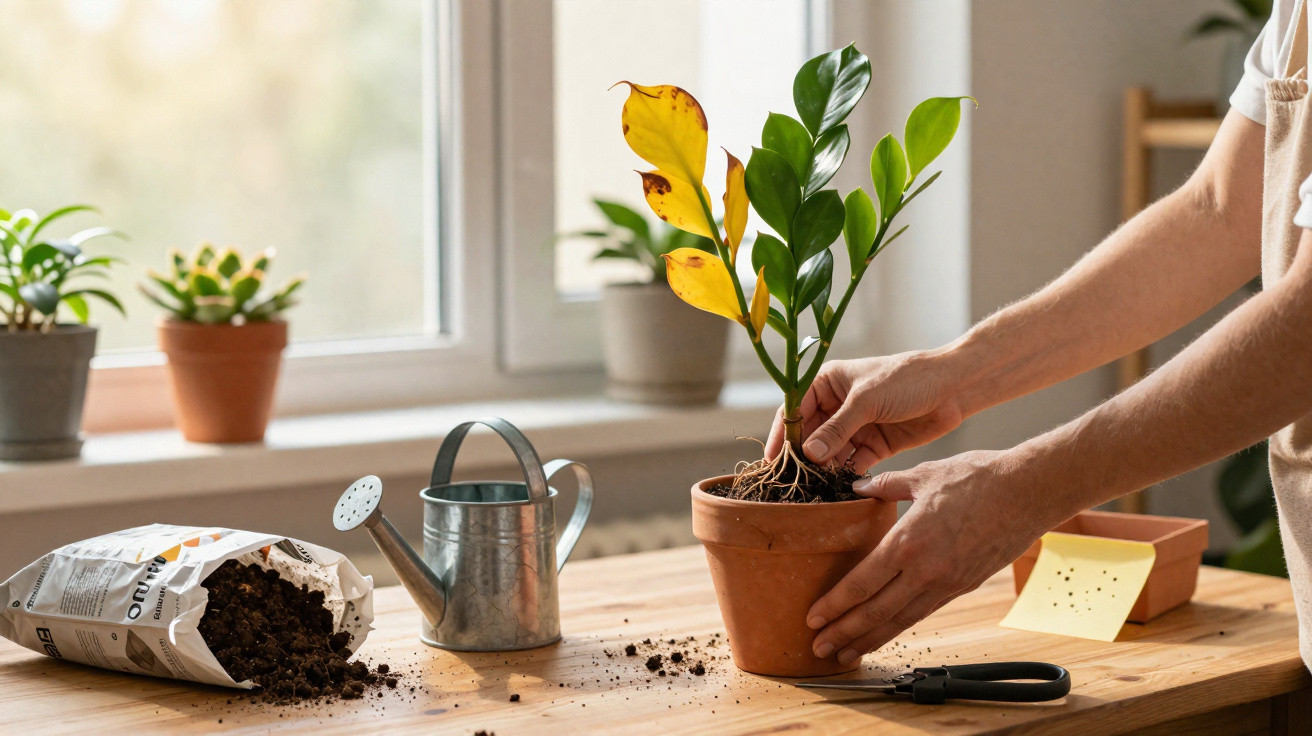
Many owners consider their jade plant to be “indestructible” and only notice that it is struggling when it is too late. The good news is that, in most cases, it is not beyond saving: incorrect watering, unsuitable compost or insufficient light are usually to blame. Anyone who spots the warning signs and responds appropriately can generally rescue this miniature tree.
Spotting warning signs early
The money tree communicates clearly, just not in words. Its leaves in particular reveal what is going wrong.
- Soft, mushy leaves and stems point to overwatering and impending root rot.
- Wrinkled, shrivelled or falling leaves indicate a lack of water.
- A musty smell coming from the pot nearly always signals rot and compost that has remained wet for too long.
- Bone-dry soil that has pulled away from the edge of the pot shows that the plant has been dry for an extended period.
- A white, cotton wool-like coating in leaf joints or on shoots suggests pests such as mealybugs.
Checking the leaf texture regularly helps you identify stress early and take action before the money tree suffers serious damage.
First aid: rescuing a weakened money tree
Before starting, place the plant away from your other pots, especially if you suspect pests. The next step is to establish exactly what is wrong.
Overwatering: an emergency plan for root rot
A money tree rarely forgives waterlogging. The sooner you intervene, the better its prospects.
- Stop watering immediately.
- Carefully remove the plant from its pot and shake off loose compost.
- Inspect the roots: use clean scissors to generously remove anything dark, slimy or mushy.
- Leave the plant to dry for 12 to 24 hours in a bright, well-ventilated place, away from direct sunlight.
- Only then repot it in fresh, free-draining compost.
Once repotted, the money tree needs time to recover. Give it a light first watering only after the cut surfaces have dried, then wait again until the compost has clearly dried out.
Too dry: gradual rehydration rather than a water shock
If the money tree looks shrivelled and is dropping leaves, it needs water, but suddenly drenching it is more likely to do harm.
Watering from below is the gentler option:
- Fill a bowl or bucket with water.
- Place the pot in it so that water can be drawn up through the drainage holes.
- Leave it for 30 to 60 minutes, depending on the pot size.
- Let it drain thoroughly before returning it to its usual spot.
This approach moistens the compost evenly without flooding the surface. Afterwards, wait several days until the growing medium looks noticeably drier again.
Pest alert: white fluff and sticky patches
Mealybugs and similar sap-sucking pests favour weakened plants. They tend to gather in leaf forks and beneath leaves.
A proven rescue plan:
- Wipe affected areas with a cotton pad soaked in alcohol (approximately 70%).
- Repeat the treatment every 7 to 10 days until no pests remain visible.
- For severe infestations, use a suitable product such as a specialist houseplant pest spray.
Weak plants attract pests. Stabilise the plant first, then fertilise it – this gives the money tree the best chance of lasting recovery.
Repotting correctly: a new home, a fresh start
Wet, compacted compost or a pot packed with roots places the money tree under continuous stress. Repotting at the right time can often act like a reset.
The right time and suitable materials
Spring is the ideal season for repotting, as the plant is naturally beginning to grow again. After an overwatering incident, however, it may need doing sooner.
- Choose a pot with drainage holes, preferably terracotta, as moisture can escape more easily.
- Add a 2–3 centimetre drainage layer of expanded clay pebbles or gravel.
- Mix the growing medium: use roughly half succulent compost or multipurpose compost, one quarter coarse sand and one quarter mineral material such as perlite or lava granules.
The mixture should run loosely through your fingers rather than feel sticky. The more open it is, the lower the risk of waterlogging.
Moving the money tree into its new pot
- Gently loosen the old compost from the roots and remove any rotten sections.
- Allow the roots to dry for a few hours.
- Position the money tree centrally in its new pot, add the growing medium and press it down lightly without compacting it too firmly.
- Do not water for at least four to five days; then begin with very small amounts.
Free-draining compost and a pot with drainage holes are the money tree’s best insurance policy.
Watering with a routine: less is usually more
A money tree originates from relatively dry regions, so it strongly dislikes permanently wet roots.
A practical rule is to water only once the top layer of compost has dried. If you are unsure, push a finger two to three centimetres into the soil. If it still feels damp, wait.
- Spring and summer: water around every 10 to 15 days, or slightly more frequently in very hot weather.
- Autumn and winter: once a month is often enough, particularly in cool rooms.
It is better to water thoroughly less often than to keep adding small amounts. Letting the compost dry out completely between waterings is usually less harmful to a money tree than constant moisture.
Light, position and nutrients: helping the money tree thrive
Without enough light, the money tree remains weak and becomes leggy. With the right balance of sunshine and protection, it develops strong, deep-green leaves.
The best location indoors
- A bright south- or west-facing windowsill, lightly protected from fierce midday sun.
- Avoid placing it directly above a radiator, as dry, hot air causes leaf drop.
- Keep it away from draughts, such as those by balcony doors that are regularly left open.
A plant LED can be useful during winter if your home is very dark. Run the light for several hours each day, but do not position it too close above the plant, as this can scorch the leaves.
Fertilise properly – but only when it has strength
Nutrients only benefit a money tree once it is reasonably stable. Fertiliser can cause further damage to a severely weakened plant.
- From March to September, feed every three to four weeks with a weak dose of succulent or cactus fertiliser.
- Do not fertilise during winter or while the plant is unwell.
- If there is visible root damage, wait at least several weeks before adding nutrients.
Preventing setbacks: a care routine rather than panic measures
Once the money tree has regained its balance, steady conditions can keep it trouble-free for many years. A few simple routines help prevent further problems.
- Briefly inspect the leaves and stems every two weeks.
- Do not use the watering can “just in case”; check the compost first.
- Occasionally wipe away dust with a soft cloth so more light reaches the leaves.
Consistent, simple care does more for a money tree than frantic intervention only when a crisis arises.
Why the money tree reacts so strongly to water
Its fleshy leaves act as water stores, holding moisture for dry spells. When it receives too much water, the roots and stem cannot process it quickly enough, cells burst and rot begins. During drought, by contrast, it slowly uses up its reserves and the leaves shrivel; at first, this is a normal protective mechanism.
Dryness only becomes problematic when it continues for weeks, causing the stem to soften and entire shoots to dry out. Avoiding that point means the plant can manage with surprisingly little water.
Practical everyday examples
The “holiday watering trap” is a typical example: while you are away, someone waters far too frequently out of kindness. When you return, the leaves are limp even though the compost is wet. In this case, decisive repotting helps rather than further watering.
Another scenario is a money tree that has spent years in a plastic pot that is far too small, directly above a radiator. Its compost dries out at record speed, while the leaves become distorted and fall off. A larger terracotta pot, mineral-rich compost and a position slightly away from the radiator restore balance.
Those who read their plant’s signals and do not constantly “tinker” with it through fear of making mistakes are often rewarded with an impressive, vigorous, branched money tree that shapes the living room like a small bonsai for many years.





Comments
No comments yet. Be the first to comment!
Leave a Comment