
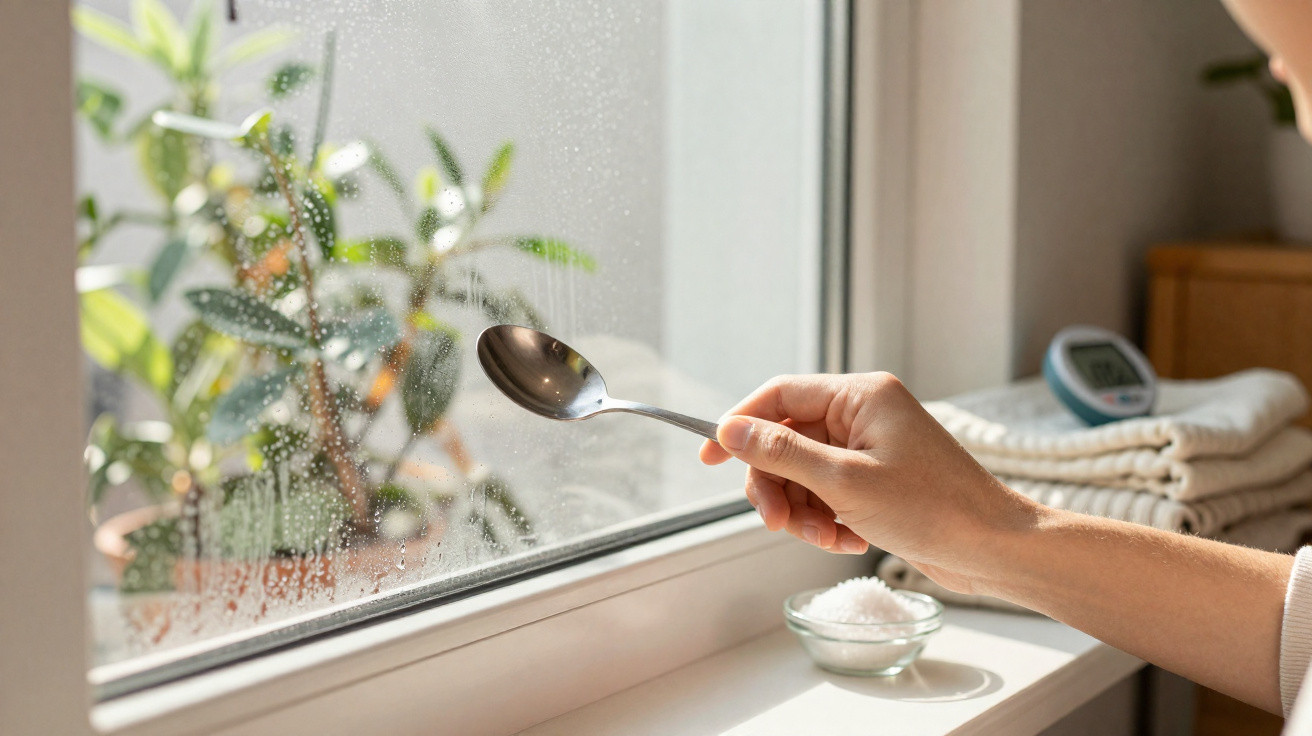
Humidity in houses and flats often rises during autumn and winter, particularly when doors and windows stay shut for extended periods. Under these conditions, indoor air becomes laden with water vapour, which settles on walls, ceilings, glass and furniture, encouraging mould, dark marks, unpleasant smells and a worn-looking appearance indoors.
What is the spoon trick on the window, and what is it for?
The spoon trick for humidity involves placing a metal spoon on the window so that it acts as a preferred point for water vapour to condense. Rather than water spreading as droplets across the entire pane, some of the vapour would tend to collect around the area where the spoon is colder.
The aim is therefore to limit water marks, misting and moisture build-up around the window frame. This household method attracts attention because it does not require alterations, expensive appliances or chemical products, making it a useful curiosity to try on cold days.
How to use the spoon trick to reduce humidity
To try this method, choose a metal utensil that conducts heat effectively, such as a stainless-steel spoon. It is particularly suited to windows where droplets form regularly, in rooms such as kitchens and bathrooms, where hot steam is stronger and builds up easily.
When positioning the spoon, a few practical precautions are important to ensure that it acts as a preferred condensation area without causing unwanted drips. Here is a straightforward guide for using it day to day:
- Choose a metal spoon, ideally stainless steel, because of its greater thermal conductivity.
- Place it against the window frame or on a small support close to the glass.
- Keep the handle facing into the room, with the bowl facing outwards or towards the area with the most condensation.
- Check regularly for water collecting on the spoon or in the surrounding area, and dry it when needed.
Some people test more than one spoon on each window to create several condensation points, while others pair the trick with small channels or cloths at the bottom of the frame to catch water flowing back.
How does the spoon trick on windows work physically?
This method works through condensation. Indoor air warmed by hot showers, cooking or heaters holds a considerable amount of water vapour; when it meets cold surfaces, that vapour cools and turns into tiny droplets that gather on glass and nearby surfaces.
Because a metal spoon has greater thermal conductivity than glass, it exchanges heat with its surroundings more quickly and tends to become cold before the surrounding surface. As a result, the point where the spoon touches or sits close to the glass becomes a preferred area for condensation, concentrating some moisture in one specific place that is easier to wipe dry or drain.
What measures help tackle humidity beyond the spoon trick?
Home maintenance specialists point out that the spoon trick does not eliminate the source of the humidity; it merely redirects some of the condensed water. In properties with widespread mould marks, flaking paint or a persistent smell, it is essential to investigate leaks, sealing problems and shortcomings in natural ventilation.
A range of simple habits can be used alongside this method to manage indoor vapour more effectively, including airing the home every day, repairing leaks, using dehumidifiers and improving the thermal insulation of windows and walls. Combining these measures can help protect walls, furniture and indoor air quality during the colder months.




Comments
No comments yet. Be the first to comment!
Leave a Comment