
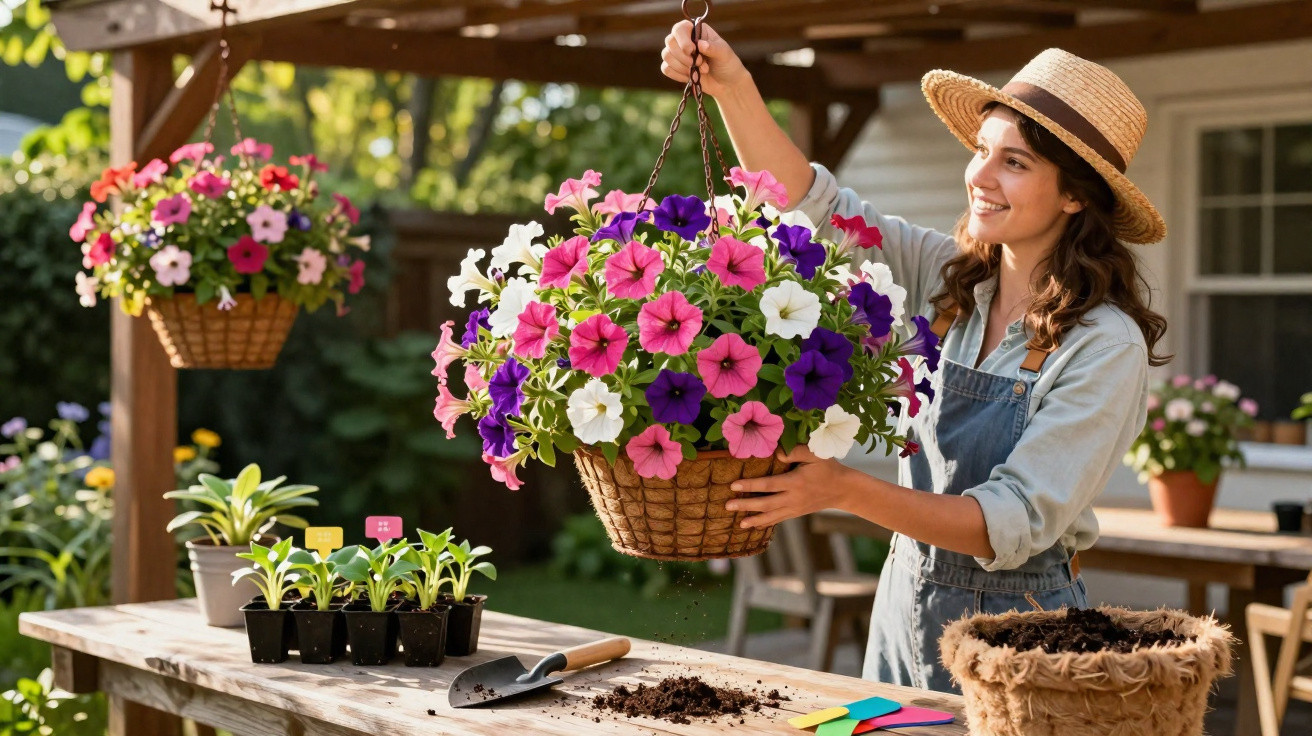
A lavish cloud of flowers at eye level, with no bare patches or visible pots – it is something many people dream of, but few achieve.
Anyone hanging baskets on a balcony or terrace in summer hopes for a full, flowering sphere. Yet in reality, they often end up with three puny plants, plenty of exposed compost and a pot rim that spoils the effect. A surprisingly straightforward 3-in-1 planting method shows how to achieve a far better result – even without professional experience.
The 3-in-1 layout: turning a hanging basket into a flower ball
The principle is easy to remember: one third trailing plants, one third upright-growing plants in the centre, and one third loose filler plants between them. That is all it takes.
Each plant group has a distinct role: conceal, build up and connect – together, they create the effect of a densely flowering ball.
For a hanging basket or container measuring 30 to 40 centimetres across, use the following as a general guide:
- 3 vigorous young plants in standard pot sizes (for example, 9 cm pots), or
- 5 smaller young plants in mini root balls.
The key is not to cram in as many plants as possible. Quite the opposite: too much root mass makes the plants compete for water, dries out the compost quickly and reduces flowering. There must still be enough loose compost between the roots.
What the three plant groups actually do
1. Trailing plants around the edge
These form the “backdrop”. They spill over the rim, conceal the pot and its hanging hardware, and create a soft, rounded transition into the surrounding space. Typical choices include:
- trailing petunias
- trailing geraniums (ivy-leaf geraniums)
- verbenas with long stems
- lobelias that cascade like a veil
- calibrachoa (mini petunias)
2. Upright plants in the centre
These give the basket height and body. Without them, the planting can look flat. Reliable options are:
- upright geraniums (zonal geraniums)
- busy lizzies (Impatiens) for partially shaded positions
- bidens, with their yellow star-shaped flowers
3. Filler plants between them
These cover gaps without adding too much weight to the display. They are smaller, airy plants that weave between the main plants without taking over. The precise selection depends on the location and desired colour effect.
The best plants for consistently full summer hanging baskets
For a hanging basket that flowers from June into autumn, many gardeners choose annual summer flowers. They grow quickly, flower generously and provide exactly the “wow” effect associated with balcony planters at garden centres.
Annual summer flowers deliver maximum floral impact in a small space – making them ideal for hanging baskets.
One possible combination for a sunny spot is:
- Edge: trailing petunias in two shades
- Centre: one sturdy, upright geranium
- Filling: blue-flowering lobelia between the main plants
For partially shaded places, busy lizzies, fuchsias or shade-tolerant geranium varieties work well when combined with softly trailing plants such as bacopa.
Think in layers rather than varieties
If you are unsure, picture the finished hanging basket as three layers:
- Lower edge and sides: everything that trails over the rim and grows outwards in a droplet-like shape.
- Centre: plants that grow upwards to form the “hill” within the sphere.
- Transition: small, adaptable plants that soften the edges between the lower and upper layers.
This framework makes it easy to find suitable combinations at the garden centre without getting lost among variety names.
How to plant your hanging basket step by step
Start by choosing a suitable container. Good options include:
- wire baskets lined with coconut fibre
- woven willow baskets
- sturdy plastic hanging baskets with sufficient drainage holes
| Step | What to do |
|---|---|
| 1. Drainage | Put a layer of expanded clay or gravel in the bottom so surplus water can drain away. |
| 2. Add compost | Fill to around two thirds with high-quality flowering-plant compost, then moisten it lightly. |
| 3. Water the plants | Briefly immerse the young plants in water until their root balls are thoroughly moist. |
| 4. Plant up | Position trailing plants around the outside first, upright plants in the middle next, then add filler plants last. |
| 5. Water in | Water carefully using a fine rose until water runs out from the bottom. |
With coconut-fibre baskets, the liner can be carefully cut at the sides. This allows individual young plants to be inserted sideways, making the trailing effect even more pronounced.
The small spacing trick when planting
Many people pack a hanging basket completely full because they want it to look finished immediately. That approach causes problems in high summer. Plants then compete heavily for water and nutrients, the compost dries out more quickly, and fungal diseases can take hold easily.
There should always be visibly loose compost between the root balls – air is not a mistake, but a reserve for growth.
A gap of one to two finger widths between root balls is ideal. After only a few weeks, the basket will still look full, as the plants grow together and create a visually unified display.
The right time: when your hanging basket can go outside
Summer baskets planted with annual flowering plants should only be left outdoors permanently after the last night frosts. In many areas, that means from May onwards. Anyone wanting an earlier start can plant their baskets in March beneath a sheltered roof or in a cool conservatory, covering them with horticultural fleece on cold nights.
A short acclimatisation period is worthwhile:
- put them outside during the day for 7 to 10 days, then move them back under cover at night
- introduce more sun gradually so the leaves do not scorch
This keeps the plants sturdier and helps the hanging basket cope better with later spells of hot weather.
Care for the “wow” effect from June to September
Hanging baskets dry out much faster than border planting because the root ball is suspended and exposed to wind from every side. During high summer, they therefore need watering very regularly.
- Water daily in summer in most cases, and briefly in both the morning and evening on hot days if necessary.
- Never leave them sitting in water: keep the compost moist, but do not allow waterlogging in saucers or outer pots.
- Feed regularly: apply liquid flowering-plant fertiliser around once or twice a week.
Anyone who feeds consistently and removes spent flowers will keep the basket youthful and flowering for longer.
Dead flower heads should be pinched off regularly. This directs the plants’ energy into fresh buds instead of seed production. Some types, including petunias, also benefit from a light “trim” if they become too long and straggly in summer.
A light trim for a perfect shape
If individual stems become excessively long and disrupt the spherical shape, cut them back firmly by one third. The plant will branch again, fill out and look rounder overall. The basket may look a little slimmer for a short time, but after two to three weeks the flower ball is usually denser than before.
Fine adjustments: location, wind and colour combinations
For lasting success, it is worth considering several conditions that are often underestimated:
- Wind: Strong winds dry a hanging basket out extremely quickly and can snap delicate stems. A slightly sheltered position noticeably extends the flowering period.
- Sun: Full sun encourages flowering but requires consistent watering. For hot south-facing balconies, choose heat-tolerant varieties.
- Colour effect: Tone-on-tone combinations, such as different shades of pink and violet, look elegant, while colourful mixes create more of a holiday feel.
If several hanging baskets are displayed along one balcony, you can experiment with colour gradients – perhaps moving from white and pale pink by the front door to rich red and purple at the far end. This creates a harmonious overall look rather than a chaotic patchwork.
The changing seasons offer another interesting option: in autumn, summer flowers can be replaced with robust autumn plants, such as small chrysanthemums, ornamental grasses and ivy. The 3-in-1 principle remains unchanged: trailing plants, upright structure and loose filling. Once you have absorbed this framework, creating lavish hanging baskets throughout the year becomes effortless.
Comments
No comments yet. Be the first to comment!
Leave a Comment