
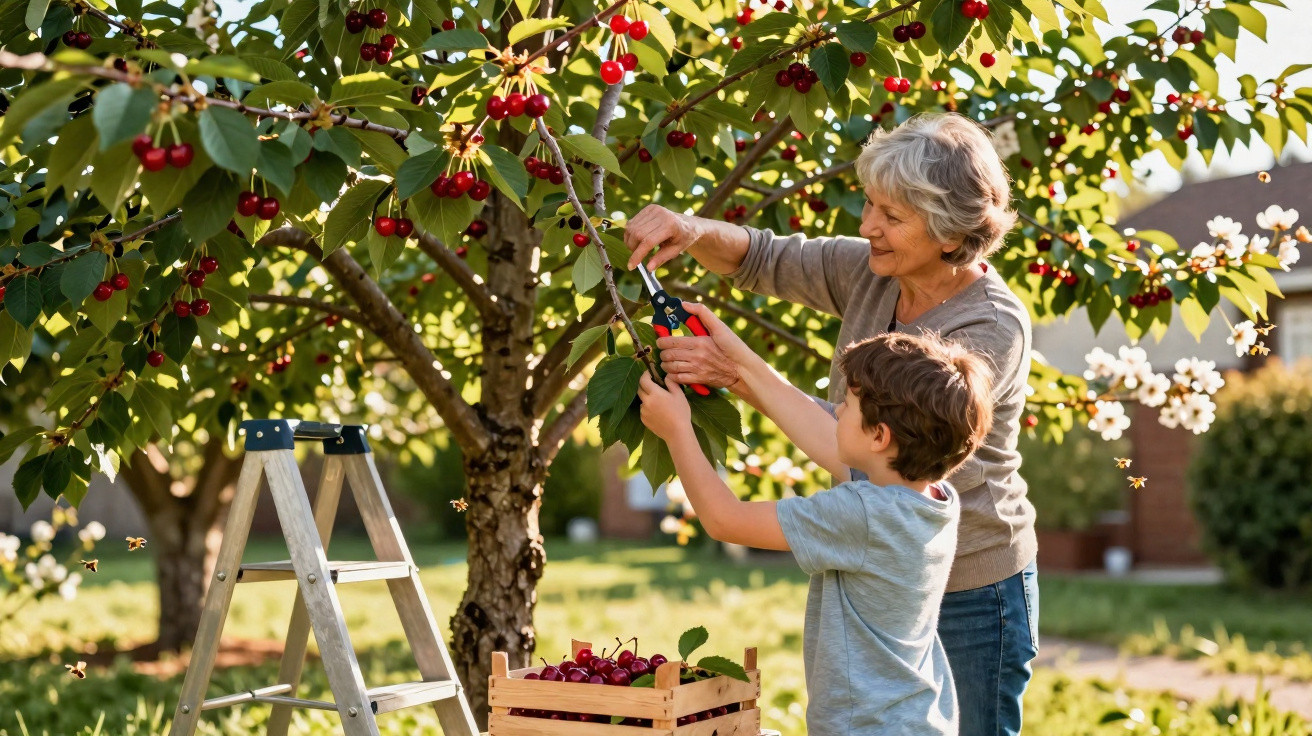
For years, the magnificent cherry tree produced almost no crop – until a neighbour demonstrated one simple but crucial pruning cut.
Many amateur gardeners will recognise the situation: the tree appears healthy, lush green and impressive, yet only a few disappointing cherries make it into the bowl each summer. That was exactly the experience of one garden owner, whose cherry tree was more ornamental than productive. Everything changed only when a neighbour took a closer look and used the secateurs in very particular places – by the following spring, the tree was laden.
Why a vigorous cherry tree may produce hardly any fruit
When leaves and wood take all the tree’s energy
At first glance, a cherry tree with dense foliage looks impressive. Many people automatically regard this as evidence of strength and good health. In fact, it often indicates an imbalance: the tree is directing nearly all its energy into leaves and fresh shoots rather than flowers and fruit.
Instead of making fruit buds, the cherry tree expands its woody growth. The result is a handsome-looking tree that bears very little. Flower buds remain scarce, while the few cherries it does produce grow right at the outer edges and are difficult to pick. Anyone focused only on “lots of greenery” can easily miss that the tree is fruiting at a very low level.
“A cherry tree that invests only in wood and leaves will not fill baskets – it needs a gentle but targeted intervention.”
A lack of light inside the crown restricts flower formation
The second major enemy of fruiting is shade – or, more precisely, darkness within the crown. When the canopy becomes too dense, sunlight can no longer reach the branches in the middle. The very places where numerous blossoms could form are left in dim light.
Without sufficient sun, the cherry tree forms fewer flower buds. The plant concentrates on survival rather than producing an abundant crop. Even excellent soil, compost and fertiliser achieve little when the crown blocks every trace of light like an umbrella.
The key discovery: identify and remove energy-draining shoots
These upright water shoots drain strength from the tree
The neighbour first pointed out particular shoots on the cherry tree: long, smooth branches growing almost vertically upwards, usually with pale, smooth bark. Known as water shoots or water sprouts, they often appear after pruning that was either incorrect or far too severe.
Although these shoots look impressively strong, they almost never produce flowers. They consume huge amounts of nutrients and water while contributing no harvest. Leaving them in place means feeding energy thieves.
- Growth direction: steeply upright
- Bark: smooth and usually lighter than the rest
- Growth: very rapid, producing long shoots in a short time
- Fruit: virtually none
Cut cleanly at the base without leaving stubs
The vital step is to take out these water shoots directly at their base. Make the cut as close as possible to where the shoot originates, without leaving a stub behind. If a remnant remains, the tree will often produce vigorous new growth from that point.
Use a very sharp, clean cutting tool for this job. Good-quality garden secateurs, such as those sold by DIY and garden centres, are highly effective here. A clean cut heals more quickly and lowers the risk of fungal infection.
“Every water shoot removed gives the tree energy it can put into flowers and fruit instead.”
Crown care: rubbing and crossing branches reduce the crop
Remove competing branches within the crown
The second stage concerns the tree’s internal structure. In many older cherry trees, branches cross over, rub together in the wind or grow inwards across the crown. The bark is damaged wherever branches rub. Such wounds provide ideal entry points for fungi and disease.
The neighbour’s rule of thumb was simple: where two branches compete for space, only the better one remains. Keep the stronger shoot that is better positioned, and remove the weaker or inward-facing branch. This gives the tree a clearer structure and reduces the likelihood of damage.
More light, warmth and bees in the tree
Once the crown can “breathe” again, several benefits follow. Sunlight reaches further into the tree, while bark and buds dry more quickly after rain, making fungal infection less likely. At the same time, spring sunshine warms the inner sections more effectively – signalling to the tree that it should form more flower buds.
Bees and other pollinators also have a shorter route to the flowers. Open, airy crowns allow insects to reach the blossoms more easily. The better the pollination, the more cherries will subsequently develop.
“A thinned crown is like an invitation to sunshine and pollinators – both determine the number of cherries.”
Pruning a cherry tree without causing stress
The right time: do not reach for the saw in midwinter
Cherry trees and other stone-fruit trees react sensitively to heavy pruning during cold weather. Deep winter cuts can cause gummosis, in which the tree releases thick, amber-coloured droplets that can weaken it over time.
Major pruning work should therefore be carried out after harvest. At this point, the cherry tree has sufficient reserves to seal pruning wounds promptly. Minor corrections, such as removing a single diseased branch, can exceptionally be made in spring, provided no extensive cutting is involved.
Clean tools protect against disease
Before each cut, it is worth quickly reaching for a bottle of alcohol or disinfectant. If secateurs are not cleaned between different trees, fungi or bacteria can be transferred. Clean blades reduce this risk considerably.
For thicker branches, a wound covering made from natural materials is advisable, such as a tree-friendly clay dressing. It protects the fresh cut from sun, rain and pathogens until the tree has formed enough protective tissue of its own.
What happens after the correct pruning treatment
From problem tree to flowering star in one spring
In the case described, it took just one cycle: the following spring, once the unnecessary shoots had gone, the cherry tree presented an entirely different picture. Rather than isolated flowers at the tips, its crown was covered in clouds of white blossom.
Branches that had previously been shaded now received sunlight, and the plant channelled more strength into these areas. The once “silent” tree became a fruit tree that cropped well. Harvest baskets filled up without the use of expensive specialist fertilisers.
Simple rules for a crop year after year
Anyone experiencing similar problems with a cherry tree can use this straightforward checklist:
- Identify upright water shoots as early as possible and remove them at their base.
- Consistently remove crossing and rubbing branches – retain the branch in the better position.
- Shape the crown so that light and air can reach its centre.
- Carry out major cuts preferably after harvest, rather than in midwinter.
- Clean cutting tools before use and keep them sharp.
- Regularly remove diseased, dead or damaged branches.
Following these points directs the cherry tree’s energy specifically towards blossoms and fruit instead of wasting it on unproductive wood.
Background knowledge for amateur gardeners: why pruning has such a strong effect
How the tree responds to pruning
Pruning alters the tree’s internal “framework”. When vigorous shoots are removed, the nutrient supply is distributed among fewer branches. The remaining branches receive more, giving them better conditions for developing flower buds.
Pruning also controls growth: severe cutbacks usually encourage fresh vegetative growth, whereas restrained, targeted cuts are more likely to support fruit-bud formation. With cherry trees, it is therefore worth avoiding radical measures.
Risks of poor pruning technique
Anyone who cuts at random risks achieving the opposite result. Excessive cutbacks can trigger an avalanche of fresh water shoots. The following year, the tree may become even denser with foliage and again produce hardly any fruit.
Untidy cuts, ragged edges and stubs are also harmful. They heal more slowly, are colonised by fungi more readily and can weaken entire branches. A little patience and careful work pay off directly in kilograms of cherries.
Anyone who feels unsure can begin by practising on one individual branch and observing the tree’s response over a season. Over time, this develops a feel for how their own cherry tree behaves and where another cut is worthwhile – without professional training, but with growing experience in their own garden.



Comments
No comments yet. Be the first to comment!
Leave a Comment